
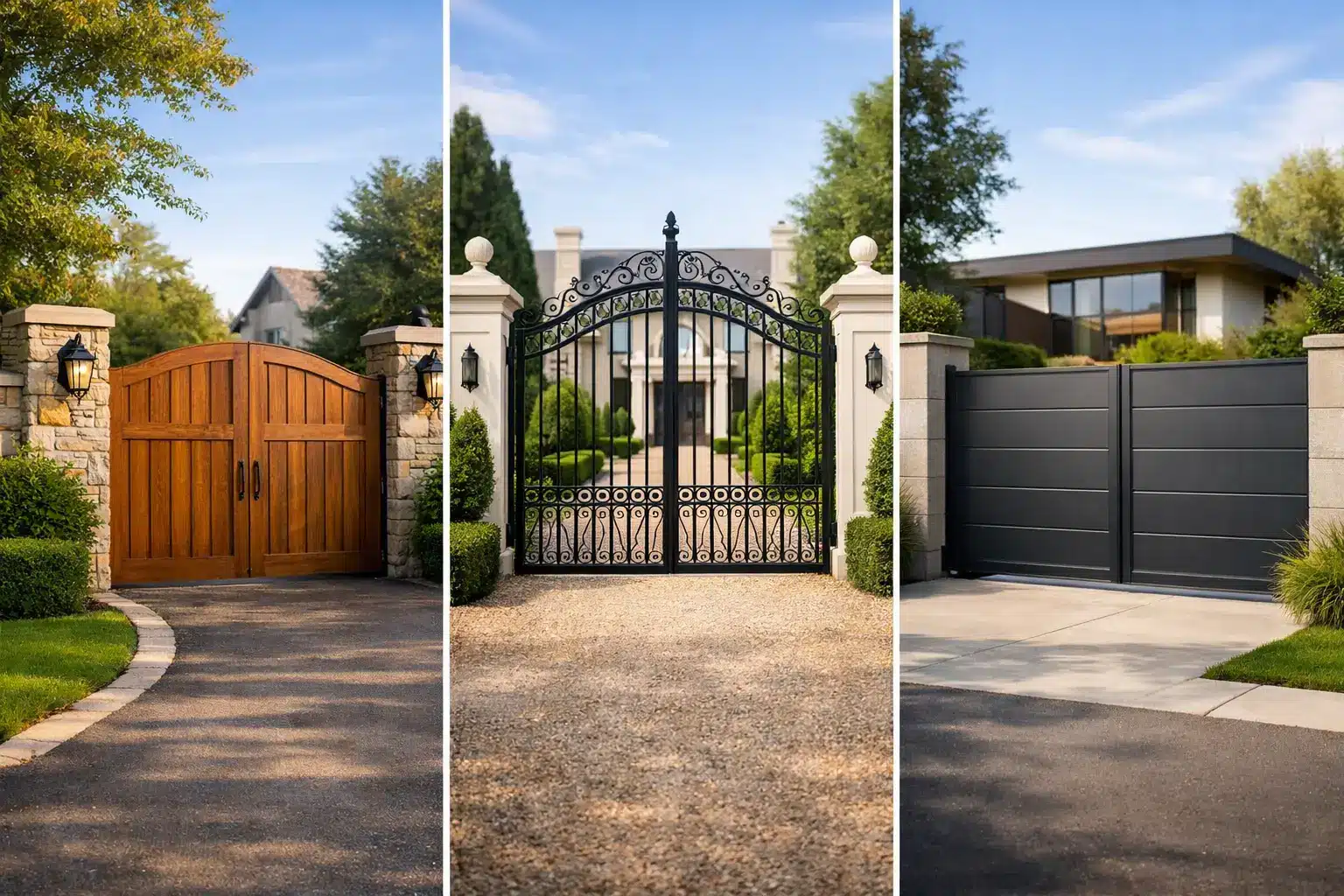
A driveway gate is often the first detail people notice from the road – and one of the few exterior features that can change the character of an entire property. The best entrance gates for kerb appeal do more than mark a boundary. They introduce the architecture, create a sense of arrival and provide everyday security without making the frontage feel closed off.
For a period home, that may mean refined vertical lines and a softer colour. For a contemporary self-build, it could be a wide aluminium gate with crisp horizontal detailing, integrated access control and matching fencing. The right answer is rarely an off-the-shelf design. It is a gate proportioned, finished and engineered for the property it serves.
What makes an entrance gate look exceptional?
Kerb appeal comes from cohesion, not simply choosing the most decorative gate. A gate should relate to the width of the driveway, the scale of the house, the boundary treatment and the materials already visible from the street. A slim, understated design can look striking against a modern rendered façade, while an ornate style may overpower it.
Proportion is the starting point. Gates that are too short or narrow can make a generous driveway appear unfinished. Gates that are excessively tall or visually heavy may dominate the frontage and reduce natural light. Made-to-measure fabrication allows the rails, infill spacing, posts and overall height to be considered as one composition rather than a collection of separate parts.
Material quality matters just as much at close range as it does from the pavement. Premium aluminium offers clean, precise profiles that hold their shape without the swelling, splitting or regular repainting associated with timber. A fully welded construction also creates a more refined finish than a gate assembled with visible fixings, while providing the strength expected at a main entrance.
The best entrance gates for kerb appeal by property style
The most successful gate styles are not necessarily the most complex. They are the ones that make the property feel considered from the first glance.
Horizontal slatted gates for contemporary homes
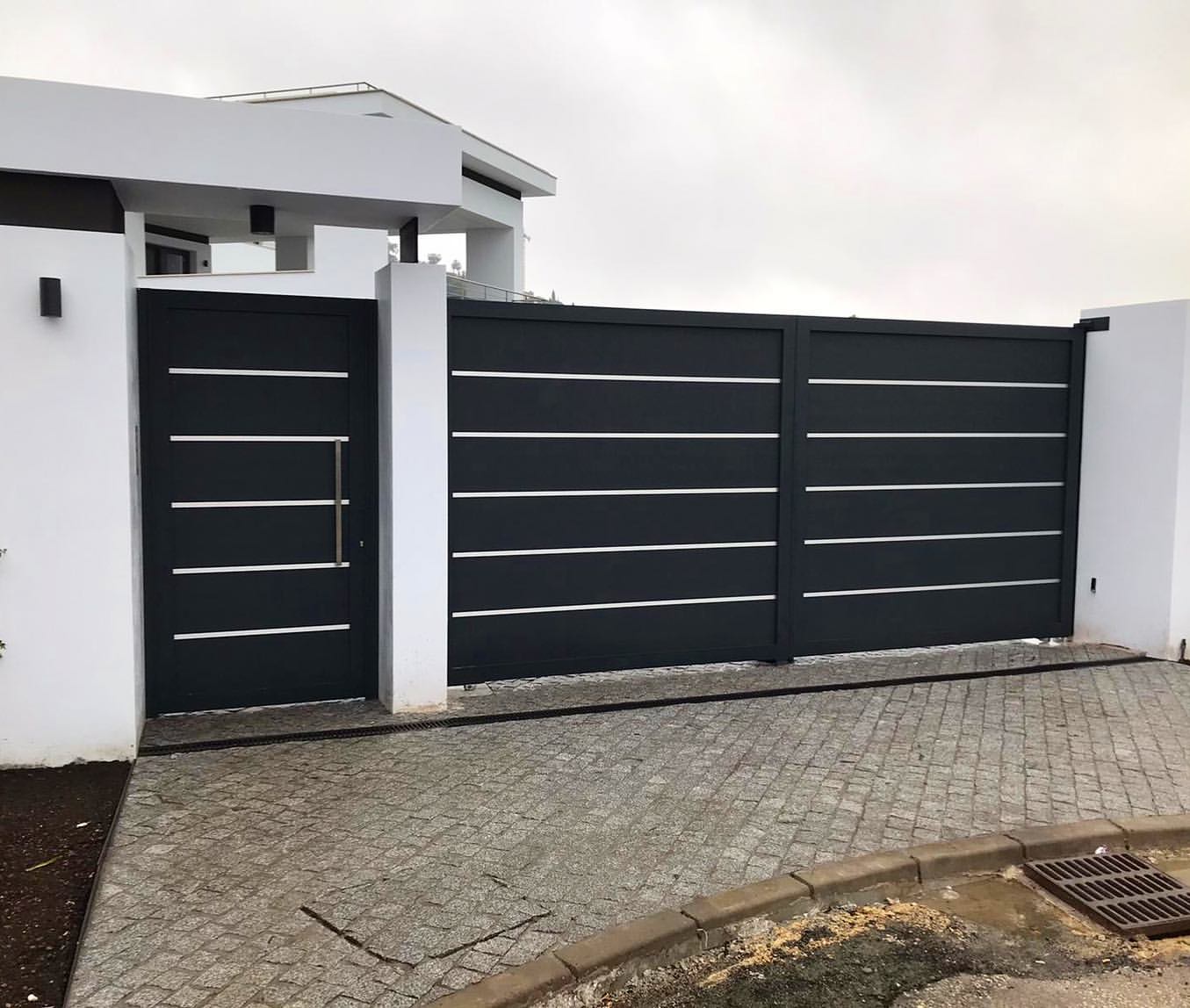
Horizontal slatted aluminium gates are a natural choice for modern houses, extensions and architectural renovations. Their strong linear form can make a frontage appear wider, especially when paired with coordinated fencing or wall-top panels. Narrow gaps between slats offer privacy while retaining depth and shadow, whereas wider spacing gives a lighter, more open look.
The trade-off is visibility. Close slats suit homes overlooking a busy road or where privacy is a priority, but they can conceal landscaped planting and make a compact entrance feel more enclosed. If the aim is to show off a carefully designed garden, a more open spacing may be the better choice.
Vertical designs for a timeless finish
Vertical infill creates a more traditional rhythm and can add apparent height to a low or wide property. It works particularly well with brick homes, detached family houses and properties where the owner wants an elegant design that will not date quickly.
A vertical design does not need to look conventional. The width of each section, the gap between them and the frame detail can all be tailored for a more contemporary interpretation. A dark anthracite grey finish gives a clean, architectural feel, while black can provide a more formal contrast against pale stone or render.
Solid-panel gates for privacy and presence
Solid or near-solid aluminium gates deliver a bold, confident frontage. They are particularly effective where homes sit close to a road, where vehicles need to be screened, or where security and privacy are central to the brief. A smooth panel can look exceptionally refined when the gate is wide, the frame lines are disciplined and the finish complements the window frames, front door or garage door.
However, a solid gate needs careful handling on smaller plots. Light colours, carefully selected panel breaks or a pedestrian gate with a contrasting detail can prevent the entrance from feeling too imposing. A design consultation should consider the view from both sides of the boundary, not only the elevation facing the road.
Mixed-material looks without the maintenance burden
Wood-effect aluminium is a practical option for homeowners who like the warmth of timber but do not want annual staining, warping or rot to become part of property maintenance. Used sparingly, it can soften a modern façade and sit comfortably alongside brick, stone and planted borders.
The key is authenticity in the overall scheme. A convincing wood-effect finish paired with well-proportioned aluminium framing can look considered and premium. It is less successful when it competes with too many other colours or textures. Keeping the posts, fencing and gate hardware visually coordinated gives the entrance greater authority.
Choose the opening style before finalising the design
A gate can look superb in a visual, yet be wrong for the way a driveway works. The opening method affects convenience, available parking space, automation options and the impression the entrance gives each day.
Swing gates remain a popular choice for private driveways. They create a classic arrival sequence and can be configured as equal or unequal leaves to suit the opening. They require clear space inside the property to open safely, so they are not always suitable where vehicles park immediately behind the gate or where the driveway rises sharply.
Sliding gates are ideal for driveways with limited depth. They travel along the boundary rather than into the property, making them a strong option for busy roads and compact sites. A sliding system needs sufficient run-back space beside the opening, and the groundworks must be properly planned, but the result can be exceptionally clean and practical.
Bi-folding and telescopic gates are worth considering where neither a conventional swing nor a full sliding gate is possible. They reduce the opening footprint and can provide fast access, particularly useful for commercial premises or narrow residential driveways. Their engineering is more specialised, so precise measurement and specification are essential from the outset.
Colour, finish and detailing create the premium effect
Colour is one of the most powerful decisions in gate design. Anthracite grey remains popular because it complements contemporary glazing, rooflines and composite doors. Black offers sharper contrast and suits both modern and traditional homes. Softer greys, muted greens and bespoke finishes can work beautifully where a property has an established palette or sits in a more rural setting.
Rather than selecting a colour in isolation, look at the fixed elements around it: brickwork, coping stones, render, window frames, garage doors and external lighting. Matching every feature exactly is not always necessary. A controlled contrast often has more impact, provided the tones belong together.
Details separate a standard boundary gate from a tailored entrance system. Concealed or discreet hardware keeps sightlines clean. Integrated letterboxes, house numbers, lighting and intercoms can reduce clutter around the entrance. An Akuvox intercom, for example, can be specified as part of a coordinated access solution, allowing visitors to be seen and managed without compromising the gate’s clean appearance.
Security should support the design, not interrupt it
The best-looking gate will quickly lose its appeal if it feels flimsy, rattles in the wind or becomes difficult to operate. Security starts with the structure: strong posts, precision welding, dependable hinges or track systems, and a latch or locking arrangement suited to how the gate will be used.
For automated gates, safety and access should be designed in together. Consider vehicle detection, pedestrian use, manual release in a power cut and the practical position of controls. A pedestrian gate may be sensible where family members or deliveries need access without operating the main driveway gate. It can also make the frontage feel more balanced when incorporated into the same design language.
Privacy is another security consideration, but it is not automatically the best choice for every property. Open or semi-open designs allow passive visibility across the entrance and can make a welcoming garden part of the street scene. More enclosed designs offer discretion. The appropriate balance depends on the road, the property layout and how exposed the entrance feels.
Why aluminium is a long-term kerb appeal investment
A gate faces rain, frost, UV exposure, road grime and daily use. Timber can be beautiful, but it demands consistent care to retain its finish and dimensional stability. Steel is strong, yet may require vigilance against corrosion if coatings are damaged. Quality aluminium offers a compelling balance of strength, corrosion resistance and low-maintenance ownership.
For premium driveway gates, the construction standard is as important as the material itself. Fully welded aluminium frames provide lasting rigidity and a cleaner appearance, while a high-quality powder-coated finish helps preserve colour and surface quality over time. This means the gate is designed to keep looking composed long after installation, rather than becoming another recurring renovation task.
At Alu-Gate, every entrance solution is made to measure, allowing the gate style, dimensions, finish and opening configuration to be specified around the property rather than forced into a standard size. The 20-year guarantee provides further confidence that the investment is built for the long term.
Before choosing a design, stand across the road and assess the whole frontage. Note the width of the opening, the strongest architectural lines, the areas that need privacy and the route vehicles and people take each day. The gate that earns lasting admiration is the one that feels as though it was always meant to be there – designed to impress, and built to last.