
A narrow driveway exposes every design mistake. Leave too little clearance and the gate becomes awkward to use. Choose the wrong opening style and you lose valuable parking space, clip a car wing mirror, or create a daily frustration every time you arrive home. That is why selecting the best gates for narrow driveways is less about trends and more about getting the geometry, access and build quality exactly right.
For many UK properties, especially period homes, town plots and urban new builds, driveway width is fixed. You cannot move a boundary wall or widen a brick pier without major cost. The gate, then, has to work harder. It must provide security, look proportionate, open cleanly and make the entrance feel considered rather than compromised.
What makes a gate work on a narrow driveway?
A narrow driveway does not always mean a tiny opening. More often, it means limited manoeuvring space, reduced depth behind the gate, awkward boundary lines, or pillars and walls that leave very little tolerance for error. The best result comes from measuring the full approach, not just the gap between posts.
A gate that suits a narrow opening usually needs to do three things well. First, it must preserve usable space, whether that means reducing swing arc or stacking neatly out of the way. Second, it must be made precisely enough to avoid clearance issues. Third, it needs to feel visually balanced. A gate that is technically functional but looks heavy or cramped can diminish the whole frontage.
This is where made-to-measure aluminium has a clear advantage. It allows for exact sizing, fully welded strength and slim, refined profiles that do not overwhelm a smaller entrance. It also gives long-term durability without the maintenance burden of timber or the weight of steel.
The best gates for narrow driveways by opening type
There is no single right answer for every property. The best gates for narrow driveways depend on how much room you have in front, behind and to the side of the opening, as well as whether you plan to automate the system.
Sliding gates
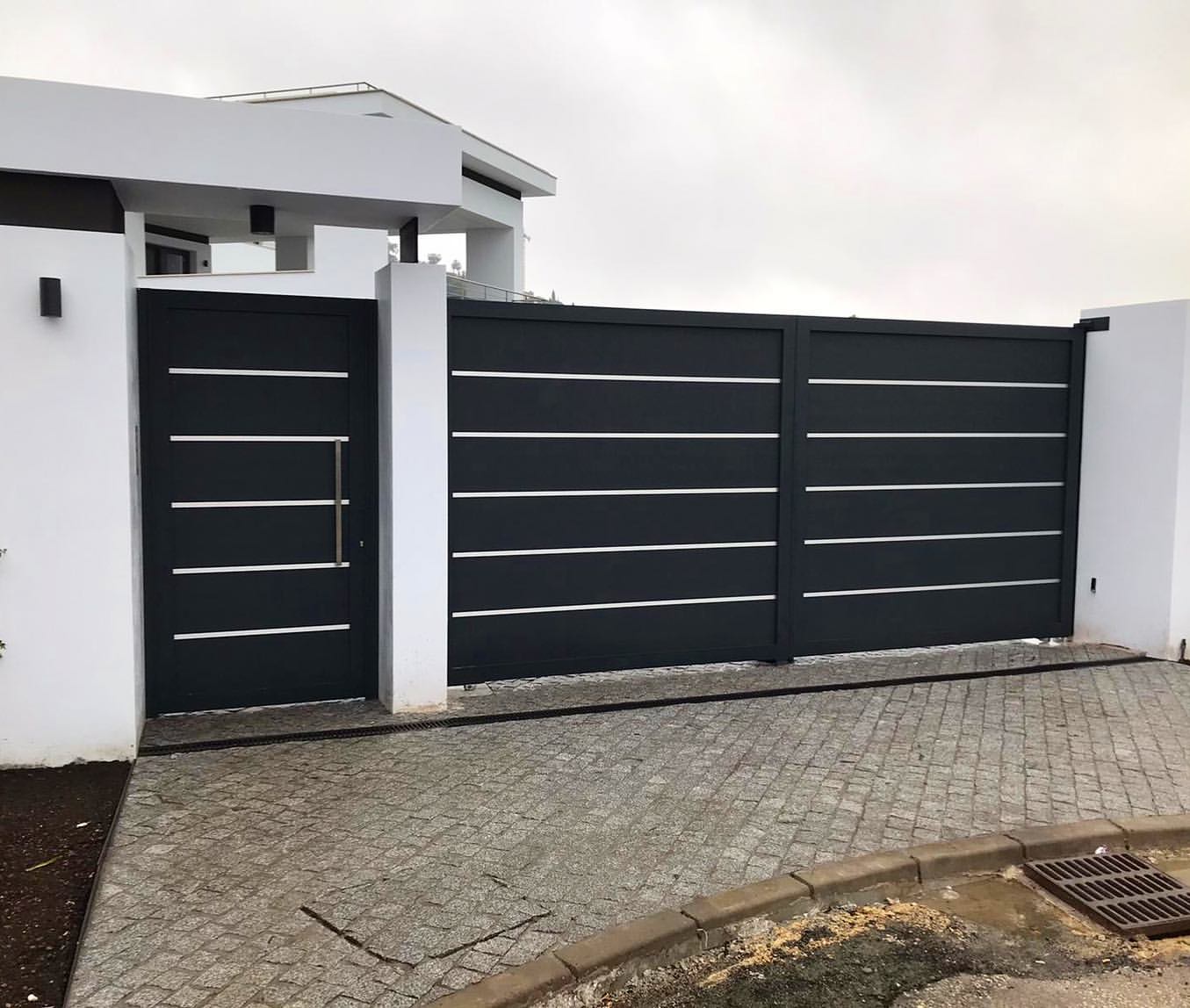
If the site allows lateral run-back, a sliding gate is often the strongest option for a narrow driveway. Instead of swinging inwards or outwards, the gate moves across the entrance and stacks to one side. That means you keep your driveway depth clear, which is especially useful when parking space is tight or the car sits close to the boundary.
Sliding gates also suit properties on slopes, where swing gates may struggle with rising ground. From a security perspective, they are strong, stable and well suited to automation. The trade-off is space to the side. You need sufficient room for the gate to travel, and the supporting structure must be specified properly.
For homeowners and commercial buyers who want a premium, space-efficient entrance, a bespoke aluminium sliding gate can offer the cleanest solution.
Bi-folding gates
Where side run-back is limited, bi-folding gates are often one of the smartest answers. These gates fold back on themselves as they open, reducing the swing arc and opening faster than many traditional systems. On a tight driveway, that speed and efficiency can make everyday access noticeably easier.
Bi-fold gates are particularly effective where cars need to pull up close to the entrance before opening. They also work well in modern settings, where a crisp architectural look matters. The key is build quality. Folding systems rely on accurate fabrication and dependable hardware, so a poorly made gate will quickly show its weaknesses.
Swing gates
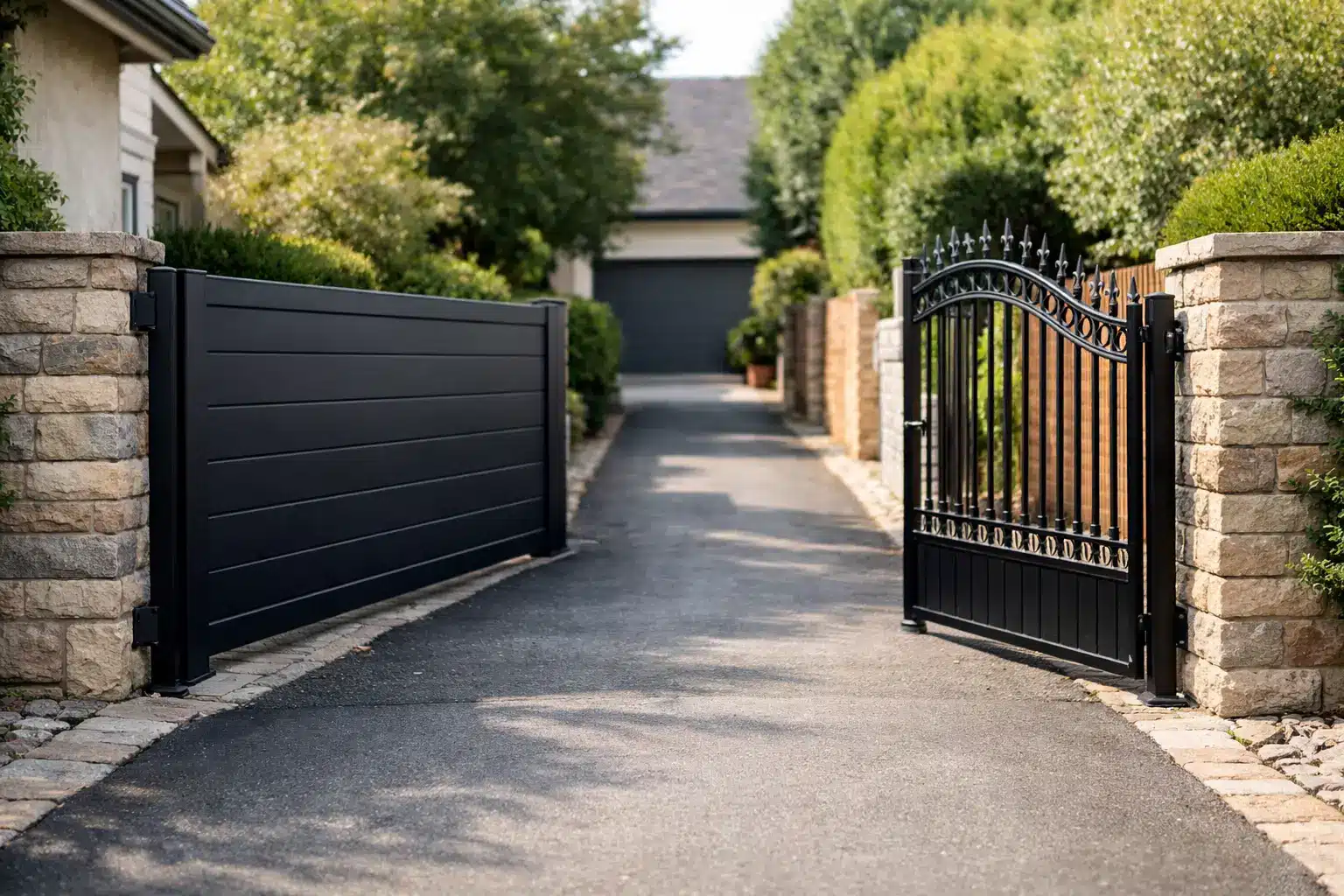
Traditional swing gates can still be the right choice on a narrow driveway, but only when the site has enough internal depth and the opening arc has been thought through carefully. Split-leaf designs are usually more practical than a single large leaf because each panel requires less clearance.
For some homes, especially those with a straight, level approach and room behind the gate, swing gates remain a classic and elegant option. They can look more residential and softer in appearance than sliding systems. The limitation is simple: if space is already tight, the swing arc may become an obstacle rather than a feature.
Telescopic sliding gates
A telescopic gate is a strong alternative when you want the benefits of a sliding gate but do not have full run-back to one side. Instead of one long gate leaf, the sections slide and stack together. This reduces the side space required and can solve layout problems that would otherwise rule out a sliding system.
This type of gate tends to suit more complex or constrained sites, including commercial entrances and high-spec residential projects. It is not always the first option people consider, but on the right property it can be the most efficient answer.
Material matters as much as the opening style
On a narrow driveway, extra weight is rarely your friend. Heavier gates place more strain on hinges, motors and track systems, and they can feel cumbersome in everyday use. That is one reason aluminium stands out.
Premium aluminium gates combine strength with lower weight, which is especially valuable for automated systems and space-conscious openings. They resist rust, require very little maintenance and hold their finish well in the British climate. Just as importantly, they can be fabricated with sleek proportions that suit narrower entrances.
Timber can look attractive, but it brings ongoing maintenance and can move over time. Steel is undeniably strong, yet often heavier and less forgiving where precision and ease of operation matter. For clients investing in a long-term entrance solution, aluminium usually offers the best balance of performance, appearance and ownership value.
Design details that make a narrow entrance look better
A narrow driveway can still make a strong visual statement. In fact, the more compact the entrance, the more important the detailing becomes.
Vertical infills often help a narrow gate feel taller and more elegant, while horizontal lines can work beautifully on contemporary homes if the proportions are handled carefully. Privacy levels matter too. Fully solid designs increase screening and security, but in a smaller opening they can feel visually heavier. Semi-solid or slatted designs often create a lighter, more refined look without sacrificing presence.
Colour and finish also play a role. Dark tones can look striking and architectural, but the best choice depends on the surrounding brick, render, fencing and front elevation. A coordinated approach across the gate, fencing and pedestrian access creates a cleaner overall result.
Practical questions to answer before you choose
Before specifying a gate for a narrow driveway, it helps to think beyond width alone. Consider how you actually use the entrance day to day. Do you reverse in or drive straight out? Does a second car need to pass through quickly? Is the driveway sloped? Will the gate be automated from the start?
You should also consider whether a pedestrian gate is needed separately, rather than forcing regular foot traffic through the main driveway gate. On tighter frontages, separating vehicle and pedestrian access can improve convenience and reduce wear on the main system.
Automation deserves special attention. On narrow driveways, automated opening can remove much of the inconvenience of a constrained entrance, but only if the gate type is suitable and the installation is properly planned. Intercoms, keypads and controlled access can all be integrated into a bespoke system, making the entrance more secure and more convenient at the same time.
When bespoke is the better investment
Narrow driveways rarely reward off-the-shelf thinking. Standard gate sizes and generic hardware often lead to compromises in clearance, appearance or operation. A bespoke gate is not simply about getting a custom width. It is about designing the right system for the property.
That includes the gate format, frame construction, infill style, automation allowances and the relationship with surrounding walls, fencing and access points. Precision matters more on a restricted site because there is less room to hide a mistake.
For that reason, consultation-led design is often the difference between a gate that just about fits and one that improves the entrance altogether. A specialist manufacturer can assess the site constraints, explain the trade-offs clearly and recommend the most effective solution based on how the property is used.
At Alu-Gate, that approach is central to the process. A gate is not treated as a generic product, but as a made-to-measure entrance solution designed to suit the exact access requirements of the site.
Which option is usually best?
If there is enough side space, a sliding gate is often the best all-round choice for a narrow driveway because it preserves depth, works well with automation and delivers strong security. If side space is limited, a bi-folding gate is often the next best option, particularly for homeowners who need a fast-opening, space-saving system. Swing gates can still work beautifully, but only where the driveway layout gives them the room they need.
The right answer depends on the property. That is the part worth getting right. A narrow driveway should never force you into a second-rate entrance. With accurate design, premium materials and the correct opening system, even a compact access point can feel secure, elegant and built for daily use.
If your driveway is short on space, the best gate is the one designed around the reality of your entrance, not the one that happens to come in the nearest standard size.