
A delivery driver arriving before opening time, a contractor requiring temporary access and staff leaving after dark all create different risks at the same entrance. A commercial perimeter security guide should therefore start with how your site actually operates, not with a standard gate size or a catalogue image. The strongest result combines controlled access, clear boundaries and a finish that reflects the quality of the business behind it.
For commercial premises, the perimeter is more than a line on a plan. It is the first physical decision a visitor, supplier or opportunist encounters. Well specified gates and fencing can discourage unauthorised entry, protect vehicles and equipment, guide legitimate visitors to the right point of access and present a professional, well-managed site.
Start with the risks specific to your site
Security requirements vary considerably between a private office car park, a warehouse yard, a school, a trade counter and a managed residential development. The goal is not simply to make entry difficult. It is to control entry without creating daily delays, blind spots or costly maintenance demands.
Begin by considering where people and vehicles approach the boundary, when the site is busiest and which areas need protection outside working hours. A yard with valuable plant may need a high, solid visual barrier and automated vehicle access. An office development may benefit more from an open aluminium design that maintains sightlines while clearly defining the boundary.
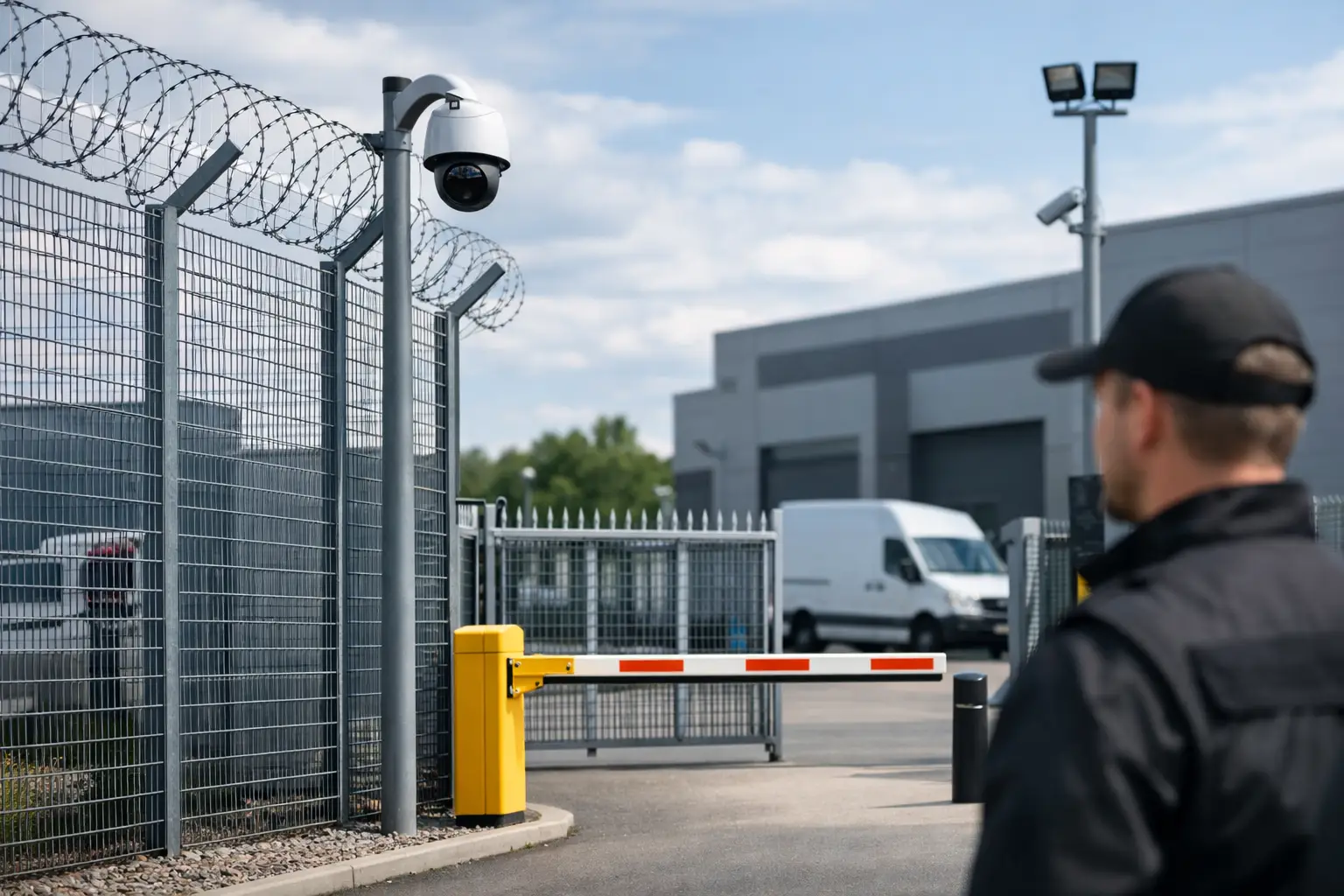
Also consider the difference between deterrence and delay. Visible gates, coordinated fencing and a clearly controlled entrance act as a deterrent. Strong construction, dependable locking and restricted access provide delay if someone attempts to enter without permission. Cameras and alarms may support the system, but they should not compensate for weak physical barriers.
Map people, vehicles and deliveries separately
A frequent specification error is treating every user in the same way. Staff, visitors, pedestrians, cyclists, articulated lorries and emergency services do not need the same route or the same level of access.
Separate pedestrian gates can prevent people walking through a vehicle entrance. A dedicated delivery point can keep lorries away from staff parking. Where traffic flow is limited, a sliding or telescopic gate may maximise the available opening without requiring the clearance area of a swing gate. These decisions improve safety as well as security.
Build a commercial perimeter security strategy around layers
An effective perimeter works as a coordinated system. The outer edge of the plot, the vehicle entrance, pedestrian access and the area immediately inside the boundary should support one another. If the gate is secure but the adjoining fencing is easy to breach, the investment has simply moved the weak point.
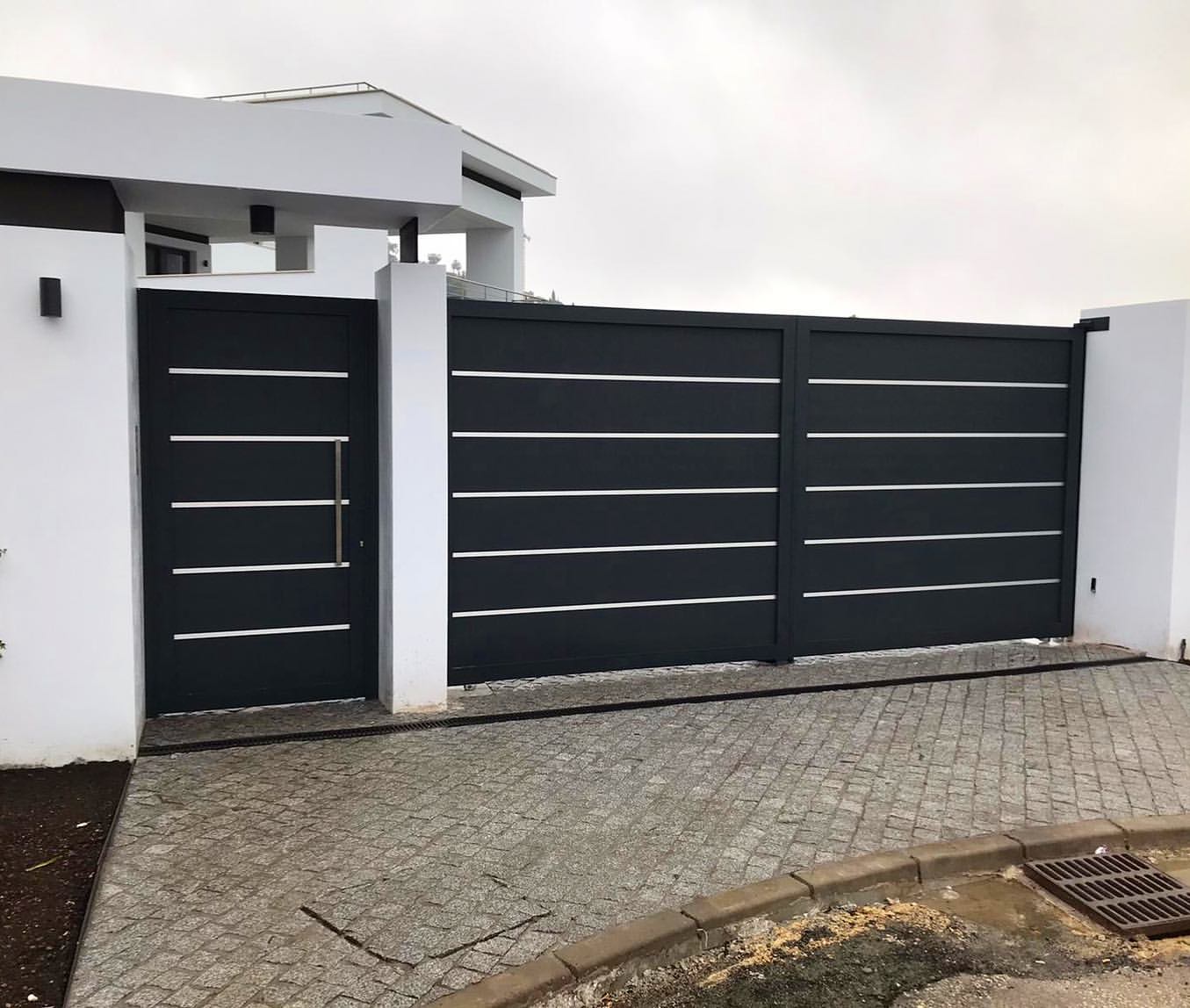
Aluminium fencing panels coordinated with the gate design create a continuous, considered boundary. Depending on the application, horizontal slats can provide greater privacy, while spacing between panels can retain visibility across a car park or entrance. The correct balance depends on whether surveillance, screening or a stronger visual deterrent is the priority.
Avoid creating concealed areas near the entrance. Dense planting, poorly positioned signage and solid sections of fencing can reduce visibility for reception staff, security personnel and cameras. This does not mean a commercial entrance must look severe. A clean, design-led aluminium system can give a property presence and privacy while preserving practical observation points.
Lighting also deserves early attention. An access-controlled gate is less effective if users cannot identify the intercom, read signage or safely navigate the entrance after dark. Lighting should support safe movement and visibility without shining into neighbouring properties or directly into approaching drivers’ eyes.
Select the right commercial gate format
The best gate format is determined by available space, traffic type, gradients, wind exposure and desired opening speed. A made-to-measure solution allows these practical considerations to shape the design rather than forcing the site to fit a standard product.
Sliding gates for constrained entrances
Sliding gates are often an excellent choice where a driveway rises behind the entrance, vehicle space is limited or the gate must open without swinging into a public footway. They can provide a wide, controlled opening and are particularly suited to busy commercial access points.
They do require sufficient lateral room for the gate to travel when open. Trackless cantilever arrangements and tracked systems each have different site requirements, so ground conditions, drainage and the usable run-back area need to be assessed before specification.
Swing gates for formal, spacious approaches
Swing gates offer an impressive entrance and work well where there is ample level space inside the boundary. They can be specified as single or double leaves, with automated operation for staff and visitors.
However, swing gates need clear opening arcs. On sites with steep approaches, frequent lorry movements or limited internal clearance, a different format may offer a safer and more efficient result.
Bi-folding and telescopic gates for speed
Where opening speed matters, bi-folding or telescopic gates can be worth considering. Their compact movement can suit busy sites where queues at the entrance would disrupt road access or operations. They are more specialised solutions, but the right configuration can make a substantial difference where space and throughput are both tight.
Put access control at the centre of the entrance
A high-quality gate only performs as intended when access is managed properly. The right system should make authorised entry straightforward while giving the business control over who enters and when.
For smaller sites, an intercom with video verification may be sufficient. An Akuvox intercom, for example, can give staff or property managers a clear way to identify visitors before releasing a gate or pedestrian entrance. For larger or multi-user premises, keypad codes, fobs, mobile credentials, timed permissions and integration with wider building access systems may be more appropriate.
Consider how credentials will be managed when staff change, contractors attend or tenants move on. A system that allows permissions to be updated quickly is usually preferable to relying on physical keys that may be copied or not returned. Emergency release, fail-safe arrangements and a clear process for out-of-hours access should be agreed before installation, not improvised later.
Specify construction for long-term performance
Commercial gates are exposed to repeated operation, changing weather and accidental contact from vehicles. Material quality and fabrication standards have a direct effect on how the entrance looks and performs over the years.
Premium aluminium offers a strong, low-maintenance alternative to timber and can avoid the rot, swelling and regular refinishing associated with natural materials. A quality powder-coated finish provides lasting colour and a refined appearance, while a fully welded construction delivers a more substantial, integrated frame than systems assembled from multiple mechanical joints.
The design should be engineered for the gate’s size, weight and operating method. Wider infill sections, solid privacy panels and exposed locations can all increase wind loading. The posts, foundations, hinges, tracks and automation must be specified as one system. Choosing a visually attractive gate without accounting for these forces can lead to poor alignment, unreliable movement and unnecessary remedial work.
At Alu-Gate, bespoke fabrication allows the gate, fencing and pedestrian access points to be designed as a coordinated entrance solution, with premium aluminium construction and a 20-year guarantee for added confidence in long-term value.
Plan installation, safety and daily operation early
Commercial gate projects benefit from a site survey before the final design is signed off. Levels, service routes, drainage, access for installation teams and the location of power supplies can all affect the specification. It is far more efficient to resolve these details at the planning stage than after groundwork has begun.
Automated gates also need appropriate safety measures. The exact requirements depend on the gate type and site use, but potential trapping, crushing and impact points must be assessed. Safety devices, controls, signage and manual release arrangements should be selected for the real operating environment, especially where pedestrians may be present.
Do not overlook maintenance access. Aluminium itself requires little routine upkeep, but moving components, automation and access controls should be inspected and serviced in line with their use. A gate that is easy to maintain is more likely to remain safe, reliable and correctly aligned.
Invest in whole-life value, not only the initial price
The lowest initial quote can become the most expensive choice if it leads to frequent repairs, repainting, corrosion issues or a premature replacement. Commercial buyers should assess the total ownership picture: fabrication quality, coating finish, automation, installation requirements, expected servicing and the strength of the warranty.
A tailored aluminium perimeter can also add value beyond security. It creates a more controlled arrival experience, improves the appearance of a tired boundary and gives clients, tenants and staff confidence that the premises are cared for. For customer-facing businesses, that first impression carries real weight.
The right perimeter should feel purposeful every day: easy for authorised users to pass through, difficult for unauthorised visitors to compromise and designed to complement the property for years to come. Start with the way your site operates, then specify every element around that reality.