
A commercial gate has to do more than control access. At a busy depot, office development, school, flat scheme or private estate, it must protect pedestrians, vehicles and visitors every time it moves. The best commercial gate safety features are therefore not optional extras chosen at the end of a project. They should shape the gate design, automation and access-control specification from the outset.
A premium entrance should feel effortless to use, but its safety strategy needs to be carefully engineered. The right combination depends on who uses the site, how traffic approaches, whether pedestrians share the entrance and the gate format itself. A sliding gate faces different risks to a pair of automated swing gates. There is no credible one-size-fits-all specification.
Start with the movement and the people around it
Every automated gate creates potential trapping, crushing, shearing and impact points as it opens and closes. The first question is not which safety device to buy. It is where people, cars, delivery vehicles and cyclists can realistically be while the gate is moving.
A commercial entrance may be used by trained staff during working hours, then by visitors, contractors and couriers with no familiarity with the layout. A gate positioned near a public footpath or communal access route demands particular care. Equally, a busy entrance with limited visibility may need more detection coverage than a quiet, controlled site.
A proper site assessment should consider the opening route, adjacent fencing, gradients, pinch points, visibility, queueing space and the way users enter on foot. It should also identify what happens when a vehicle stops halfway through the entrance or a pedestrian follows a car towards the gate. Safety works best when it is designed into the full entrance arrangement, rather than added to an unsuitable gate later.
Best commercial gate safety features for active protection
Active safety devices detect an obstruction or person and either prevent movement, stop the gate or reverse it. They are central to a professionally specified automated system, particularly where a gate operates without a person standing beside it.
Photocells and monitored detection beams
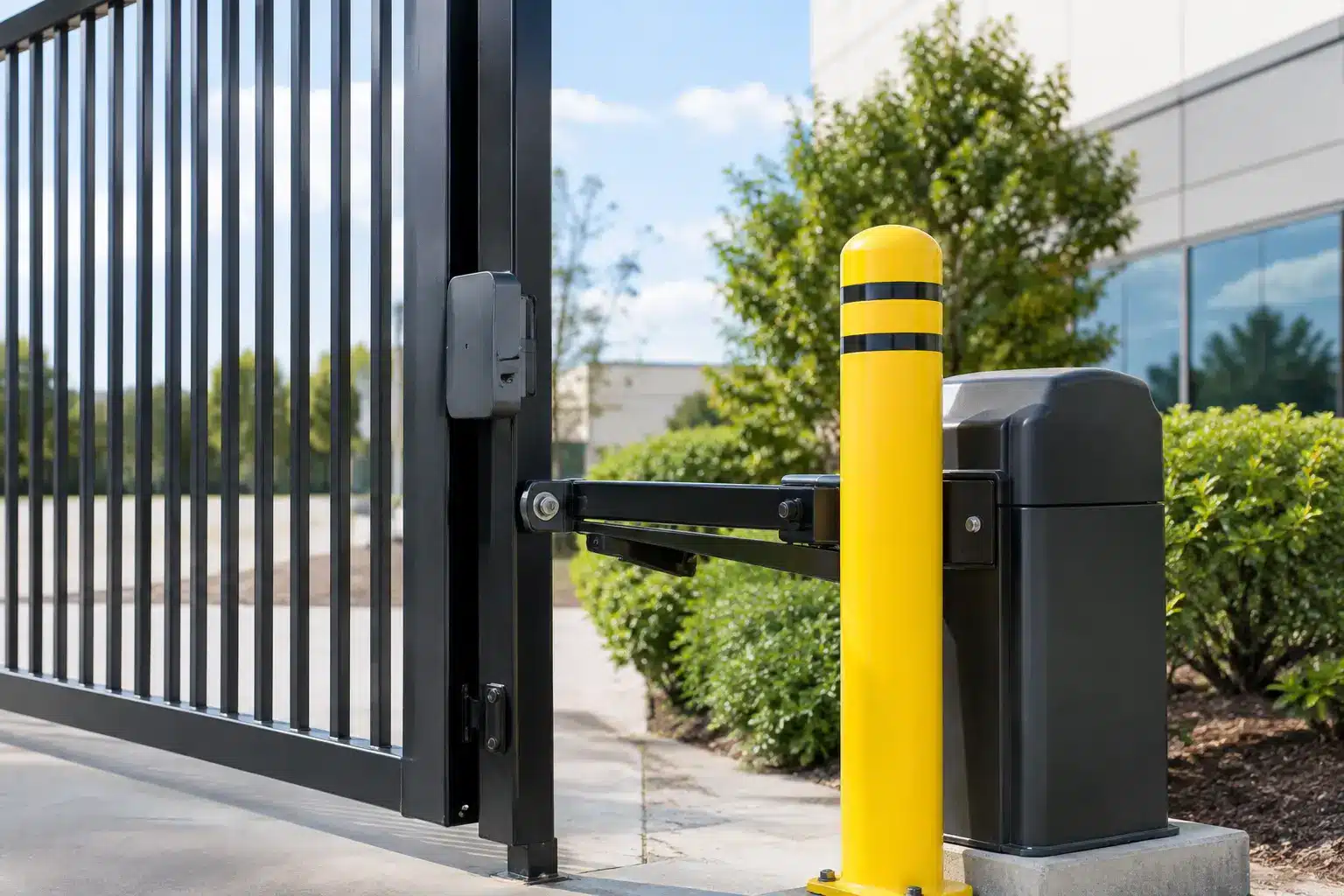
Photocells create an invisible beam across an access route. If the beam is interrupted while the gate is closing, the control system can stop or reverse the gate before contact occurs. They are particularly effective for protecting the clear opening between gate posts and for detecting vehicles that have not fully passed through.
For commercial use, placement matters as much as the device itself. A single low beam may not detect every hazard. Additional beams at suitable heights can provide better coverage for cars, pedestrians and smaller obstructions. They must also be positioned to avoid false triggers caused by normal site activity, while remaining accessible for cleaning and testing.
Pressure-sensitive safety edges
Safety edges are fitted to leading or closing edges where there is a foreseeable contact risk. When compressed, they send a signal to stop or reverse the gate. On a sliding gate, this may include the leading edge and areas where the gate passes close to a post, wall or fixed panel. On swing gates, edges can protect closing gaps at the meeting point, hinge-side areas and other trapping zones identified by the assessment.
A safety edge is not an excuse for poor geometry. It is a final layer of protection where a residual risk remains. Premium fabrication helps here: accurately aligned gate leaves, stable frames and properly designed clearances allow protective devices to perform as intended over the long term.
Safety scanners and light curtains
Where people regularly pass close to a gate, monitored laser scanners or light curtains can create a wider, more intelligent detection zone than standard photocells. These systems can detect presence within a defined area and prevent the gate moving into that space.
They are especially valuable at high-traffic commercial sites, entrances with unusual layouts or locations where pedestrians may approach from the side. They require careful commissioning, however. A poorly configured scanner can create nuisance stoppages, while inadequate coverage leaves risks unresolved. The goal is dependable protection without frustrating legitimate access.
Force limitation and obstacle recognition
Modern gate operators can monitor resistance as they move. If the gate meets an obstruction, the operator can stop or reverse. This provides useful secondary protection, but force limitation should never be relied upon as the sole safeguard at a commercial entrance.
The operating force must be correctly set for the size, weight and movement of the gate. A made-to-measure aluminium gate offers a practical advantage here. Aluminium combines strength with relatively low weight, helping to create a responsive automated system without compromising the substantial, premium appearance expected at a commercial property.
Controls that prevent unsafe operation
The safest gate is one that only moves when its surroundings are appropriately protected. Access controls and operating logic play a major role in achieving this.
A well-specified system may use keypad entry, key fobs, proximity credentials, vehicle detection or an intercom to manage access. Video intercoms allow staff or residents to identify visitors before granting entry, which can reduce unnecessary gate cycles and improve control at the boundary. For commercial sites, timed permissions and restricted user access may also be appropriate.
Control positions deserve the same attention as the gate itself. A pedestrian should not be able to operate a gate from a place where they cannot see its path of travel. Where a hold-to-run control is suitable, it should be positioned to give the operator a full view of the danger area. In other settings, guarded automatic operation with suitable detection is the more practical choice.
Emergency stop controls, where appropriate, should be visible, accessible to authorised users and clearly understood by those responsible for the site. A manual release is also essential for controlled access during power failure or maintenance. It should be secure from misuse, yet available to trained personnel when needed.
Gate design still matters to safety
Safety equipment cannot compensate for an entrance that has been poorly planned. The best result brings gate design, fencing, posts, automation and pedestrian access together as one system.
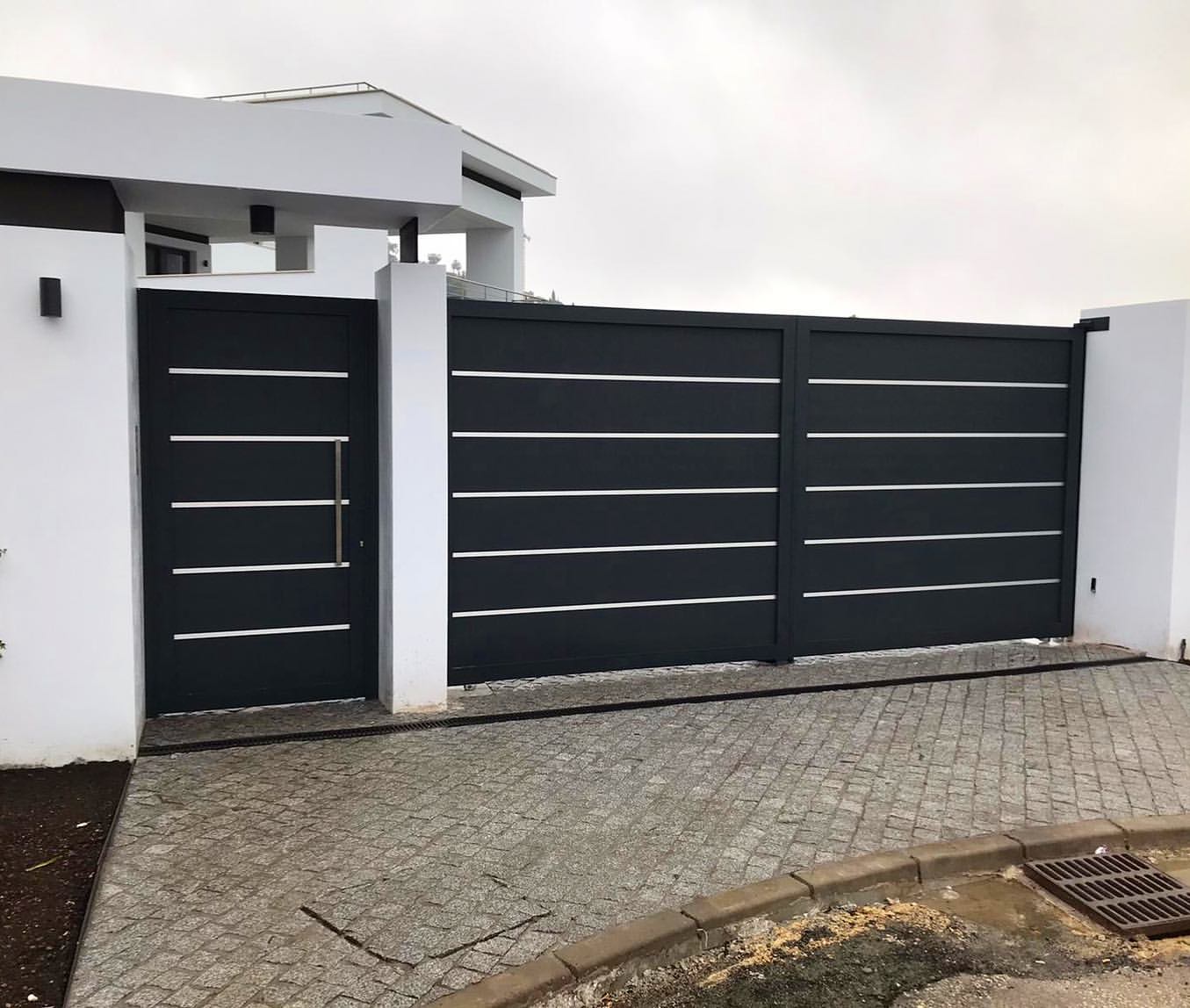
Separate pedestrian access is often a sensible decision. Asking people to walk through the same opening used by delivery vehicles and cars increases interaction with a moving gate. A coordinated pedestrian gate, with appropriate access control, can make daily use safer and more convenient while preserving a consistent architectural finish.
Sliding gates are often well suited to commercial entrances because they do not sweep into a roadway or vehicle waiting area. They do, however, need sufficient run-back space and careful protection along the travel line. Swing gates can be an excellent choice where space allows, but their opening arcs must remain clear of vehicles, pedestrians, slopes and public highways.
The construction quality of the gate also affects safe operation. Fully welded aluminium frames resist movement and distortion, helping the gate remain correctly aligned with its safety devices. Premium powder-coated finishes reduce the maintenance burden, while correctly specified hinges, track systems, rollers and guides support predictable movement. A gate that drags, drops or becomes misaligned is not simply inconvenient. It can compromise the performance of the entire safety system.
Commissioning, documentation and maintenance
Commercial gate safety is not completed on installation day. The system should be professionally commissioned, tested and handed over with clear information on operation, emergency procedures and maintenance requirements. The responsible person for the premises should understand how to isolate the system, use the manual release and report faults.
The legal and technical obligations will vary by site and application, so the automated gate should be assessed and supplied in line with relevant UK legislation and applicable safety standards. This is one reason a consultation-led specification is so valuable. It allows the gate, safety devices and operational controls to be chosen for the real conditions on site, not an assumed layout.
Regular planned maintenance is equally essential. Photocells can become dirty or misaligned. Safety edges can suffer damage. Tracks collect debris, and moving components require inspection and adjustment. A visual check by site staff is useful, but it does not replace scheduled professional servicing and recorded safety testing.
If a gate behaves unpredictably, reverses without reason, fails to stop correctly or shows visible damage, it should not be treated as a minor inconvenience. Restrict use and arrange inspection before normal operation resumes. Reliable access begins with a system that is maintained as carefully as it was designed.
For a commercial entrance that looks as considered as it performs, specify safety at the same time as the gate style, finish and access method. The result is a tailored aluminium entrance built to make a strong first impression, while giving every user the confidence to pass through it safely.