
A solid pair of manual driveway gates can look the part, but getting out of the car in rain, darkness or heavy traffic soon loses its appeal. So, can electric gates be retrofitted? In many cases, yes. The deciding factor is not simply whether an operator can be fitted. It is whether the existing gates, supporting structure and access layout can provide the strength, movement and safety needed for dependable automation.
Retrofitting can be an excellent way to improve security, convenience and kerb appeal without replacing every part of an entrance. However, it should be assessed as a complete system. A high-quality motor cannot compensate for weak timber, poorly aligned hinges or unstable gate posts.
Can electric gates be retrofitted safely?
Existing swing gates and sliding gates can often be automated successfully where they are structurally sound and correctly installed. This includes gates made from aluminium, steel and, in some circumstances, well-maintained hardwood. The gates must be suitably sized and weighted for the proposed automation equipment, and they must move freely by hand before any motor is considered.
For a swing gate, each leaf should open and close smoothly without dragging, dropping or binding. There should be no excessive play in the hinges, and the posts or pillars must remain stable under load. For a sliding gate, the track, rollers, guide posts and cantilever components need the same careful scrutiny. A gate that already struggles to travel freely will place unnecessary strain on its motor, shortening the system’s working life.
The best retrofit projects begin with an on-site assessment. This establishes whether the gate is a suitable candidate, what equipment is required and whether replacing the gates would deliver better long-term value.
The condition of the gate comes first
Automation adds controlled force to a moving gate. That makes the quality of its construction critical. Lightweight decorative gates, ageing timber leaves or gates assembled with bolted joints may not withstand the repeated loading that powered operation creates.
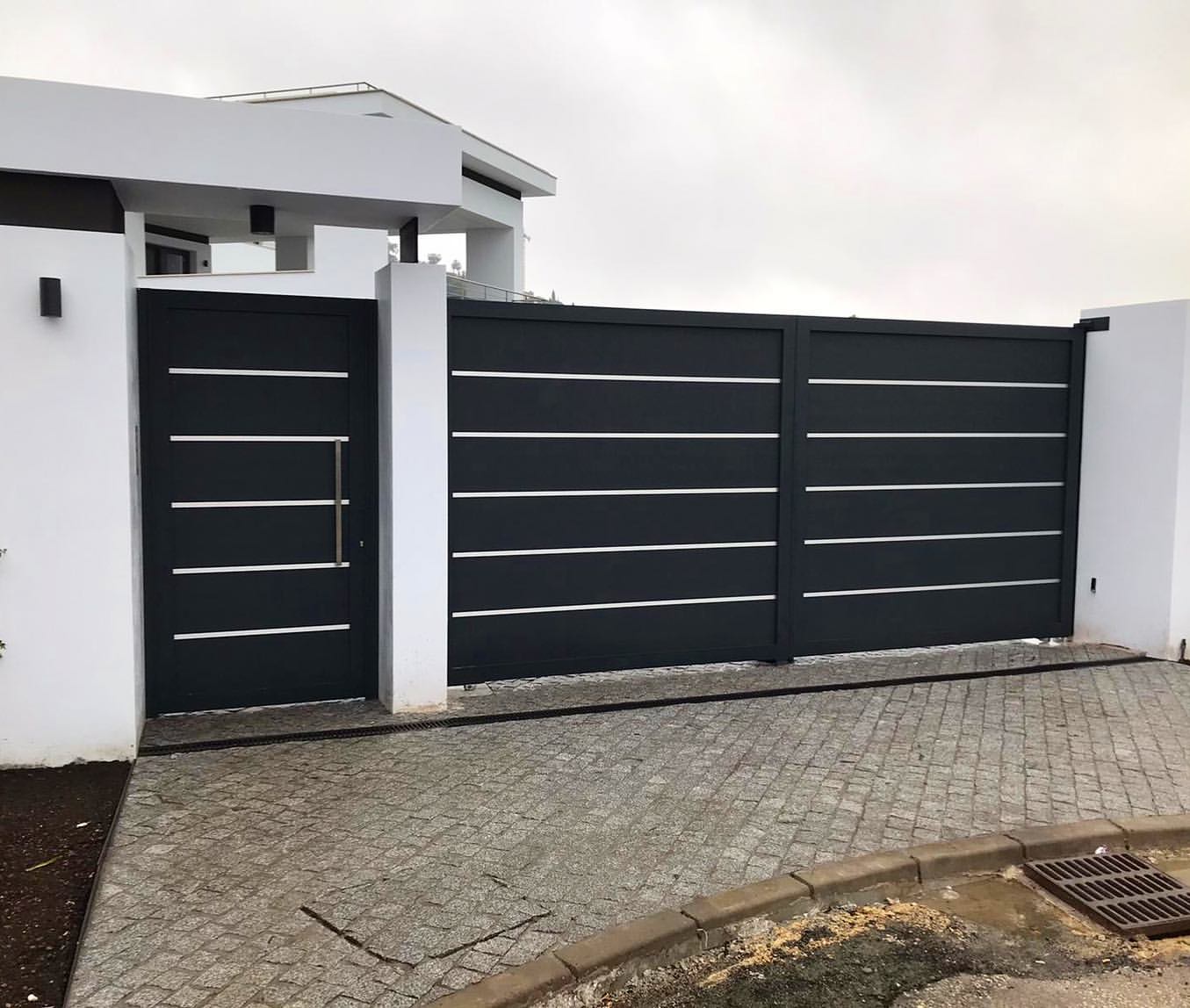
Fully welded aluminium gates are particularly well suited to automated operation. They offer an excellent balance of strength and manageable weight, do not rot or rust, and retain their shape with minimal maintenance. For larger openings, this lower weight can reduce demand on motors, hinges and foundations while still achieving a substantial, premium appearance.
Existing metal gates may also be suitable, but corrosion must be addressed honestly. Surface rust, cracked welds and distorted frames are warning signs. A repair may be viable, but there comes a point where fitting automation to a gate nearing the end of its serviceable life is false economy.
Weight is not the only consideration. Gate design affects how wind passes through it. A tall, solid-panel gate can behave like a sail in exposed locations, placing considerable pressure on hinges, posts and motors. Perforated panels, carefully spaced slats or an alternative gate configuration can be a more practical choice where wind exposure is high.
Posts, pillars and foundations must carry the load
The gate itself is only one part of the installation. Posts and pillars take the forces created every time the gate starts, stops and rests in an open position. Masonry pillars may look substantial but can still be unsuitable if they lack proper foundations, have movement cracks or were not designed to carry a heavy gate leaf.
Timber posts can be adequate for lighter gates if they are sound, correctly sized and securely founded. Yet they may not be the best long-term partner for a premium automated entrance. Steel or aluminium posts fixed into properly designed concrete foundations often offer greater stability and a cleaner, more durable finish.
During a retrofit survey, an installer should check gate alignment, hinge fixings, ground levels and the condition of the supporting structure. This is particularly relevant on sloping driveways. Swing gates need enough clearance to open without catching the surface, while sliding gates need sufficient level run-back space beside the opening.
Choosing the right type of automation
The operator must suit the gate format, dimensions, weight and site layout. There is no single motor that is right for every entrance.
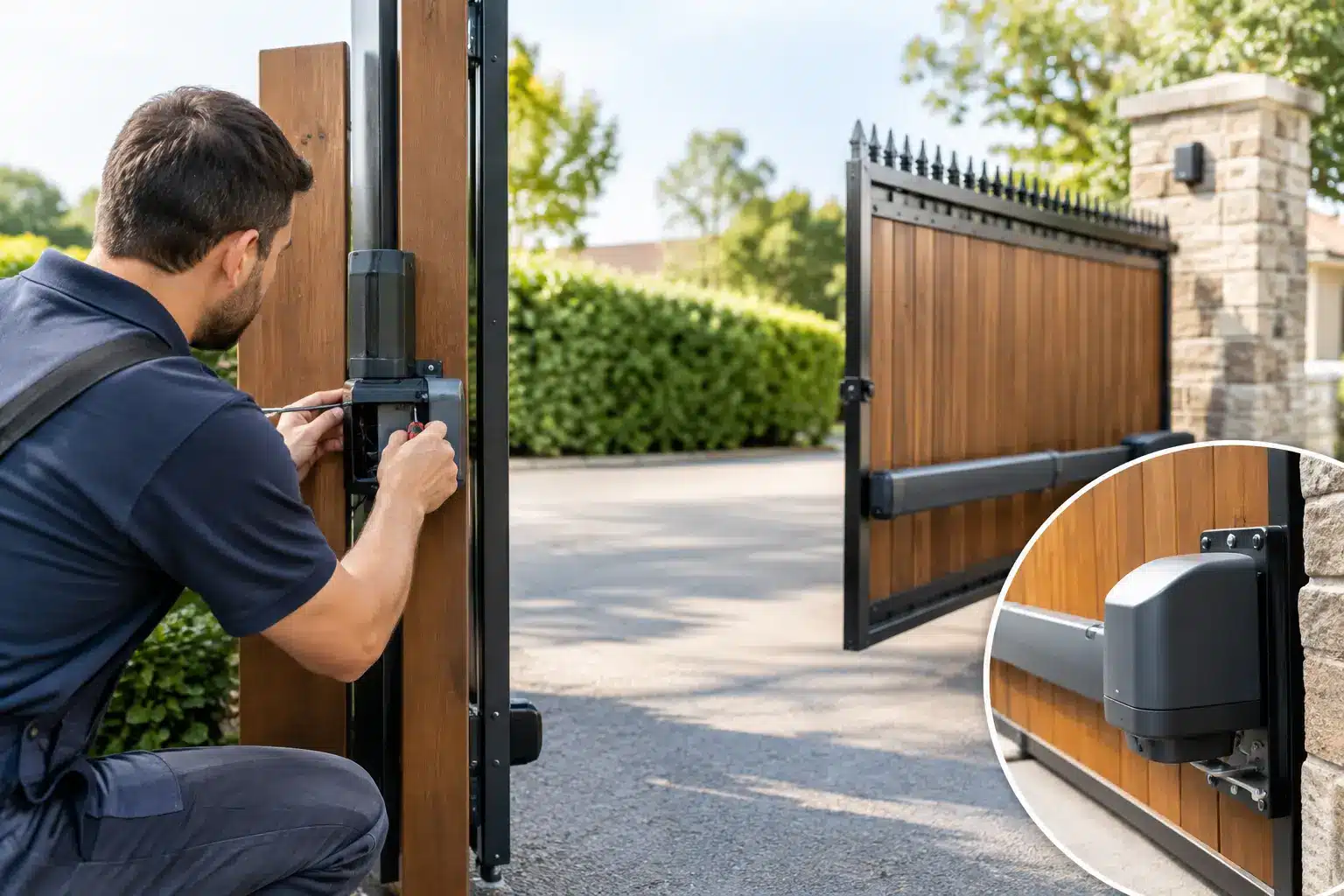
For swing gates, underground motors are often chosen where a discreet, high-end finish is the priority. They are largely concealed below ground and preserve the clean lines of the gate. They do, however, require appropriate drainage and civil works. Above-ground ram or articulated-arm operators can be more straightforward to service and may be the better choice where pillars, hinge positions or ground conditions limit underground installation.
Sliding gates usually use a track-mounted or cantilever arrangement with a rack-and-pinion motor. They are well suited to driveways where there is limited space for gate leaves to swing inward. A sliding system needs adequate room alongside the entrance for the gate to park when open. If that space is restricted, telescopic or bi-folding gate designs may offer a more compact solution.
A careful specification also considers duty cycle. A private home with a few movements each day has different demands from a commercial site with regular vehicle access. Selecting equipment with suitable capacity protects reliability and avoids a system that feels underpowered from day one.
Power, controls and everyday access
Most retrofitted electric gates require a dedicated mains electrical supply. The cable route should be planned early, particularly where it must cross a driveway, pass through landscaping or connect to a property some distance from the entrance. Electrical work must be completed by a competent professional and designed for external use.
Solar-powered automation can be a practical option where running a mains supply would be disruptive or costly. Its suitability depends on gate use, local shading, panel position and the available daylight throughout the year. For a heavily used entrance or a shaded rural setting, mains power is usually the more dependable choice.
The retrofit is also an opportunity to improve how the entrance is used. Remote controls provide straightforward vehicle access, while keypads, fobs, GSM calling systems and video intercoms can give residents and visitors controlled entry. A professionally specified intercom allows you to see and speak with callers before granting access, adding a valuable layer of security without compromising the appearance of the entrance.
Do not overlook pedestrian access. A separate pedestrian gate is often the safest and most convenient way for people to enter, rather than opening the main driveway gates for every delivery, visitor or school run.
Safety is a design requirement, not an optional extra
An automated gate is a powered machine, and it must be designed and installed with appropriate safety measures. This is especially important where children, visitors, delivery drivers or members of the public may come into contact with the entrance.
A compliant system will normally include safety devices such as photocells to detect an obstruction in the gate’s path, force limitation, emergency release arrangements and risk protection at potential trapping points. The exact measures depend on the style and movement of the gate, the surrounding fencing, the hinge arrangement and how the entrance is used.
For example, a swing gate can create crushing or shearing zones near its hinges and closing edge. A sliding gate introduces different risks around its leading edge, rollers and run-back area. The gate, automation and surrounding structure must work together to prevent access to hazardous gaps and moving parts.
Safety should never be treated as an add-on to reduce costs later. A properly planned installation is safer, more reliable and easier to maintain. It also gives property owners greater confidence that their entrance is suitable for daily use.
When replacement is the better investment
Retrofitting is not always the right answer. If existing gates are warped, corroded, too heavy, poorly proportioned or unsupported by stable posts, replacement can be the more sensible route. It avoids spending on motors and controls only to encounter structural problems further down the line.
A made-to-measure aluminium gate system can be designed specifically for automation from the outset. The gate weight, frame strength, infill style, hinge positions, posts and ground clearances can all be coordinated before fabrication. The result is an entrance that looks intentional rather than adapted, with the performance to match its appearance.
For homeowners replacing tired timber or steel gates, this can also be the moment to create a unified frontage with matching pedestrian gates, fencing and access control. Premium powder-coated aluminium offers lasting colour, precision-welded strength and low-maintenance ownership, making it a compelling long-term alternative to repeated repairs and repainting.
A retrofit should be assessed as a complete entrance system
The right question is not just whether a motor can be attached to existing gates. It is whether the entire entrance can operate safely, smoothly and reliably for years to come. Gate condition, structural support, available space, power provision, wind exposure, control requirements and safety all deserve equal attention.
A professional consultation brings those considerations together before work begins. Whether your current gates are ready for automation or your driveway would benefit from a bespoke replacement, the strongest result is one designed to impress and built to last.