
A sloping driveway changes everything. A gate that looks perfect on paper can scrape the ground, leave awkward gaps, or demand far more space than your entrance can realistically give. Choosing the best gate for a sloping driveway is less about picking a style you like and more about selecting a system engineered around the gradient, the opening width and how you use the entrance every day.
That is why the right answer is rarely a one-size-fits-all product. On a level driveway, you can often choose between gate types based mainly on appearance. On a slope, geometry, clearance and automation become the deciding factors. Get those right and your gate feels effortless. Get them wrong and even a premium gate will frustrate you from day one.
What makes the best gate for a sloping driveway?
The best gate for a sloping driveway is the one that opens safely, clears the ground properly and suits the way vehicles and pedestrians move through the entrance. That may sound obvious, but it rules out a surprising number of off-the-shelf solutions.
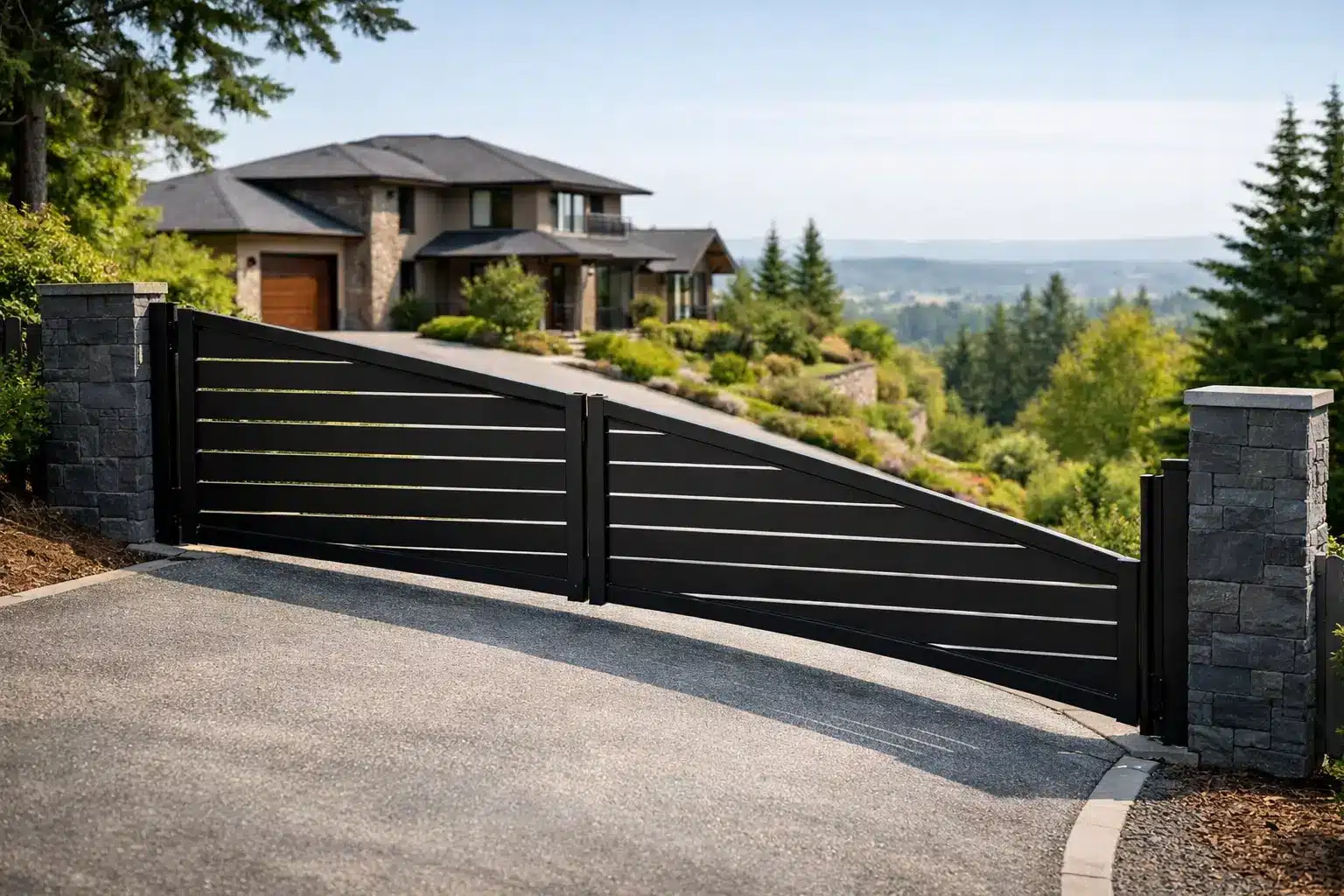
The steepness of the slope matters first. A gentle incline may still allow for a well-designed swing gate, particularly if the opening direction and hinge arrangement are carefully considered. A steeper rise often pushes the decision towards sliding, bi-folding or other specialist formats that avoid the ground clearance issue altogether.
You also need to think about the visual result. Some gate systems technically work on a slope but create large triangular gaps beneath the gate leaf. For security-conscious homeowners and commercial sites, that compromise can undermine the whole purpose of installing a gate. The best solution balances function, appearance and security rather than sacrificing one for the other.
Why standard swing gates can struggle on slopes
Traditional swing gates are usually the first option people picture for a driveway. They are classic, familiar and often well suited to period and contemporary properties alike. But on a sloping driveway, they need much more careful planning.
If a gate swings inwards and the ground rises immediately behind it, the bottom of the gate can catch on the driveway surface. To prevent that, the gate either needs additional clearance or a design adapted to the slope. More clearance can solve the operational problem, but it may also leave a larger gap underneath than many owners are comfortable with.
There is also the issue of vehicle movement. If the driveway is short or steep near the entrance, cars may not have enough waiting space for a pair of swing gates to open comfortably. Add automation into the mix and the margins become tighter. Safety edges, ram geometry and hinge positioning all need to be considered from the outset, not added as an afterthought.
That does not mean swing gates are unsuitable. It means they must be properly specified. For some properties, a made-to-measure split leaf arrangement or carefully configured hinged system is still the right answer. The detail matters.
Sliding gates are often the strongest option
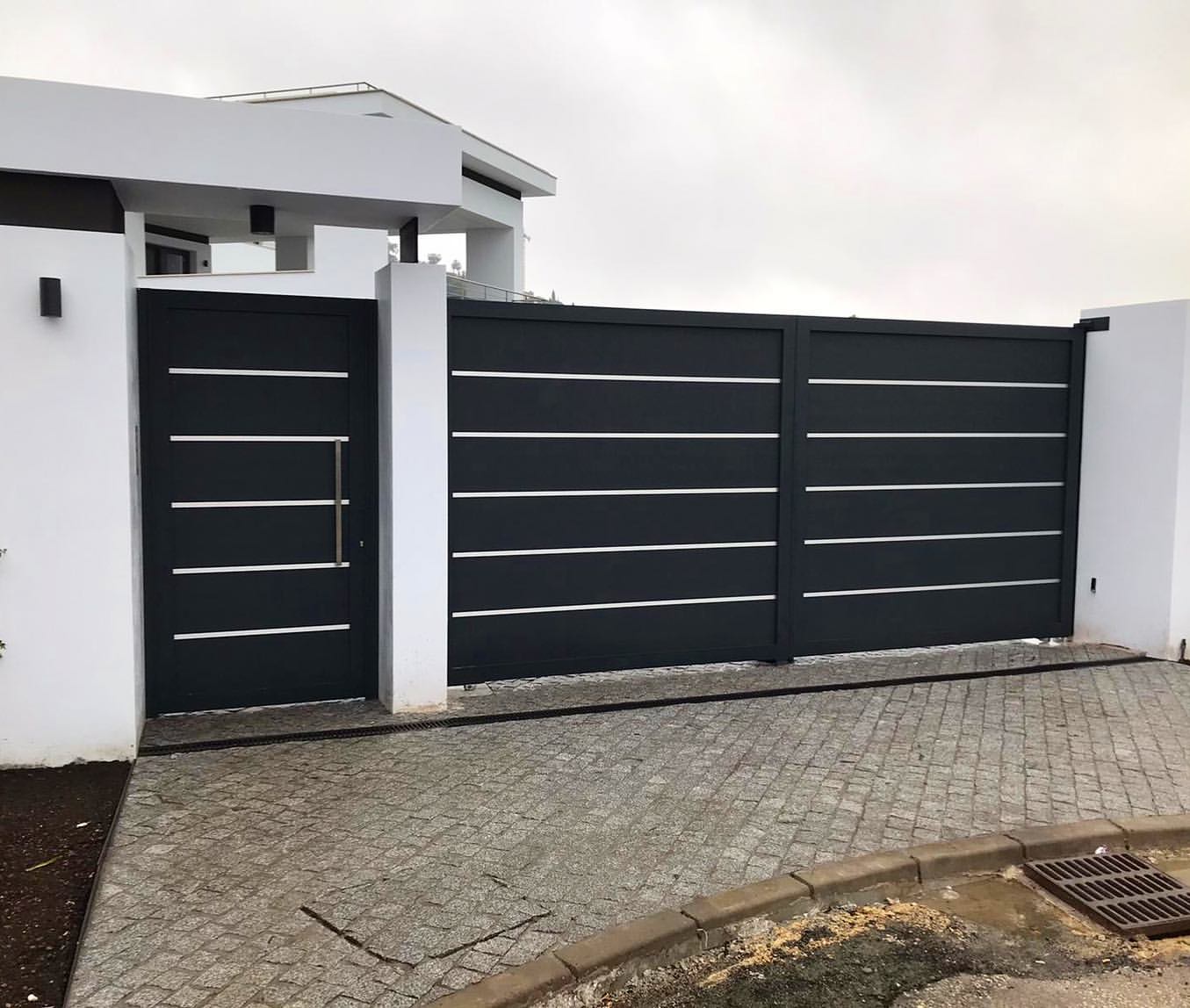
For many properties, a sliding gate is the best gate for a sloping driveway because it removes the main problem entirely. Instead of swinging across a rising surface, the gate travels laterally along the boundary line. That means no scraping, no need to create exaggerated under-gate gaps, and no awkward compromise between clearance and appearance.
Sliding gates are especially effective where the driveway slope is pronounced near the entrance. They also suit wider openings and properties where security is a priority, as the gate can maintain a more consistent line at the bottom. Visually, the result is usually cleaner and more deliberate.
The trade-off is space. A sliding gate needs sufficient run-back area to one side of the entrance. If boundary walls, planting, level changes or site constraints prevent that, then another format may be better. Installation requirements are also more demanding, as the track or cantilever arrangement and supporting structure must be set up with precision.
For premium residential projects and commercial entrances, though, sliding gates often deliver the most refined combination of practicality, security and design. When fabricated in aluminium, they also avoid the maintenance burden and weight associated with traditional materials.
When bi-folding or telescopic gates make sense
Some sloping driveways have another complication: limited space. You may not have enough depth for a standard swing gate or enough lateral space for a single sliding gate. In those cases, bi-folding or telescopic systems deserve serious attention.
A bi-folding gate reduces the space needed for opening by folding its leaves as it operates. This can be particularly useful on entrances close to the road, where fast opening and compact movement are important. A telescopic gate, meanwhile, splits the sliding action across multiple gate sections, reducing the run-back length required.
These are specialist systems, and they must be manufactured and specified properly to perform reliably. But on the right site, they solve problems that a conventional gate cannot. For design-led properties where every metre counts, they can offer a premium answer without forcing compromises in style.
Material matters as much as gate type
Even the right opening method can disappoint if the material is wrong. On a sloping driveway, gate weight and structural stability have a direct impact on performance. Heavy gates place greater demand on hinges, automation and support posts. Over time, that can affect alignment and reliability.
This is where aluminium stands out. A high-quality aluminium gate offers the strength required for a secure entrance while remaining significantly lighter than many steel or timber alternatives. That lower weight helps the gate operate more efficiently and places less strain on moving parts.
For the owner, the long-term benefits are just as important. Aluminium will not warp, rot or demand the routine repainting associated with timber. For exposed UK driveways dealing with rain, frost and year-round use, low maintenance is not a luxury. It is part of the value proposition. A bespoke aluminium system also allows for cleaner detailing and more precise fabrication, which is particularly important where a gate must be tailored to a difficult gradient.
Design details that affect real-world performance
The best gate for a sloping driveway is rarely decided by gate type alone. Smaller technical details often shape whether the finished result feels premium or problematic.
The gradient profile matters more than many people expect. A driveway may appear to have a simple rise, but changes in pitch near the threshold can alter the available clearance dramatically. The width of the opening matters too, because wider gates create different loading and movement demands. Then there is the question of how the gate will be used. A family home with a few daily movements has different priorities from a commercial entrance with regular traffic and controlled access.
Automation should be considered early. On a slope, motors, safety systems and opening speeds all need to suit the gate format and site layout. Intercoms, access control and vehicle entry planning should work with the gate system rather than being bolted on later. This is one reason a consultation-led approach tends to produce better results than choosing a gate from standard dimensions and hoping it will fit.
How to choose the right solution for your property
If you are deciding on the best gate for a sloping driveway, start by looking at the site honestly rather than starting with a preferred style. Measure the opening, identify where the slope begins and note how much space exists behind and to the side of the entrance. Think about whether vehicles need to stop close to the gate, whether pedestrians use the entrance separately, and how important a flush visual line is at the base of the gate.
From there, the decision usually becomes clearer. If the slope is mild and space allows, a properly designed swing gate may still work very well. If the incline is more severe, a sliding gate is often the stronger choice. If space is restricted in every direction, bi-folding or telescopic formats may offer the best answer.
The crucial point is that sloping driveways reward bespoke design. A premium entrance should be designed around the property, not forced onto it. At Alu-Gate, that means considering the gradient, the structure, the finish and the access requirements as part of one complete specification rather than a series of disconnected choices.
A gate on a slope should not look like a compromise. With the right system, it can feel just as precise, secure and impressive as any entrance on level ground – and often more so, because it has been designed with real intent.