
A timber gate rarely fails all at once. It starts with a sticking latch after rain, a bottom rail softening near the ground, or a finish that needs repainting far sooner than expected. The best timber gate replacement ideas address more than the appearance of an ageing gate: they improve daily access, strengthen security and give the whole frontage a more considered finish.
For many UK properties, aluminium is the natural next step. It can recreate the warmth, privacy and proportions of a timber design while removing the regular cycle of sanding, staining and repairing. More importantly, a made-to-measure replacement can be designed around the way the entrance actually works.
Start with the reason for replacing the timber gate
A replacement should solve the problem that prompted it. If the existing gate is warped, split or rotten, durability may be the priority. If it looks dated against a renovated home, the focus may be architectural style. For a driveway opening onto a busy road, security, visibility and automated operation may matter most.
This is why replacing timber with a like-for-like gate is not always the strongest option. The opening may be wide enough for a pair of swing gates, but unsuitable for their arc of travel. A sliding gate may save usable driveway space. A pedestrian gate may need a new locking arrangement or intercom rather than simply a new leaf and hinges.
Before choosing a design, consider the width and height of the opening, the available space behind or within the driveway, ground levels, existing pillars and how frequently the gate will be used. Commercial sites should also account for vehicle movements, access permissions and the need for reliable operation throughout the working day.
Aluminium timber gate replacement ideas that last
Aluminium offers a crisp, premium alternative to timber without forcing every property towards a starkly modern look. The right profile, spacing and colour can make it feel traditional, contemporary or deliberately understated.
Wood-effect aluminium for familiar warmth
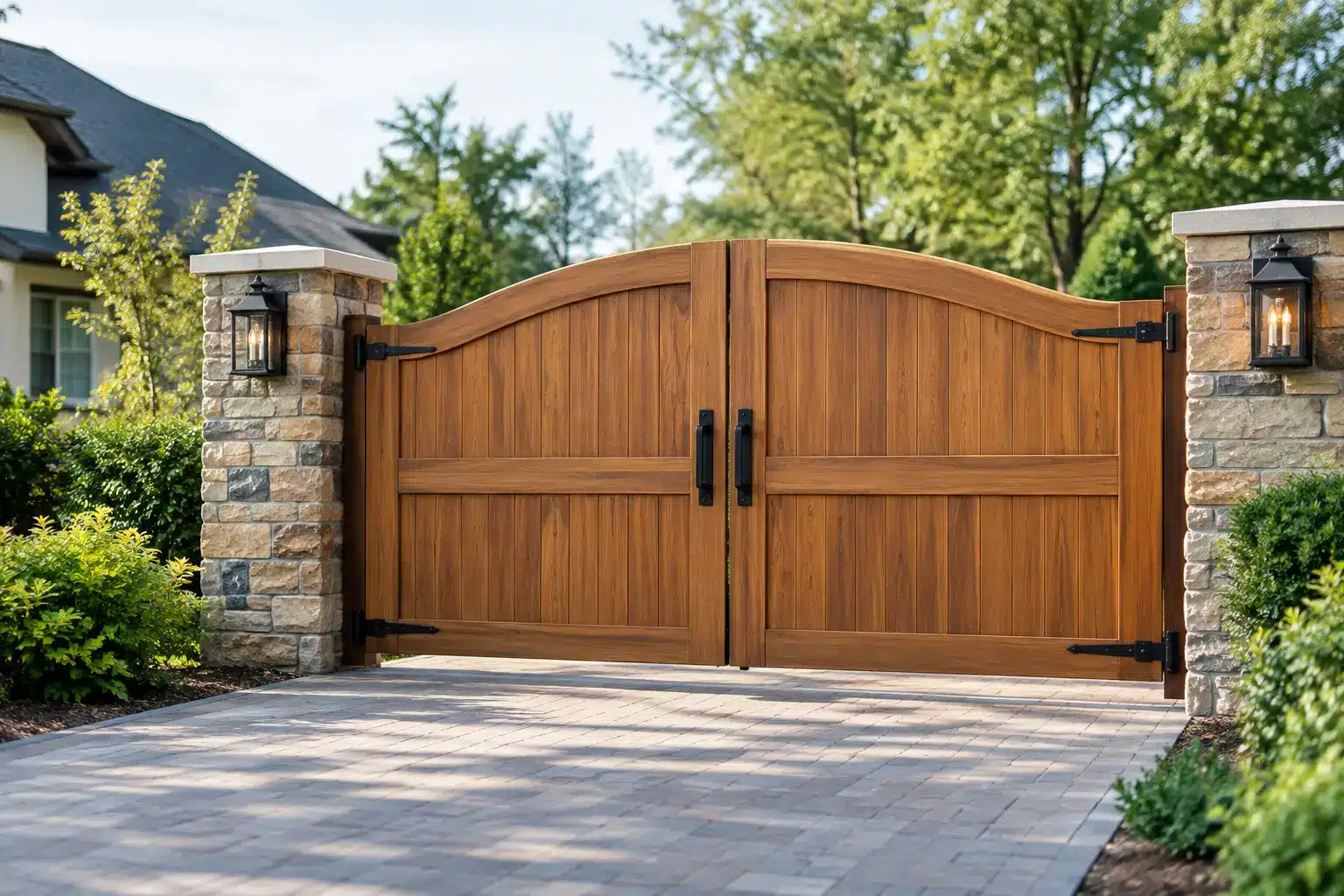
For homeowners who like the character of timber, wood-effect aluminium is a compelling option. It gives the visual texture of wood grain while avoiding the vulnerabilities of natural boards. There is no timber to absorb moisture, swell through winter or become a target for rot at the post and rail joints.
This approach works particularly well for period properties, rural homes and gardens where a plain grey gate would feel out of place. A vertical-board arrangement creates a clean, tailored interpretation of a traditional timber gate, while horizontal boards can make a frontage feel wider and more contemporary.
The trade-off is that a realistic wood-effect finish is a design choice rather than an attempt to disguise the material completely. For some schemes, a confident solid colour provides a sharper match to window frames, doors or metal fencing.
Slatted gates for privacy with lighter visual weight
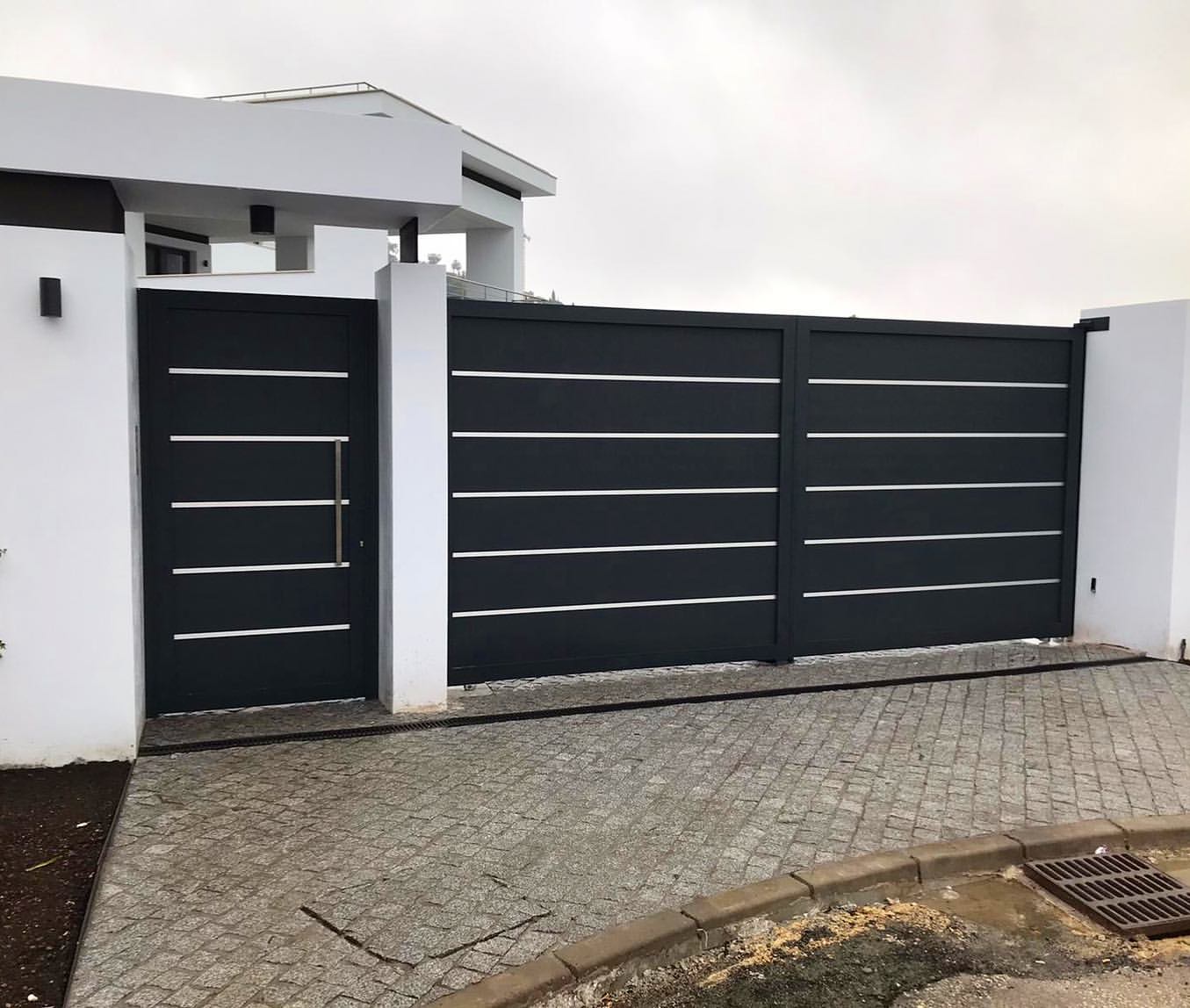
Slatted aluminium gates are among the most versatile replacements for heavy timber panels. Narrow horizontal or vertical slats can provide strong privacy, but their shadow lines introduce detail and prevent a large gate from looking flat.
The spacing is crucial. Closed or closely spaced slats suit a property where screening is the main requirement. Small gaps allow light and airflow while retaining a sense of enclosure. Wider gaps create a more open, architectural look, although they are less suitable where privacy or containment is essential.
A slatted design can be continued into side panels and fencing to turn a tired boundary into one cohesive entrance scheme. This is often more effective than installing an impressive new driveway gate beside mismatched, weathered timber fencing.
Solid infill gates for stronger screening
Where a property fronts a road or overlooks a public footpath, solid aluminium infill offers a clean solution. It creates a confident boundary, limits views into the driveway and provides a substantial visual barrier without the bulk or maintenance burden of a traditional close-boarded timber gate.
Solid gates are well suited to modern homes, commercial premises and side entrances where privacy is non-negotiable. They can be softened with a warm finish, framed detailing or a contrasting border. Consider wind exposure, however. A fully closed gate catches more wind than an open slatted design, so the posts, hinges and foundations must be specified accordingly.
Framed designs that respect a traditional home
Not every timber gate needs to be replaced with an ultra-modern statement. A fully welded aluminium gate can be designed with framed sections, rails and balanced proportions that echo the form of a classic five-bar or boarded timber gate.
This is an especially strong choice for homes with brick piers, heritage detailing or established landscaping. The benefit is not merely visual. Precision-welded construction removes the loose mechanical joints that can develop movement over time, producing a gate that retains its alignment and presence.
Choose the right operation for the entrance
The format of the gate has as much influence on convenience as the finish. Timber replacements are an opportunity to correct an awkward layout rather than repeat it.
Swing gates for classic driveways
Swing gates remain a popular choice where there is clear space inside the property for the leaves to open. They suit symmetrical entrances, pillar-mounted installations and homes that want a formal arrival. Single-leaf versions can work well for narrower driveways, while double-leaf gates reduce the sweep required from each side.
For automation, swing gates need adequate clearance, sound foundations and careful positioning. They should never open across a public pavement or carriageway. On sloping driveways, the direction of the fall must also be assessed early, as it can affect whether the leaves can open safely.
Sliding gates for space-conscious layouts
A sliding aluminium gate is often the better answer where a driveway rises immediately behind the entrance, vehicles park close to the gate or there is limited room for swinging leaves. It travels parallel to the boundary, keeping the drive clear and creating a controlled, high-security entry point.
Sliding systems require sufficient run-back space alongside the opening. Where that is unavailable, telescopic or bi-folding options can provide a faster, more compact solution. These formats are particularly useful for commercial sites and urban homes where every metre matters.
Pedestrian gates that complete the boundary
A side or garden gate should not be an afterthought. Replacing a timber pedestrian gate with a coordinated aluminium design can improve security at a vulnerable access point and create consistency across the whole property.
Specify a quality lock, secure hinges and a latch arrangement that suits daily use. For shared or controlled access, an intercom system can allow visitors and deliveries to be managed without compromising the appearance of the entrance.
Make security part of the design
A gate is only as effective as its construction, fixings and access strategy. Decorative detailing has value, but a premium replacement should begin with strength. Look for fully welded aluminium construction, substantial posts or appropriate pillar fixings, dependable locking and hardware designed for the gate’s size and weight.
Height and visibility need balancing. A tall, closed gate increases privacy, yet a more open upper section may preserve sightlines when leaving the driveway. This depends on the location, the road layout and the level of security required. In some cases, integrated access control, lighting and matching fencing will deliver more practical benefit than simply making the gate taller.
Automation also changes how an entrance is used. Remote operation offers comfort in poor weather, while keypad, intercom or app-enabled access can make a property easier to manage for family members, staff and regular visitors. It should be specified as part of the system from the outset, not treated as an add-on after the gate has been made.
Select colour and finish with the whole property in mind
Anthracite grey and black remain popular because they complement contemporary brick, render, aluminium windows and composite doors. They are not the only premium choices. Deep green can sit beautifully within mature planting, while a wood-effect finish brings warmth to stone, brick and rural settings.
The strongest results come from considering the gate alongside fencing, railings, garage doors, window frames and front-door hardware. A coordinated palette makes an entrance feel designed rather than assembled over time. Powder-coated aluminium finishes also offer a durable, low-maintenance surface that can remain smart with straightforward cleaning rather than frequent redecorating.
At Alu-Gate, bespoke fabrication allows the proportions, infill, colour and operating format to be shaped around the property rather than selected from a limited off-the-shelf range. That detail matters when replacing a gate at the front of a valuable home or business.
Budget for the complete replacement, not just the gate leaf
The cost of a timber gate replacement can vary substantially because the visible gate is only part of the installation. Posts, foundations, ground preparation, automation, safety equipment, access control and removal of the old gate all influence the final specification.
It can be tempting to reuse existing timber posts or worn masonry fixings, but this is often a false economy. A premium aluminium gate deserves support that is correctly engineered for its dimensions and operation. If the entrance is being upgraded, it is also worth resolving drainage, uneven levels and tired boundary panels at the same time.
A 20-year guarantee can provide useful confidence, but only when the overall system has been designed and installed with comparable care. Ask how the gate is constructed, what finish is applied, how movement is managed and which elements are covered. Clear answers are a sign of a supplier that understands long-term performance.
The right replacement does more than remove the maintenance frustrations of timber. It gives every arrival a stronger sense of security, quality and intent – designed to impress, and built to last.