
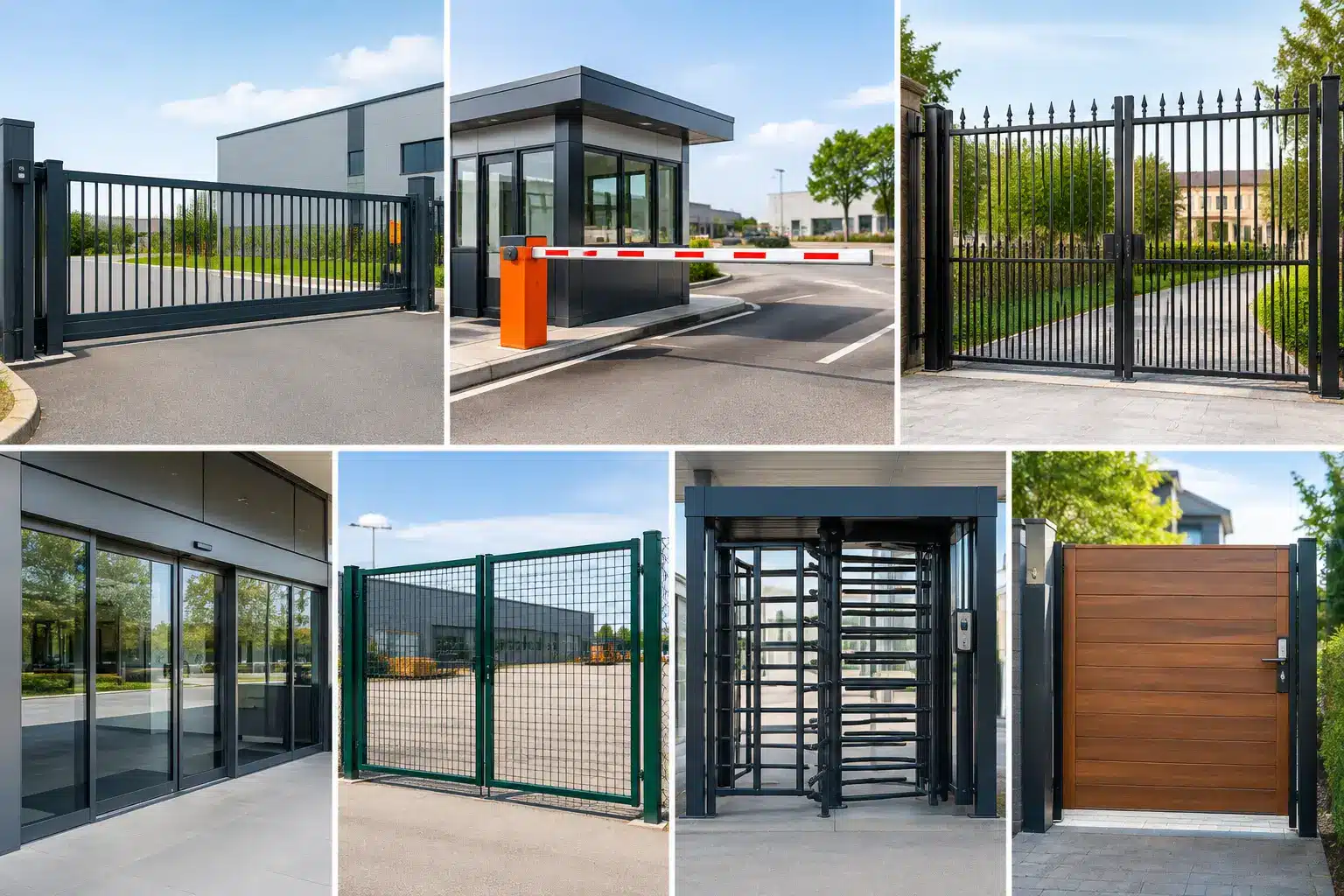
A commercial entrance does more than mark a boundary. It controls who enters, protects people and assets, and sets expectations before a visitor reaches reception. The right commercial entrance gate examples show how security, traffic flow and architectural character can work together rather than compete.
For business parks, schools, distribution yards, flat developments and private estates, a gate should be specified around the site’s real conditions. Vehicle volume, available opening space, pedestrian movements, visibility requirements and access-control needs all affect the best choice. A made-to-measure aluminium system gives you the freedom to address each of them without settling for an off-the-shelf appearance.
1. Sliding gate for a busy business park
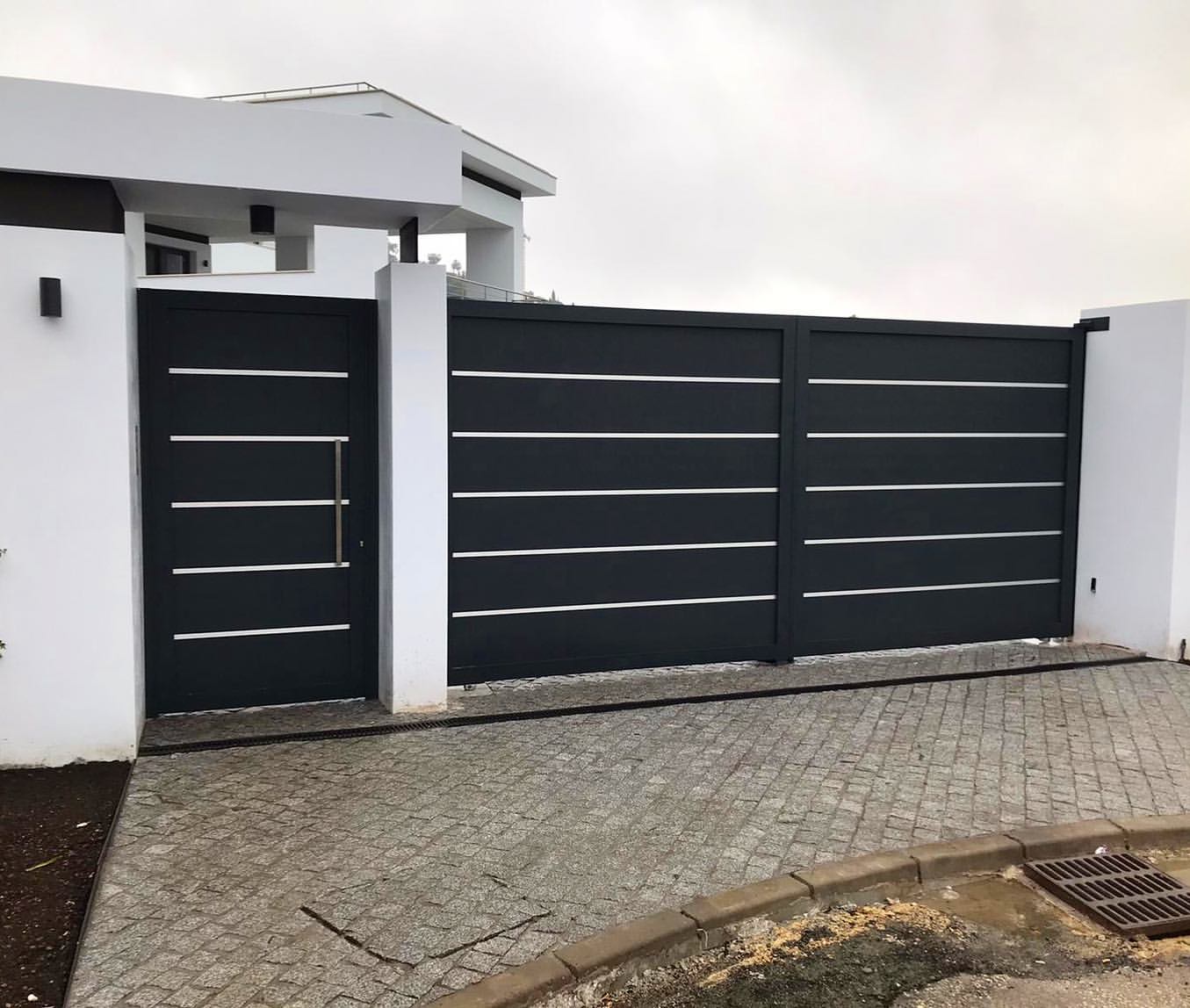
A cantilever sliding gate is often the strongest choice for a business park or managed commercial premises with regular vehicle traffic. The gate travels sideways along the fence line, leaving the driveway clear and avoiding the arc required by a swing gate.
This format suits entrances where vehicles arrive throughout the day, including staff, visitors, service engineers and deliveries. It can be paired with an intercom, keypad, fob access or number-plate recognition, allowing the entrance to operate efficiently without leaving the site exposed.
Aluminium is particularly well suited to larger sliding gates because it delivers substantial visual presence without unnecessary weight. A fully welded frame and precision fabrication help the gate retain its alignment through repeated use, while a premium powder-coated finish keeps maintenance demands low. Horizontal aluminium infill creates a clean, contemporary frontage; slatted designs can also provide privacy while allowing some airflow.
The trade-off is the need for sufficient run-back space beside the opening. Where that space is unavailable, another operating style may be more practical.
2. Automated swing gates for professional premises
For offices, clinics, smaller commercial yards and prestige developments, automated swing gates create a composed, welcoming entrance. A pair of equal leaves can frame a broad driveway beautifully, while an asymmetrical configuration can suit tighter access points or a separate pedestrian route.
Swing gates work best where the driveway is level and there is room inside the boundary for the leaves to open safely. They offer a strong sense of arrival, particularly when matched with aluminium fencing, pedestrian gates and coordinated entrance panels.
A solid-panel design provides more privacy for staff parking or service areas. Open slats, decorative cut-outs or a combination of solid and spaced sections can make the gate feel lighter and improve sightlines. The best design depends on whether the priority is discretion, visibility from the road or a more architectural statement.
For sites with frequent traffic, automation should be specified carefully. Safety edges, photocells and appropriate controls are essential, while a reliable manual-release arrangement is worth considering for power interruptions or maintenance access.
3. Telescopic gates where frontage space is limited
Some commercial sites have a wide entrance but very little room alongside it. A telescopic gate provides an intelligent answer. Instead of one long gate leaf travelling the full width of the opening, two or more leaves slide and stack behind one another.
This makes telescopic systems particularly effective for urban developments, compact depots and sites with buildings or parking bays close to the entrance. They can secure a generous access width without demanding an equally generous return area.
A telescopic gate needs accurate engineering and installation because multiple leaves must move in sequence and close precisely. This is not a place to compromise on fabrication quality. Bespoke aluminium construction allows the frame, infill pattern and finish to be designed around the exact opening, with a consistent visual line once closed.
4. Bi-folding gates for rapid access
Where opening speed matters, bi-folding gates are among the most practical commercial entrance gate examples. Their leaves fold back as they open, reducing the operating footprint and allowing vehicles through quickly. This can be valuable at high-turnover sites such as logistics facilities, vehicle compounds, emergency-service access points and service yards.
The principal benefit is speed, but the visual result can still be refined. Aluminium bi-folding gates can be fabricated with horizontal slats, vertical bars or more enclosed infill to reflect the building’s exterior. A powder-coated colour chosen to complement signage, windows or perimeter fencing brings the full frontage together.
Bi-folding gates involve more moving parts than a conventional sliding gate, so component quality and planned servicing matter. They are an excellent solution when speed and restricted space are genuine priorities, not simply because they look technically impressive.
5. Pedestrian entrance gates with controlled access
A secure vehicle gate is only part of the solution. Staff, residents, contractors and visitors need a clear pedestrian route that does not encourage people to follow vehicles through the main entrance. A coordinated aluminium pedestrian gate creates that separation while maintaining a polished appearance.
At a commercial property, this might be a lockable side gate beside a sliding driveway gate, or a dedicated entrance integrated into fencing and brickwork. An Akuvox intercom can provide video verification and remote release, giving reception staff or property managers greater control over who enters.
The design should make the intended route obvious. Good visibility, sensible handle placement, appropriate lighting and a durable threshold all improve daily use. If the site needs step-free access, gate width and ground conditions must also be considered from the outset.
6. Privacy-led gates for service yards and storage areas
Not every commercial entrance needs to be open to public view. Storage yards, waste-management areas, maintenance compounds and trade premises often benefit from a more enclosed gate design that limits visibility from the street.
Solid aluminium panels or closely spaced slats can screen equipment, vehicles and stock without relying on timber that may warp, fade or require regular treatment. The result is a clean boundary that looks considered from the road and remains dependable through British weather.
Privacy does not have to mean an imposing blank wall. A stepped slat pattern, narrow reveal lines or a contrasting frame colour can add depth without revealing what is behind the gate. Where surveillance is a priority, the level of screening should be balanced against the need for cameras and staff to maintain clear views around the entrance.
7. Estate and multi-occupancy entrances
For flat schemes, private estates and mixed-use developments, the entrance gate has a dual role: it must provide dependable access control while contributing to the value and character of the whole development. This is where a coordinated approach delivers the strongest result.
A sliding or swing gate can be designed alongside matching pedestrian gates, aluminium fencing, letterbox panels and intercom posts. Repeating the same slat width, frame detail and powder-coated finish across the frontage makes a large site feel intentional rather than assembled from separate products.
Because different users have different needs, access control should be planned early. Residents may use fobs, keypads or app-based access; visitors may call through an intercom; service providers may need timed or managed entry. The gate design and control system should support these routines without making day-to-day access difficult.
Choosing the right entrance format
The most successful commercial gate starts with the opening, not a catalogue image. Measure the driveway width, approach angle, ground levels and room available behind or beside the gate. Then consider how many vehicles use the entrance, whether lorries need to turn, who needs pedestrian access and how the site is managed outside normal hours.
Material and construction deserve equal attention. Premium aluminium offers corrosion resistance, low maintenance and a refined finish, but the quality of the frame, welds, hinges, tracks and automation will determine how the system performs over time. A fully welded, made-to-measure gate is built for the opening it will serve, rather than adapted to fit at the last moment.
At Alu-Gate, each commercial entrance can be specified around the property, operational demands and desired visual impact, with a 20-year guarantee providing confidence in the investment. The most effective choice is rarely the biggest or most complex gate. It is the one that makes access feel controlled, secure and effortless every day.