
A driveway entrance can be the most exposed part of a property. If a gate leaves clear views of parked cars, front doors or garden areas, the boundary may feel secure without delivering the privacy you expect. Knowing how to improve gate privacy means looking beyond height alone. The best result combines considered sightlines, a gate design suited to the opening and a finish that enhances the character of the property.
For homeowners, this is often about creating a quieter, more secluded arrival. For commercial sites, it may also mean reducing visibility into yards, loading areas or private parking. In both cases, a made-to-measure aluminium gate gives far more control than an off-the-shelf solution.
Start with the views you want to block
Privacy is not simply a question of choosing a solid gate. Stand outside the property and identify what can be seen through, over and around the entrance. A low point in the drive, an uphill road, neighbouring first-floor windows and gaps between gate leaves can all affect the finished level of screening.
Consider the view from both directions. You may want to obscure the driveway from the pavement while retaining a measured view out when leaving in a vehicle. This is especially relevant at busy junctions, where visibility splays and safe egress need careful consideration. A gate should never compromise the driver’s ability to see approaching pedestrians, cyclists or traffic.
The position of the gate matters too. Gates set back from the highway can create a more controlled arrival space and allow room for a vehicle to wait clear of the road. On a narrow or sloping drive, the opening method may have a greater influence on the design than the screening material itself.
Choose a gate infill that delivers real privacy
The infill is the main visual privacy tool. It determines whether the gate reads as an open boundary, a filtered screen or a solid architectural feature.
Solid aluminium panels for maximum screening
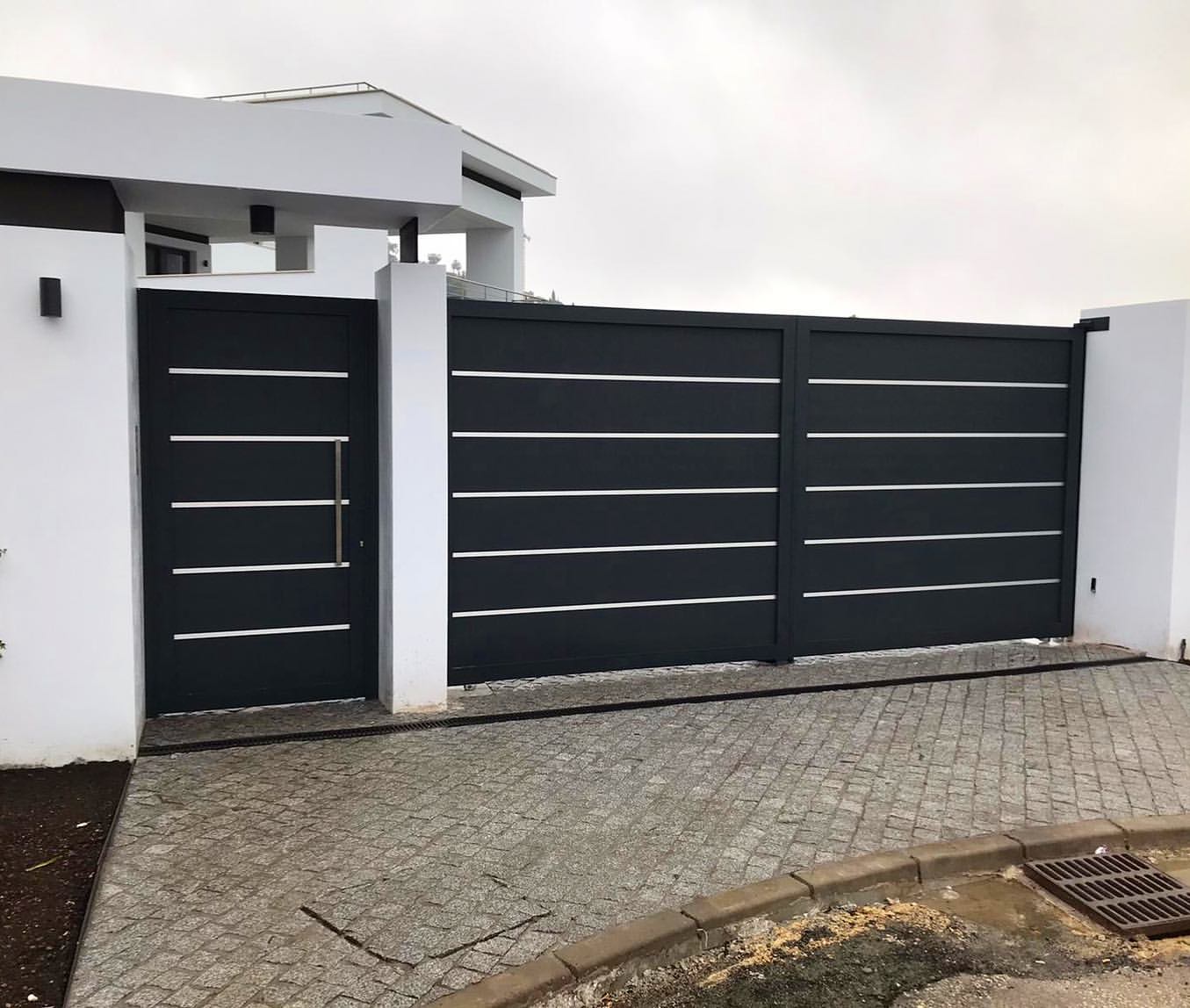
Solid-panel gates offer the most direct answer where privacy is the priority. They conceal the drive and help form a clean, contemporary frontage, particularly when paired with matching aluminium fencing and side panels. The absence of gaps also gives the entrance a calm, substantial appearance.
There is a trade-off. A fully solid surface is more exposed to wind than an open design, so the posts, foundations, hinges and automation specification must be engineered accordingly. This is not a reason to avoid solid gates. It is a reason to choose a system designed as a complete installation rather than treating the gate as an isolated panel.
Close horizontal slats for a softer, modern finish
Horizontal slatted aluminium gates are a popular choice for properties that want privacy without a visually heavy frontage. With narrow, carefully controlled gaps, they filter views at normal standing height while allowing light and air to pass through. They can also make a wide entrance feel more elegant than a single uninterrupted expanse of metal.
The exact spacing is crucial. A gap that appears small in a showroom can be surprisingly transparent from an angle or from a vehicle. Bespoke fabrication allows the slat depth, spacing and overall arrangement to be selected for the property, rather than accepting a standard pattern that may not provide enough cover.
Vertical slats and mixed designs
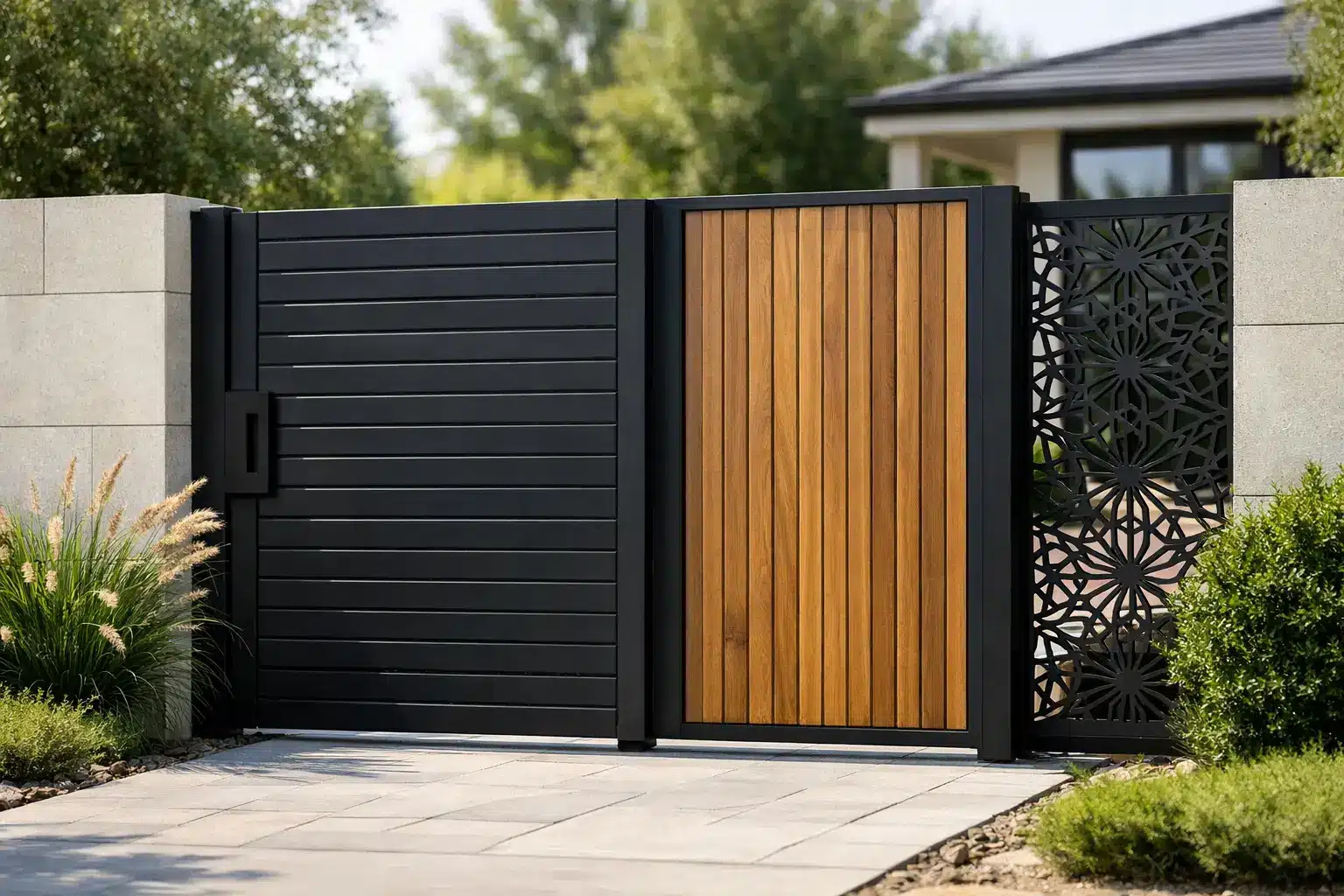
Vertical slats can bring a more formal rhythm to a period home or commercial frontage, while mixed solid-and-slatted layouts offer useful balance. For example, a solid lower section can protect privacy around vehicles, with slatted upper sections reducing wind pressure and keeping the elevation lighter.
This approach is often effective where the gate needs to coordinate with existing brickwork, stone piers or railings. The aim is not to make every boundary element identical. It is to make the entrance look intentionally designed.
Improve gate privacy with the right height and width
A well-designed private gate should screen the area that matters without overpowering the property. For a typical driveway, the required height depends on road level, the distance between the gate and the house, and whether the drive rises or falls behind the entrance. A gate that looks tall on plan may be ineffective if the road is elevated.
Width deserves equal attention. Privacy can be lost through awkward side returns, oversized clearances and mismatched pedestrian access. Coordinated fixed panels can close off these vulnerable areas and create a continuous boundary line. Where a separate pedestrian gate is needed, it should follow the same infill design and height so that it does not become the weak point in the scheme.
Before choosing an unusually tall gate or altered boundary treatment, check whether planning controls apply to your property. Restrictions can vary, particularly beside a highway, in conservation areas or where permitted development rights have been removed. A professional survey and design consultation can identify practical constraints early.
Eliminate the gaps around the gate
Many privacy problems are caused by the details rather than the main gate surface. A large gap beneath the gate can expose a driveway on a slope. Wide clearances at the hinge or meeting edge can create direct sightlines into the property. Uneven ground can make a standard gate appear poorly fitted even when the gate itself is high quality.
Made-to-measure aluminium gates allow these details to be addressed at design stage. Raked or stepped configurations can follow changing levels, while fixed side panels can resolve irregular openings. For swing gates, the centre meeting point and drop bolts should be planned around the actual surface level. For sliding gates, the track or cantilever arrangement must be compatible with the drive finish and available run-back space.
The result is not merely neater. It is more secure, more private and more convincing as a premium entrance.
Match the opening system to the site
The right operating format can protect privacy in ways that are easy to overlook. Swing gates create a strong, traditional arrival and work well where there is sufficient clear space behind the entrance. They are ideal for many residential drives, but inward opening leaves must not interfere with parked vehicles, slopes or pedestrian routes.
Sliding gates are often better for short, sloping or space-restricted driveways. A single sliding leaf can provide a broad, uninterrupted privacy screen and works particularly well with solid-panel designs. Telescopic and bi-folding systems can achieve a similar effect where the run-back space is limited.
Automation also changes how private the entrance feels in daily use. A gate that can be opened from a vehicle or through an intercom avoids the need to leave it open while answering visitors. Access control, such as an Akuvox video intercom, gives residents the opportunity to identify callers before granting entry, adding a practical layer of reassurance alongside physical screening.
Coordinate gates, fencing and landscaping
A private gate can look incomplete if the adjoining boundary remains open. Matching aluminium fencing, infill panels and pedestrian gates create continuity, closing sightlines that would otherwise undermine the main entrance. Aluminium is particularly suited to this approach because the same finish and profile can be carried across different elements without the maintenance demands associated with painted timber.
Landscaping can soften the architecture, but it should support the gate rather than be relied upon as the primary privacy measure. Evergreen planting may take years to establish, requires regular care and can create maintenance issues if it presses against moving leaves or access equipment. A high-quality gate provides immediate screening; planting adds depth, texture and seasonal interest around it.
Colour also affects the result. Dark grey, black and textured finishes can give solid gates a crisp, recessive quality, while warmer tones may complement timber cladding, brick or stone. The most successful choice relates to window frames, doors, metalwork and the wider palette of the property rather than following a passing trend.
Do not sacrifice durability for screening
A privacy gate has to withstand daily use, changing weather and years of exposure while continuing to align correctly. Thin, poorly supported panels can flex, rattle or distort. Timber can weather, split and require repeated treatment. These issues soon affect both appearance and the privacy provided by the gate.
Premium aluminium combines a clean finish with low-maintenance ownership. Fully welded construction is especially valuable on large gates because it creates a strong, precisely fabricated frame rather than relying on multiple mechanical joints. With the correct posts, hardware and installation preparation, the gate is built to hold its shape and perform reliably over time.
At Alu-Gate, bespoke aluminium gate systems are designed around the exact opening, operating requirements and privacy objective, with fully welded construction and a 20-year guarantee. That level of specification matters when the entrance is expected to protect the property and elevate its kerb appeal for the long term.
A private entrance should not feel like a blank barrier. With the right proportion, infill and detailing, it becomes a confident first impression – one that gives you more control over your home or site without asking you to compromise on style.