
A new driveway gate can transform the front of a property, but it will never look fully resolved if the fencing beside it feels like an afterthought. The same applies at the side or rear boundary: understanding how to match gates and fencing means considering the whole approach, not choosing individual products in isolation. When proportion, finish and construction work together, the result is a stronger, more secure boundary that looks designed for the property.
For premium homes and commercial sites alike, coordinated aluminium gates and fencing offer a clean way to achieve that consistency. The key is to make the design decisions in the right order.
Start with the property, not the gate catalogue
The architecture of the building should lead the design. A sharp-edged contemporary home often suits horizontal slats, flat-top panels and a restrained colour palette. A more traditional stone, brick or rendered property may call for vertical lines, framed detailing or a gate design with more visual definition.
Look closely at the elements already visible from the street: brick colour, driveway surfacing, window frames, roofline, external lighting and front door furniture. Gates and fencing should relate to these features rather than compete with them. Anthracite grey aluminium can sit confidently alongside modern black window frames, for example, while a warm textured finish may better complement natural stone or timber-effect cladding.
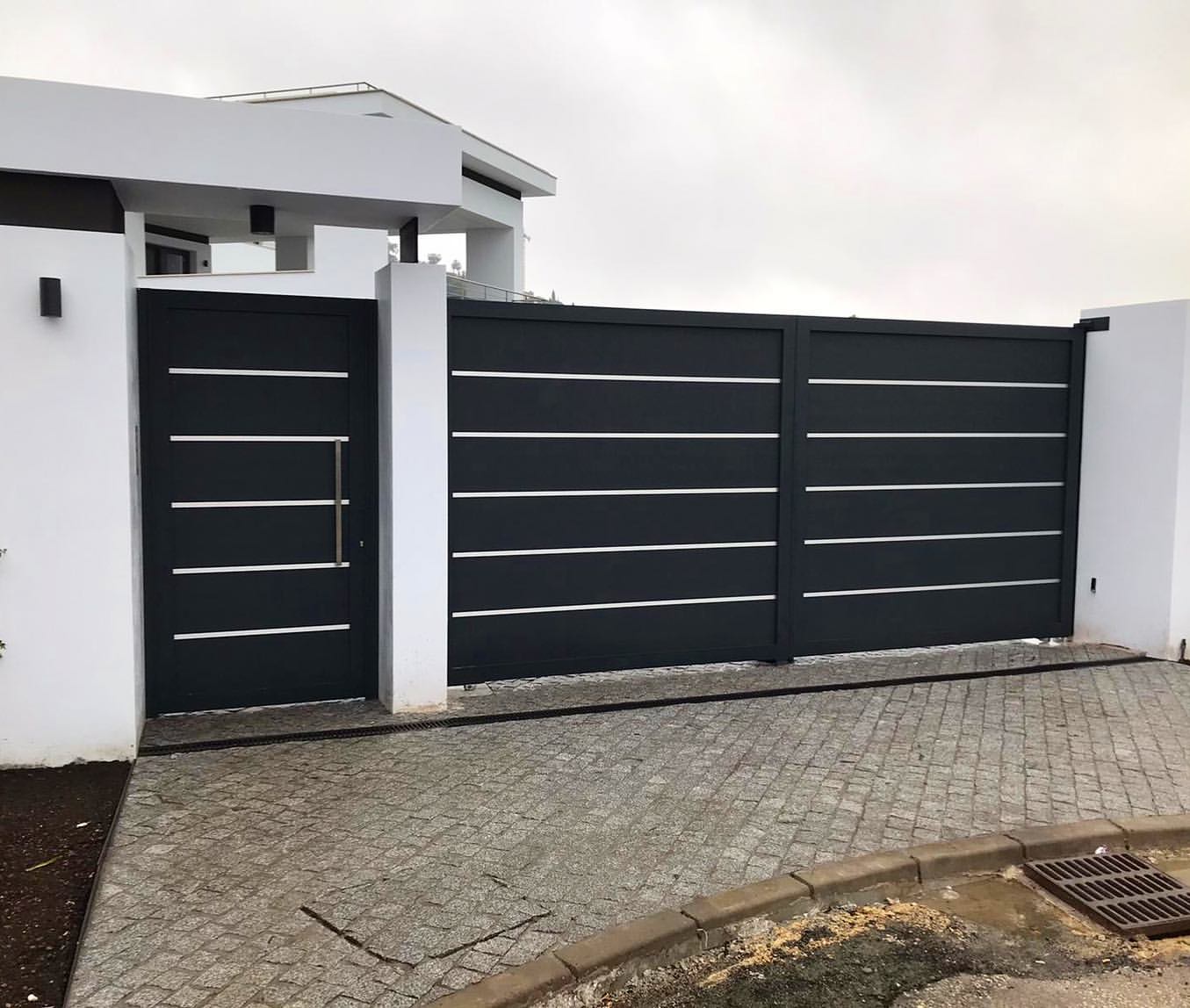
Matching does not mean every surface must be identical. In fact, a boundary can feel flat if every component has the same finish and line pattern. The aim is coordination. A driveway gate and pedestrian gate might share the same aluminium profile and colour, while the fencing uses the same slat style at a lower height to create a lighter boundary.
How to match gates and fencing by style
The most successful schemes repeat a clear visual language. This usually comes down to line direction, spacing, frame treatment and the degree of privacy required.
Repeat the profile and orientation
If the driveway gate uses horizontal aluminium slats, carry that horizontal rhythm into the fencing panels. This makes a wide frontage feel considered and can visually stretch a narrow plot. Vertical slats, by contrast, can give a boundary more height and work well where a formal or traditional appearance is preferred.
Pay attention to slat spacing as well as direction. Closely spaced or fully enclosed profiles create privacy and a more solid architectural statement. Wider gaps allow light and air through, soften the boundary and may be better suited to garden divisions where complete screening is not necessary. Mixing open fencing with a solid gate can work, but it needs a deliberate connection, such as the same frame depth, colour and top line.
Keep the frame language consistent
A fully framed gate beside frameless-looking fencing can appear disjointed unless the difference is intentional. Consider whether posts, perimeter frames and infill sections are meant to be a feature or recede into the design.
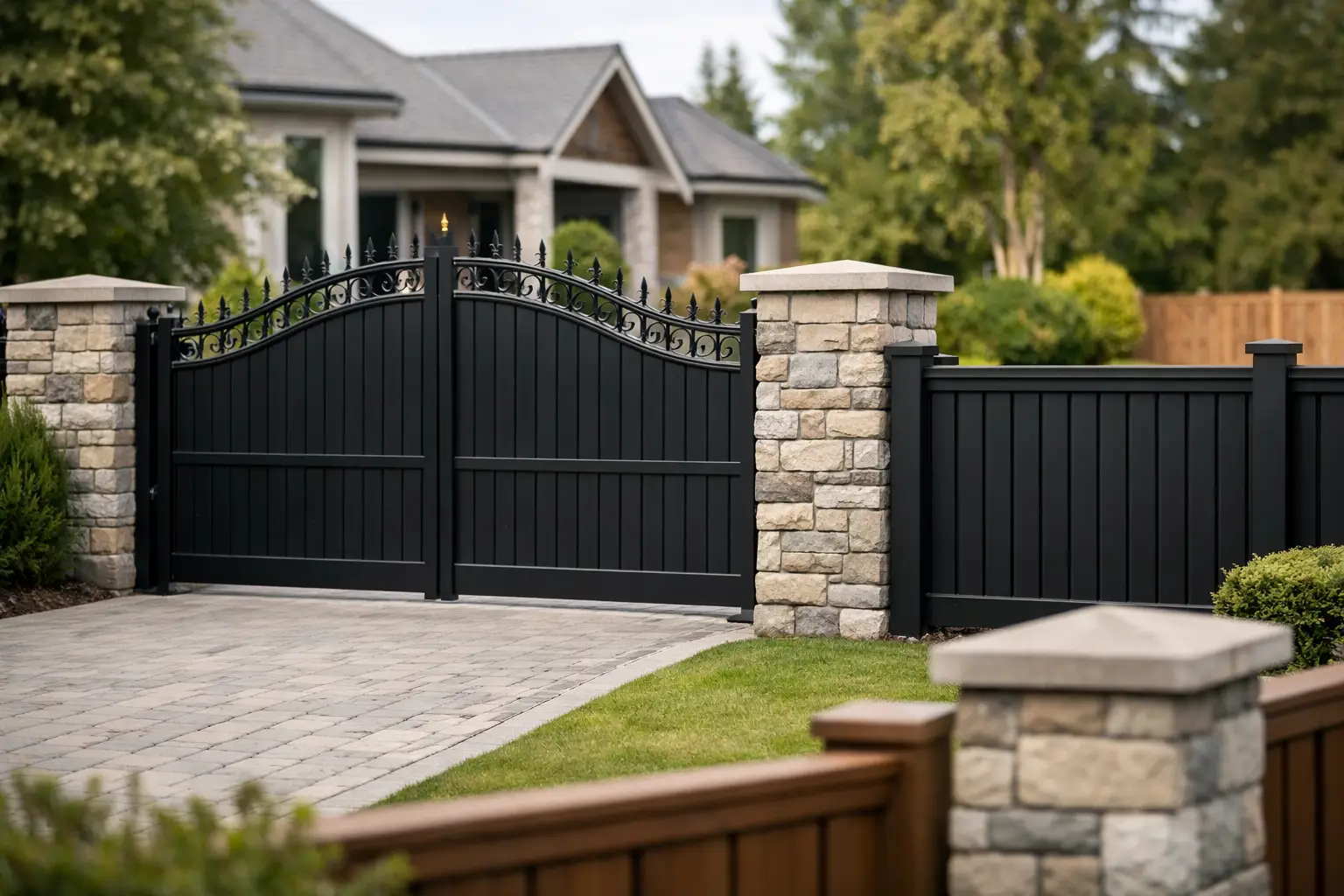
For a crisp contemporary frontage, concealed fixings and clean-edged aluminium panels can create a refined finish. Where the property has more substantial masonry piers, a stronger framed gate may provide the presence needed to balance them. The fence should then carry enough visual weight to avoid looking temporary beside the entrance.
Match the level of detail
Decorative inserts, laser-cut patterns and contrasting trims can make an entrance distinctive, but they should be used with discipline. If a gate has a detailed feature panel, simpler fencing usually provides the best backdrop. If the fencing itself is the design feature, a quieter gate can create a more elegant overall composition.
This is especially relevant on long boundaries. A highly detailed panel repeated many times can become visually busy, while a simpler profile retains its impact across the full run.
Get proportions right before choosing colours
A gate is judged against the width of the entrance, the height of nearby walls and the scale of the house. Fencing must support those proportions.
A tall, imposing driveway gate beside low open fencing can feel defensive rather than premium. Equally, shallow gates next to high solid panels may make the entrance look undersized. Where privacy is a priority, stepped fencing can be an effective solution: retain a welcoming height around the entrance, then increase screening along the side return or garden boundary.
The top line deserves particular attention. Aligning the gate and fence heights produces a formal, continuous appearance. Introducing a deliberate step down from gate to fence can make a large entrance feel less heavy, particularly on a residential street. On sloping ground, raked or stepped panels need careful planning so that gaps beneath the fencing do not undermine security or spoil the finish.
Driveway gates should also suit the space available to operate them. Swing gates need clear room behind the opening, while sliding, telescopic or bi-folding formats are often better where the driveway is short or falls away from the road. This choice affects the visual balance too: a sliding gate can create a strong uninterrupted frontage, whereas swing gates place more emphasis on the central entrance point.
Choose a finish that ties the boundary together
Colour is one of the fastest ways to make gates and fencing look like one system. A single powder-coated finish across gates, panels, posts and associated metalwork creates immediate consistency. Popular dark shades remain a strong choice because they complement most brick, render and paving while giving aluminium profiles definition.
That said, dark is not always best. On a heavily shaded elevation, black or very dark grey fencing can lose detail and make a compact frontage feel enclosed. Lighter greys, muted greens and carefully selected textured finishes can provide contrast without looking conspicuous. The best choice depends on the surrounding materials, natural light and the character of the property.
Finish texture changes the impression as much as colour. A fine textured coating can add depth and reduce the visibility of everyday marks, while a smoother finish has a more minimalist look. Whichever option you select, specify the same finish across the coordinated elements. Slightly different shades of grey are far more noticeable when they sit side by side.
Aluminium is particularly well suited to this approach because it can be powder coated in a wide range of durable colours without the regular staining, painting or treating associated with timber. For a boundary that is exposed to British weather, low-maintenance performance is part of good design, not an optional extra.
Treat posts, pillars and access control as part of the design
The details around the gate often determine whether the installation looks bespoke. Posts should align with panel widths and gate frames, with neat transitions at masonry pillars, retaining walls and changes in level. Avoid forcing standard-sized panels into an irregular boundary if it creates narrow, awkward sections at either end. Made-to-measure fabrication gives the design room to look intentional.
Consider access control early. An intercom, keypad, post box, house number, lighting and pedestrian gate latch should not be added once the main installation is complete. A purpose-designed entrance post can house these elements cleanly, keeping cabling protected and avoiding surface-mounted boxes that interrupt the fence line.
For commercial premises, this planning is even more valuable. Vehicle access, visitor entry, delivery requirements and emergency egress may all need to work within one perimeter system. A coordinated gate and fence specification can provide a professional first impression while meeting the site’s practical security needs.
Balance privacy, security and kerb appeal
The right boundary is rarely the most closed-off one. Full-height solid panels offer excellent privacy, but they can reduce natural surveillance and make a front garden feel unwelcoming. Semi-open aluminium slats can maintain a clear boundary while allowing views out and daylight in.
Think about where privacy is genuinely needed. Many properties benefit from a more open driveway frontage, with taller screening positioned beside seating areas, bins, side passages or neighbouring windows. The gate can still be secure, particularly when combined with reliable automation, controlled access and strong welded construction.
Security also depends on the small decisions. Avoid horizontal profiles that create obvious footholds where climbing is a concern. Ensure pedestrian gates have appropriate locking, hinges and closing arrangements. Specify fencing heights that suit the boundary purpose, and check local planning requirements before finalising a design, particularly near a highway or where the property is listed or in a conservation area.
Specify one system, then refine it for each boundary
A coordinated scheme does not require every panel to perform the same job. Your driveway gate may need automation and full privacy; the side gate may need practical everyday access; garden fencing may need to let light through. What matters is that the components share a common design family.
This is where a consultation-led approach pays off. Accurate site dimensions, ground levels, pillar positions, opening clearances and desired access arrangements should be considered before fabrication. At Alu-Gate, bespoke aluminium gates and fencing can be designed as a connected system, with precision-welded construction, tailored finishes and the confidence of a 20-year guarantee.
Choose the boundary you want people to experience before selecting individual panels. When the gate, fencing and entrance details are designed together, the property feels more secure, more valuable and unmistakably complete.