
A commercial entrance has to perform under pressure. It may control vehicle movements at the start of a busy shift, protect stock and equipment after hours, welcome visitors, and present the right image to clients in the same working day. Secure commercial entrances should do more than close off a boundary. They should give the site owner control, stand up to regular use and look appropriate for the business behind them.
For warehouses, offices, schools, private estates, industrial yards and multi-unit developments, the right entrance system starts with an honest assessment of how the site operates. A gate that is strong but slows delivery traffic creates a daily frustration. An attractive entrance without properly considered access control can leave a weak point in the perimeter. The best specification balances security, flow, durability and design from the outset.
What secure commercial entrances need to achieve
Commercial sites rarely have one type of user. Staff may need fast access at peak times, authorised vehicles may arrive throughout the day, and visitors may need to wait safely until they are verified. At the same time, the entrance must discourage unauthorised access without making the property feel unwelcoming or overly fortified.
This is why a gate should be considered as part of a wider entrance solution, rather than as an isolated product. The gate format, opening direction, infill style, fencing, posts, controls and safety equipment all need to work together. A made-to-measure system can account for the width of the opening, gradient, turning space, vehicle types and the level of privacy or visibility required.
Aluminium is particularly well suited to this role. It offers a premium, clean-lined finish without the ongoing maintenance associated with timber or the risk of corrosion that can affect poorly protected steel. Quality aluminium gates are designed for year-round exposure to British weather, with powder-coated finishes that retain their appearance with minimal upkeep.
Security is more than a locked gate
A lock alone does not make an entrance secure. The physical construction of the gate matters first. Fully welded aluminium frames provide a strong, consistent structure without relying on visible fixings that can loosen over time. The gate should feel solid in operation, sit accurately within its opening and be supported by posts, hinges, tracks or guide systems specified for its size and weight.
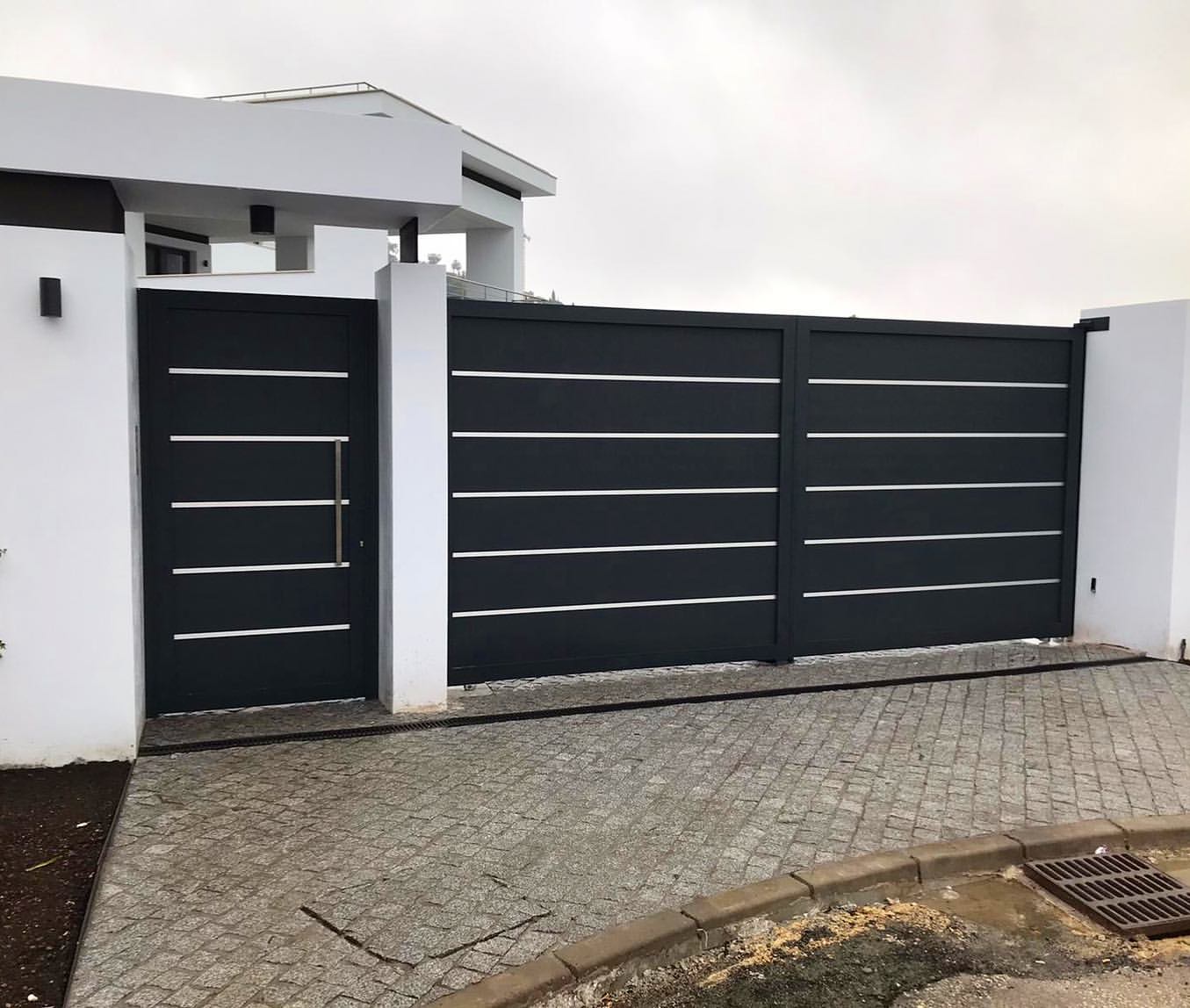
The design of the infill also plays a practical part. Closely spaced horizontal slats, solid panels or louvred designs can limit opportunities to climb through or gain a clear view of valuable assets. Where a site benefits from natural surveillance, more open designs may be the better choice. There is no universal answer: a customer-facing business may want a welcoming visual connection to the street, while a storage yard may prioritise privacy.
Perimeter fencing should be coordinated with the gate rather than treated as an afterthought. Mismatched heights, weak side returns or poorly planned pedestrian access can undermine an otherwise secure installation. A continuous, considered boundary gives the entrance greater presence and closes the obvious gaps that opportunistic intruders look for.
Choosing the right commercial gate format
The best gate type depends on the available space and the way vehicles move through the site. A consultation should establish not only the clear opening width, but also how much room exists behind and beside the gate, whether the ground is level, and whether large vehicles need to enter or exit regularly.
Sliding gates for busy or restricted sites
Sliding gates are often a strong choice where a wide opening is required and there is insufficient space for leaves to swing into the site. They move laterally along the boundary, making them practical for commercial yards, business parks and industrial premises. A cantilever sliding gate can be especially useful where a ground track would be unsuitable because of uneven surfaces, loose debris or frequent vehicle traffic.
The trade-off is the space needed along the fence line for the gate to travel when open. This must be planned carefully. A sliding gate also needs a correctly specified motor and safety system, particularly where it will operate frequently throughout the day.
Swing gates for a formal arrival point
Swing gates create a more traditional, architectural entrance and can suit offices, private commercial premises, hotels and managed developments. They are available as single or double-leaf systems and can be designed to complement the building exterior, signage and surrounding fencing.
They do, however, require clear space for the leaves to open. On sloping ground or sites close to a public highway, this can affect the specification. Inward opening is commonly preferred so that gate leaves do not obstruct a pavement or road, but every layout should be assessed individually.
Bi-folding and telescopic gates where speed matters
For high-traffic locations with restricted run-back space, bi-folding or telescopic gates offer a practical alternative. Their opening action allows them to clear the entrance faster than many conventional systems, helping to reduce waiting times and keep traffic moving. They are particularly worth considering for sites with tight internal roads, loading areas or controlled vehicle access points.
These systems contain more moving parts than a simple swing gate, so build quality, professional specification and a maintenance plan are essential. The right solution is not always the simplest looking one. It is the one that performs reliably for the site’s daily demands.
Access control should match the risk and routine
An automated gate becomes significantly more useful when access is simple for authorised people and difficult for everyone else. The level of control should reflect the site’s risk profile, staffing arrangements and visitor volumes.
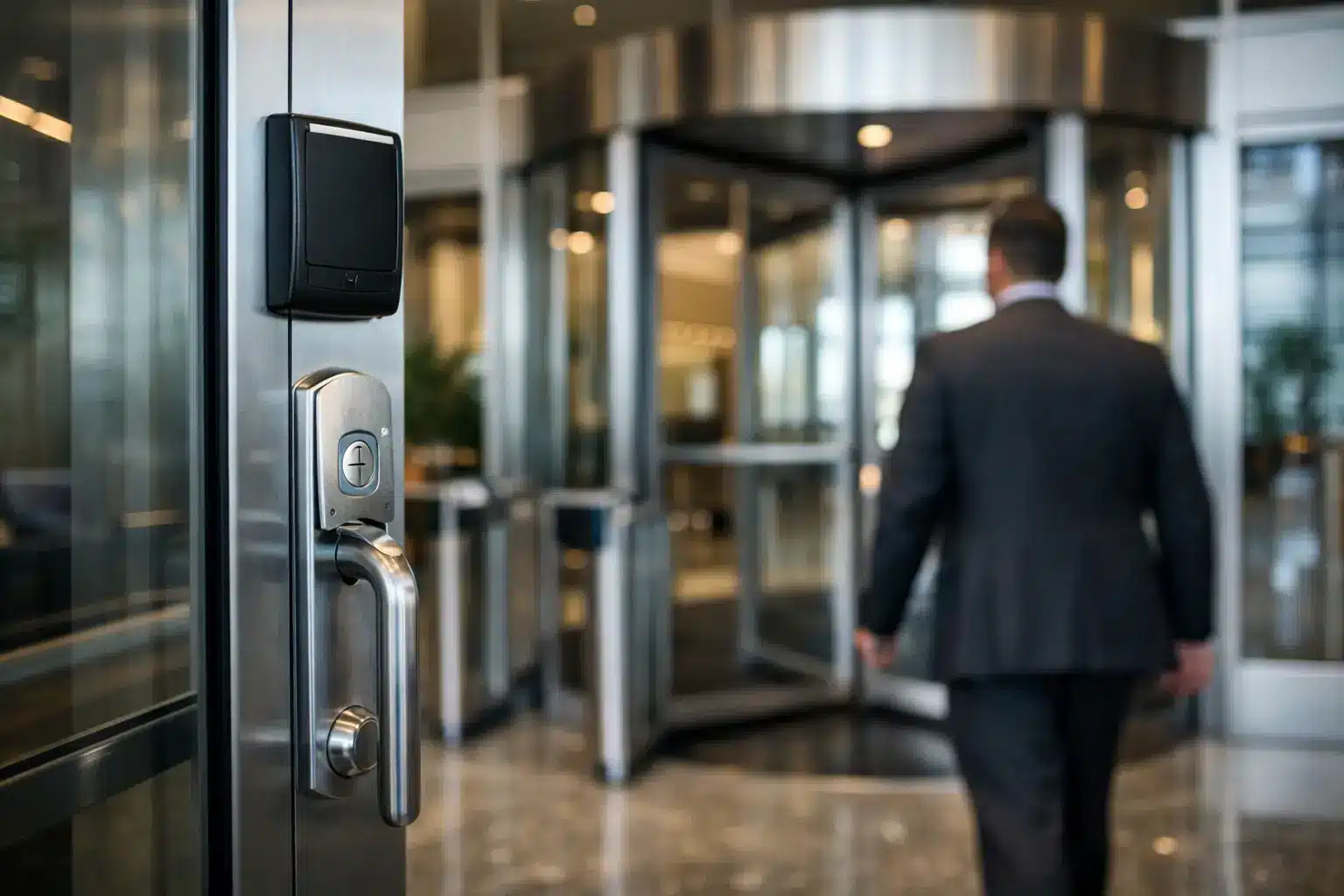
For a small commercial premises, a keypad, key fob or remote system may be sufficient. For sites receiving regular visitors, deliveries or contractors, an audio and video intercom provides greater confidence. An Akuvox intercom, for example, can allow authorised staff to identify a caller before releasing the gate, helping to keep control at the entrance rather than relying on an unlocked reception area.
Access control should also be convenient. If employees repeatedly have to leave vehicles to operate a gate manually, the system is likely to be bypassed or left open at busy times. Timed opening schedules, managed credentials and appropriately placed call points can make security easier to maintain in practice.
Safety must be built into any powered installation. Features such as photocells, safety edges, warning devices and emergency release arrangements should be selected and positioned according to the site layout. This is particularly important where pedestrians, cyclists, visitors and delivery vehicles share an entrance.
Design still matters at the boundary
Security-led does not need to mean utilitarian. The entrance is often the first physical contact a customer, tenant or visitor has with a business. A poorly finished gate can make even a well-maintained site feel neglected. A precisely fabricated aluminium entrance, in contrast, signals order, investment and attention to detail.
Powder-coated aluminium gives commercial buyers considerable flexibility in colour and finish. A dark contemporary tone can create a crisp, professional boundary, while a colour selected to complement cladding, window frames or signage helps the whole site feel deliberate. Slatted, louvred and solid-panel styles can be tailored to achieve a more open, private or distinctive appearance.
The practical advantage is longevity. Unlike painted timber, aluminium does not require frequent sanding, staining or repainting. Regular washing and occasional checks of moving components are generally all that is needed to maintain a quality finish. Over the life of a commercial property, this lower maintenance requirement can make a premium entrance a more sensible investment than a cheaper system that soon needs attention.
Specify for the years ahead, not just opening day
A commercial entrance is exposed to repeated cycles, weather, vehicle activity and daily contact. It should be selected with future use in mind. If a site expects more deliveries, greater staff numbers or a change in operating hours, allow for that now. Upgrading an undersized gate or underpowered automation later is more disruptive and costly than specifying correctly at the beginning.
Ask clear questions during the design stage: how many opening cycles are expected each day, what is the widest vehicle using the entrance, where will visitors stop, and what happens if power is interrupted? These details turn an attractive gate into a reliable working asset.
At Alu-Gate, bespoke aluminium gates and coordinated entrance solutions are fabricated around the precise requirements of the property, with fully welded construction and a 20-year guarantee for lasting reassurance. That level of tailoring matters when an entrance has to look exceptional and operate without compromise.
A well-planned commercial entrance gives people a clear message before they reach the building: this site is managed, protected and built for the long term. Start with the way your property works, then choose a gate system designed to keep pace with it.