
A side entrance is often the least considered part of a property boundary, yet it is the point used most often by visitors, deliveries, staff and family. A pedestrian gate with intercom turns that everyday access point into a controlled, considered entrance – improving security without making the property feel closed off or unwelcoming.
For a premium home or commercial site, the best result is not simply a gate with a call button attached. It is a made-to-measure entrance system where the gate, posts, latch, intercom, cabling and finish are specified to work together. Done properly, it should look as though it has always belonged to the property while giving you clear control over who enters.
Why specify a pedestrian gate with intercom?
A pedestrian gate defines the experience of arriving at a property. Without controlled access, anyone can reach a side path, garden, rear entrance or commercial yard before they have been challenged. An intercom moves that decision back to the boundary, allowing residents, reception teams or site managers to identify a visitor before releasing the gate.
The practical benefits are immediate. You can speak to callers without walking to the entrance, release access remotely where the system allows, and provide a clearer route for legitimate visitors. For homes, this is particularly valuable where the front door sits some distance from the gate. For offices, flat developments, schools and managed sites, it supports a more organised approach to daily foot traffic.
There is also a visual benefit. A high-quality aluminium gate and coordinated intercom panel create a clear threshold between public and private space. The entrance feels purposeful, secure and well finished rather than improvised.
Start with the way people will use the entrance
The right specification begins with usage, not a catalogue image. Consider who will use the gate, how often they will arrive, and whether access needs to be granted from inside the building, from a mobile device or from a staffed reception point.
A family home may need a simple video intercom with indoor monitoring and app-based call handling. This gives homeowners visibility when they are upstairs, in the garden or away from the property. A commercial entrance may require multiple internal handsets, timed access permissions, key fobs or keypad entry for staff and contractors.
It also matters whether the gate will be the primary pedestrian route or a secondary access point beside driveway gates. A heavily used route needs hardware chosen for frequent operation, a sensible opening direction and enough clear width for buggies, wheelchairs, bins or deliveries where relevant. A narrow gate may look neat on a drawing but become frustrating every day.
Video, audio and smart access options
Audio intercoms remain a dependable choice where the goal is straightforward visitor communication. They are discreet, familiar and often suitable for lower-risk entrances where a visual check is unnecessary.
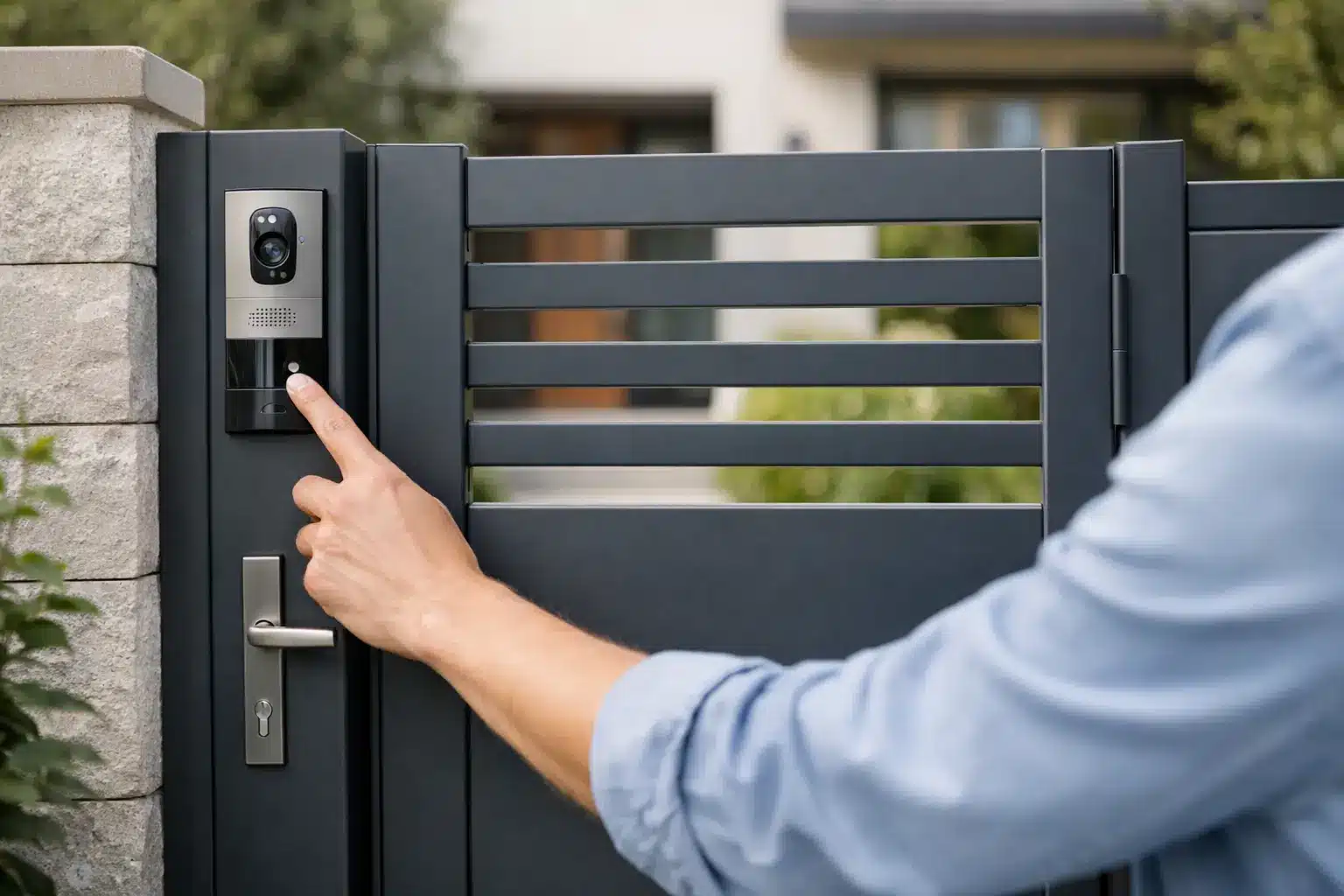
Video intercoms offer greater reassurance. A live image lets you see who is at the gate before opening it, which is useful when couriers, tradespeople and unfamiliar callers use the entrance regularly. Premium systems can offer wide-angle cameras, night visibility, mobile app notifications and call forwarding, depending on the model and site connectivity.
For greater flexibility, access control can be combined with a keypad, proximity fob reader or coded entry. This allows trusted users to enter without calling, while visitors still use the intercom. The trade-off is administration: codes need managing, fobs can be lost and any shared credential should be changed when circumstances change. Convenience works best when it is supported by clear access rules.
Choose a gate built for the hardware it carries
Intercom equipment is only as reliable as the gate system around it. A poorly aligned gate, a weak post or exposed cabling can undermine an otherwise excellent access-control system. This is why the gate structure and intercom location should be planned together from the outset.
Fully welded aluminium construction provides a strong, stable framework for a pedestrian entrance. Unlike timber, aluminium will not absorb moisture, swell or require regular repainting. Unlike many lighter assembled systems, a precision-welded gate is designed to retain its shape and clean lines over years of daily use.
The intercom is usually fitted either into a dedicated gate post or a purpose-made panel. Positioning is critical. It must be easy for visitors to find and use, but not so exposed that rain, glare or passing traffic affects visibility and operation. The camera height should suit the expected users, while the call button, speaker and reader must remain accessible.
Cabling should be protected within the posts or underground route wherever possible. This produces a cleaner finish and helps safeguard the installation against weather, accidental damage and tampering. Retrofitting an intercom to an existing gate can be possible, but it often involves compromises around cable routes, mounting positions and power supply.
Match security with the right locking method
The gate lock is where physical security and day-to-day convenience meet. A manual key lock may suit a rarely used garden entrance, but it does not deliver controlled remote release. For an intercom-controlled entrance, an electric strike or magnetic locking arrangement is commonly considered, subject to the gate design, access requirements and the installation environment.
An electric strike can provide a familiar latch-and-handle experience, allowing the gate to remain securely closed until authorised release. Magnetic locks can be effective in particular applications, although they need careful specification for safety, power continuity and egress. The correct choice depends on whether the entrance is residential or commercial, how the gate opens, and whether people need to leave freely from the inside.
Do not overlook exit arrangements. A gate that is secure from the street should still be simple and safe to leave from within the property. This may mean a handle, push-to-exit button, free egress mechanism or another solution appropriate to the site. On commercial premises, fire safety and building requirements may influence the specification, so professional advice is essential before finalising the system.
Design the entrance as one composition
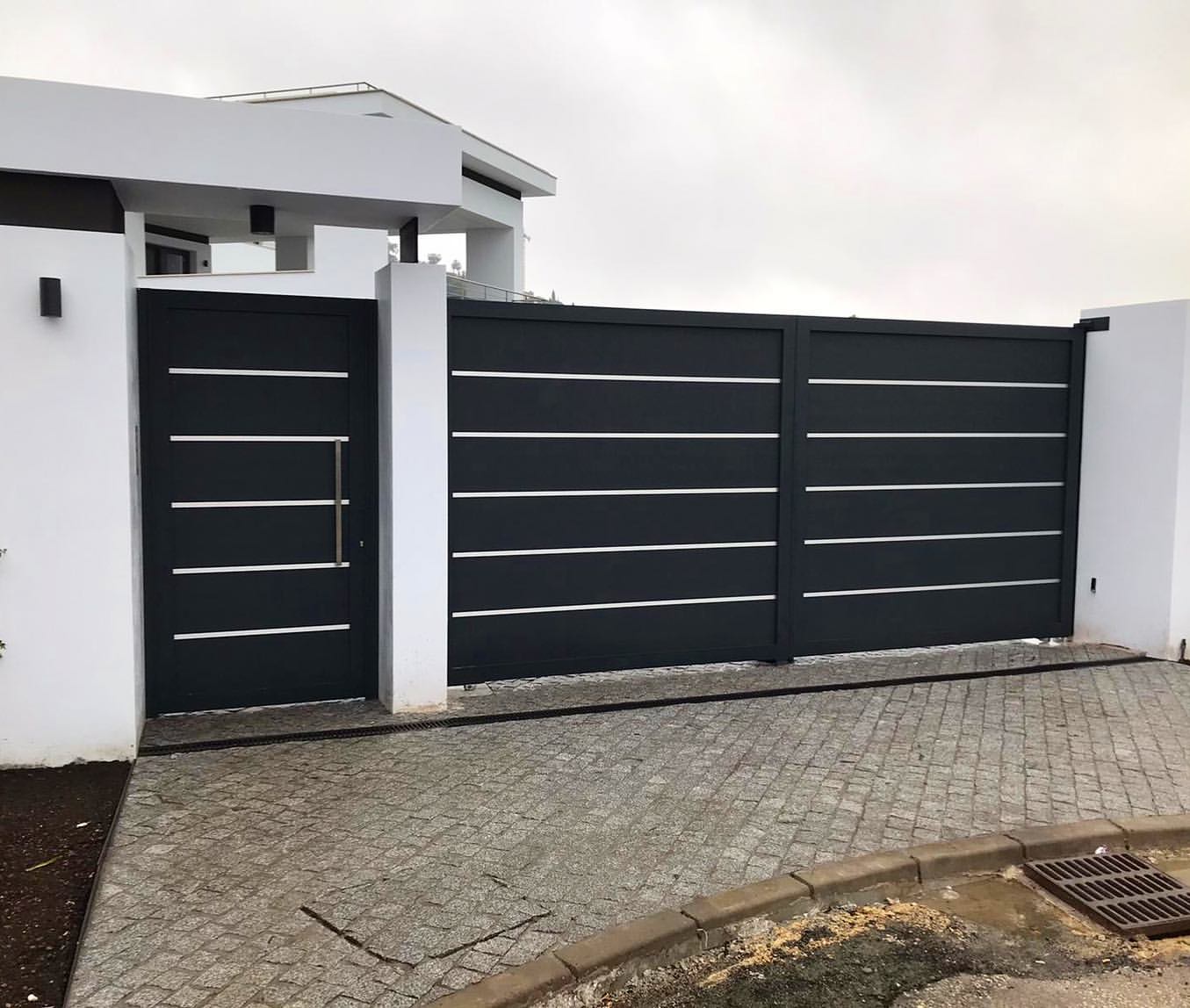
A pedestrian gate does not need to be purely functional. It can carry the same design language as driveway gates, fencing, screens and cladding details, giving the boundary a more considered architectural finish.
Horizontal slats can create a contemporary, linear appearance. Vertical profiles can make a narrow entrance feel taller, while solid or closely spaced designs provide greater privacy. Laser-cut details, house numbers and integrated letterboxes may also be possible where the layout allows. The aim is to achieve the level of screening and security you need without making the entrance feel heavy.
Powder-coated aluminium offers a wide choice of durable colours and finishes. Black, anthracite grey and bespoke tones can be selected to complement window frames, brickwork, render or existing metalwork. A coordinated intercom panel keeps the technology visually quiet, allowing the gate design to remain the focal point.
For many properties, the strongest choice is a pedestrian gate that mirrors the driveway gate rather than competing with it. Consistent spacing, frame proportions and colour create a unified frontage that improves kerb appeal from the first glance.
Plan power, connectivity and long-term use
A high-performing intercom relies on suitable power and communication provision. Wired systems can offer dependable operation and are particularly suited to new builds, major renovations and sites where trenches can be planned before landscaping is complete. Wireless or network-connected options can reduce disruption in some retrofit projects, but signal strength, Wi-Fi coverage and device placement need to be assessed honestly.
It is worth thinking beyond installation day. If mobile access is important, ensure the property has reliable connectivity at the gate location. If the entrance is exposed to heavy rain, coastal air or frequent use, choose equipment rated for the conditions rather than selecting on appearance alone. A premium gate deserves access-control hardware with comparable longevity.
Maintenance should be straightforward, but not ignored. Keep the latch area clear, check hinges and closing action periodically, and ensure the intercom camera and speaker grille remain clean. Aluminium’s low-maintenance qualities remove the cycle of sanding, staining and repainting associated with timber, leaving more time to enjoy the entrance rather than maintain it.
A tailored entrance delivers more than access
At Alu-Gate, every made-to-measure pedestrian entrance can be designed around the property, the desired level of privacy and the way access needs to work. From fully welded aluminium fabrication and premium powder-coated finishes to compatible Akuvox intercom options, each detail can be considered as part of one complete system.
The most successful entrance is not necessarily the most complex. It is the one that lets the right people in easily, keeps unwanted callers at the boundary and continues to look exceptional after years of use. Start with the route people take to your door, then specify a gate and intercom system worthy of the property behind it.