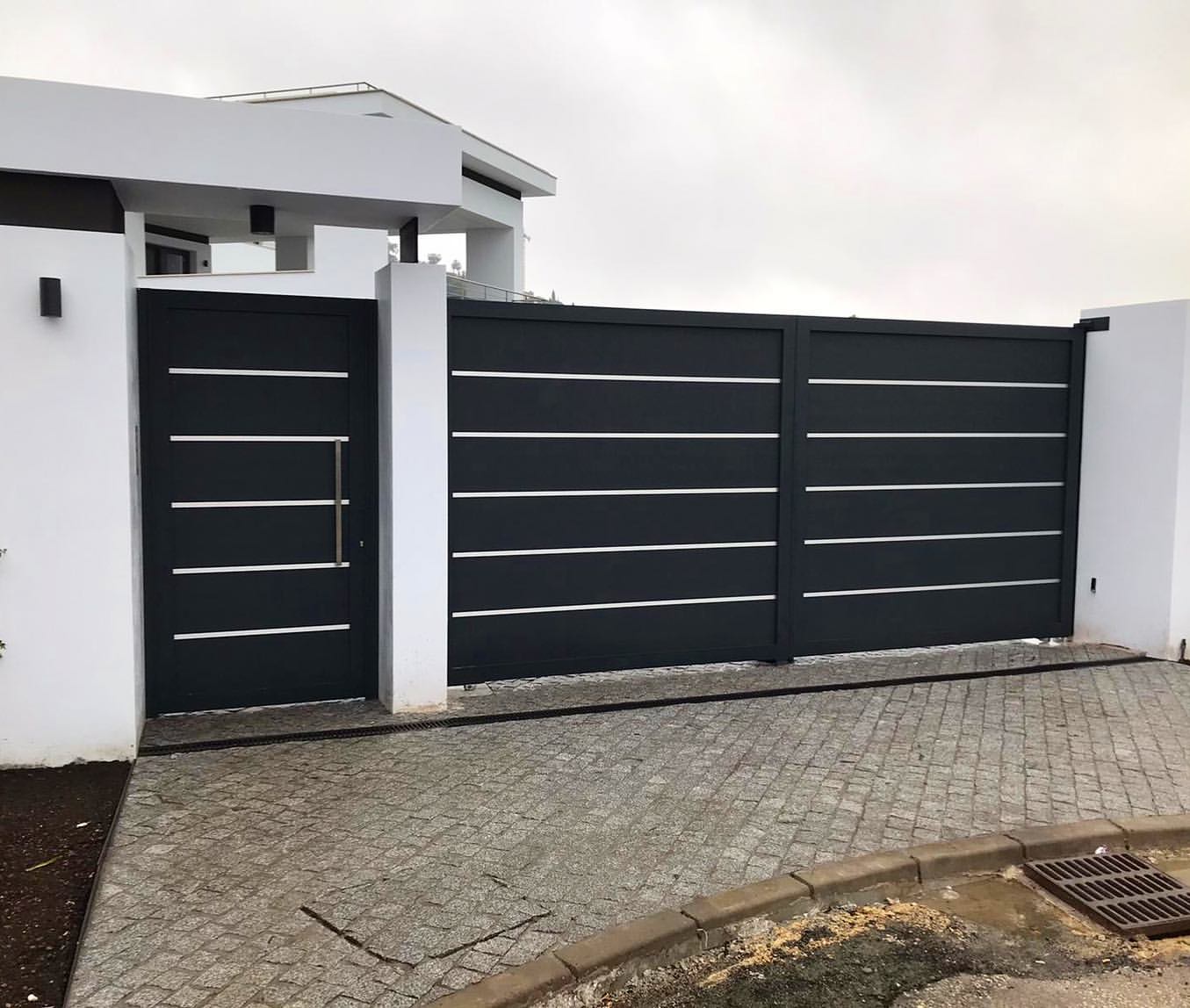

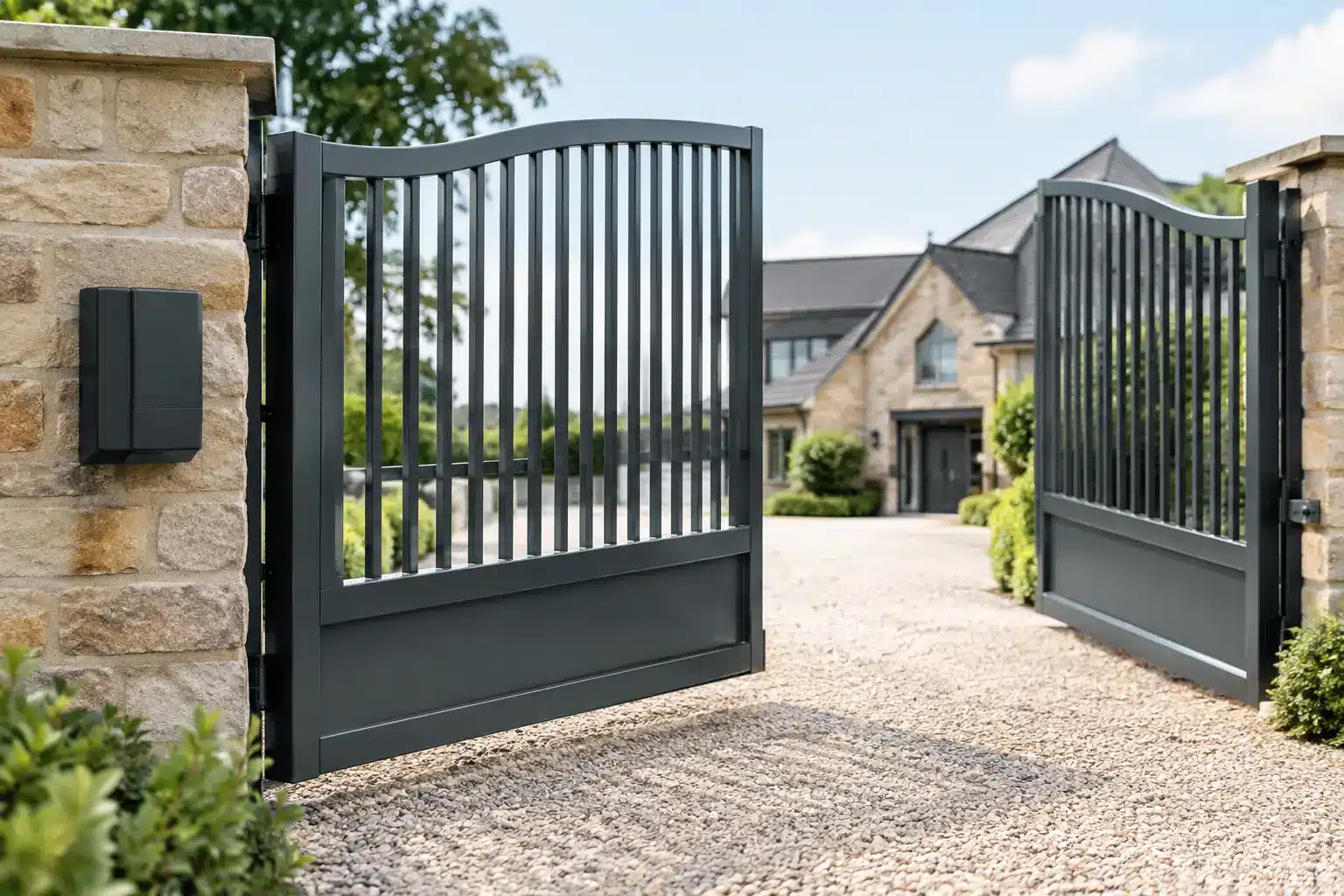
A powered driveway gate should feel effortless to use, not uncertain to approach. This electric gate safety guide sets out what UK homeowners, developers and commercial site managers should expect from a properly specified automated entrance – from the first design conversation to routine servicing years later.
A premium gate system combines security, kerb appeal and convenient access. Yet automation introduces moving forces, pinch points and control systems that must be carefully managed. The right gate is not simply attractive and strong. It is designed, installed and maintained to operate safely around people, vehicles, pets and deliveries.
Why electric gate safety begins before installation
The safest solution is rarely chosen from a standard size chart. Gate layout, opening direction, gradient, traffic levels and how people enter the property all affect the specification. A sliding gate may be ideal where a driveway slopes towards the road, while a swing gate can create a more traditional entrance on level ground. Each format presents different risks that need to be assessed.
For example, a swing gate needs a clear opening arc and protection around hinge-side crushing zones. A sliding gate needs appropriate guarding around the leading edge, rear run-back area and any gap between the gate and adjacent fencing. Bi-folding and telescopic designs offer speed and space efficiency, but their multiple moving sections require equally considered safety measures.
A professional site survey identifies these issues before fabrication begins. It should consider who will use the entrance, whether pedestrians are likely to pass through the vehicle opening, where visitors stop, how refuse collections or deliveries are handled, and whether children may be nearby. A separate pedestrian gate is often the best way to prevent people from walking through an automated vehicle entrance.
The core safety features of an automated gate
No single device makes an electric gate safe. Protection comes from a considered system of physical design, sensors, controls and commissioning. The precise combination depends on the gate type and risk assessment, but several elements are common across well-specified installations.
Safety edges and obstruction detection
Pressure-sensitive safety edges can detect contact at key points, such as a closing edge, opening edge or hinge area. When activated, they signal the operator to stop and reverse the gate. They are particularly valuable where physical gaps or moving sections could create a trapping hazard.
Modern operators may also include force limitation and obstacle detection. These functions can help a gate respond when it meets resistance, but they should not be treated as a substitute for correctly positioned protective devices. The gate’s weight, speed, geometry and likely use all determine what is required.
Photocells and monitored detection zones
Photocells create an invisible beam across the entrance. If a person, vehicle or object interrupts that beam while the gate is moving, the system can stop or prevent the gate from closing. On wider entrances, multiple beams or additional detection methods may be needed to protect the full travel area.
Correct placement matters as much as the product itself. Photocells positioned too high may miss a low object. Those installed where parked vehicles, planting or site features interfere with the beam can produce unreliable operation. A detailed installation plan avoids both blind spots and unnecessary nuisance stops.
Manual release and safe controls
Every electrically operated gate needs a reliable manual release so it can be opened during a power failure or equipment fault. Property owners and authorised users should know where the release is located and how to use it safely. It should be accessible when needed, while protected from casual tampering.
Controls also need thoughtful placement. Keypads, intercoms and access readers should allow drivers to operate the gate without standing in its movement path. A quality video intercom, such as an Akuvox system, can help occupants identify visitors and manage access without approaching the entrance unnecessarily.
Gate design has a direct effect on safety
A made-to-measure gate allows safety to be built into the design rather than added as an afterthought. This is particularly relevant for aluminium gates, where the style, infill spacing, frame construction and surrounding panels can be coordinated around the needs of the entrance.
Gaps between gate leaves, posts, fencing and walls must be considered carefully. A visually clean detail can still create a risk if fingers, hands or clothing could become trapped as the gate moves. Protective guards, appropriate spacing and strategically placed safety edges help manage these areas without compromising the finished appearance.
Structural strength matters too. Gates that flex, sag or move unpredictably place greater strain on automation equipment and may affect sensor alignment over time. Fully welded aluminium construction provides a stable foundation for reliable movement, while its resistance to corrosion supports long-term performance in the British climate. Good safety and good craftsmanship are closely connected.
The finish should not be overlooked. Powder-coated aluminium needs far less routine attention than painted timber or untreated steel, but it still benefits from periodic cleaning and inspection. Keeping tracks, hinges and sensor areas free of accumulated debris supports reliable operation as well as a refined appearance.
Electric gate safety guide: installation and commissioning
Even the best gate and automation equipment can become unsafe if installed poorly. Foundations, posts, track alignment, hinge geometry, cable protection and operator mounting all need precision. The gate should move smoothly before the motor is asked to automate it. Automation cannot correct a badly aligned gate.
At commissioning, the installer should test the complete safety system in real operating conditions. This includes opening and closing cycles, detection devices, safety edges, manual release, control points and emergency behaviour. The system should be adjusted so that it responds consistently, not simply works once on the day.
Powered gates in the UK must meet applicable safety requirements. The responsible installer should assess hazards, supply the relevant documentation and explain how the system is intended to be used. For commercial premises, it is especially important to establish who is responsible for ongoing checks and maintenance, rather than assuming this will happen automatically.
Owners should receive clear handover information, including operating instructions, manual release guidance and a record of the installed safety components. Keep this information with other property documents. It is useful for future servicing, changes of ownership and any upgrades to access control.
Routine checks that protect your investment
An automated gate is a mechanical and electrical system exposed to weather, traffic and daily use. Regular servicing protects its appearance and lifespan, but more importantly, it helps identify safety issues before they become serious.
Between professional visits, owners can make simple visual checks. Look for loose fixings, damaged cables, bent safety edges, debris in a sliding gate track, unusual noises or changes in travel speed. Test that photocells respond as expected, following the installer’s instructions, and never bypass a safety device because it appears inconvenient.
Arrange professional maintenance at intervals suited to the gate’s use. A quiet residential entrance may have different needs from a busy commercial site with frequent vehicle movements. During a service, a competent engineer can check mechanical wear, alignment, safety-device operation, electrical connections, settings and the overall condition of the gate structure.
Do not continue using the automation if the gate behaves unpredictably, fails to stop when expected, has suffered an impact or shows obvious damage. Isolate it where safe to do so, use the manual release only if you have been shown how, and arrange inspection. A gate that still opens is not necessarily a gate that remains safe.
Upgrading an older electric gate
Older automated gates deserve particular attention. Safety expectations, equipment options and installation standards have developed significantly over time. Gates fitted years ago may lack modern safety edges, adequate photocells, guarding or properly documented commissioning.
An upgrade does not always mean replacing the complete entrance. In some cases, a structurally sound gate can be assessed and improved with new safety equipment, controls or automation. In others, worn construction, unsuitable geometry or extensive corrosion makes replacement the more sensible long-term decision.
This is where expert advice has real value. A consultation should look beyond the motor and consider the gate as a whole: the frame, posts, hinges or track, pinch points, available space, user behaviour and access requirements. The aim is a system that performs confidently every day, rather than a collection of parts that happen to move.
A carefully designed aluminium gate system offers more than a controlled boundary. It gives your property a strong, composed entrance with safety engineered into every opening and closing cycle. If you are planning a new installation or questioning an existing one, a professional assessment is the right place to start.