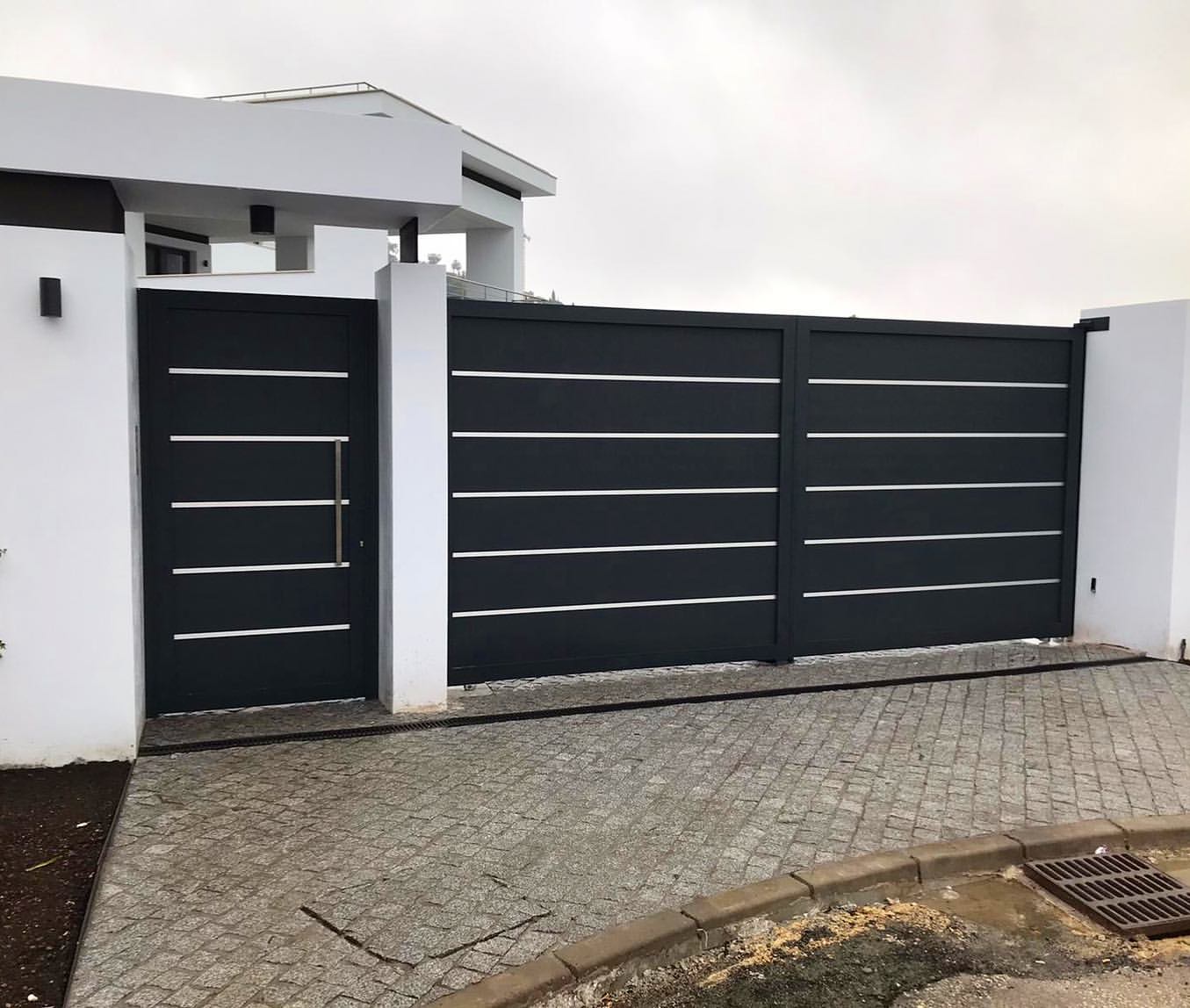

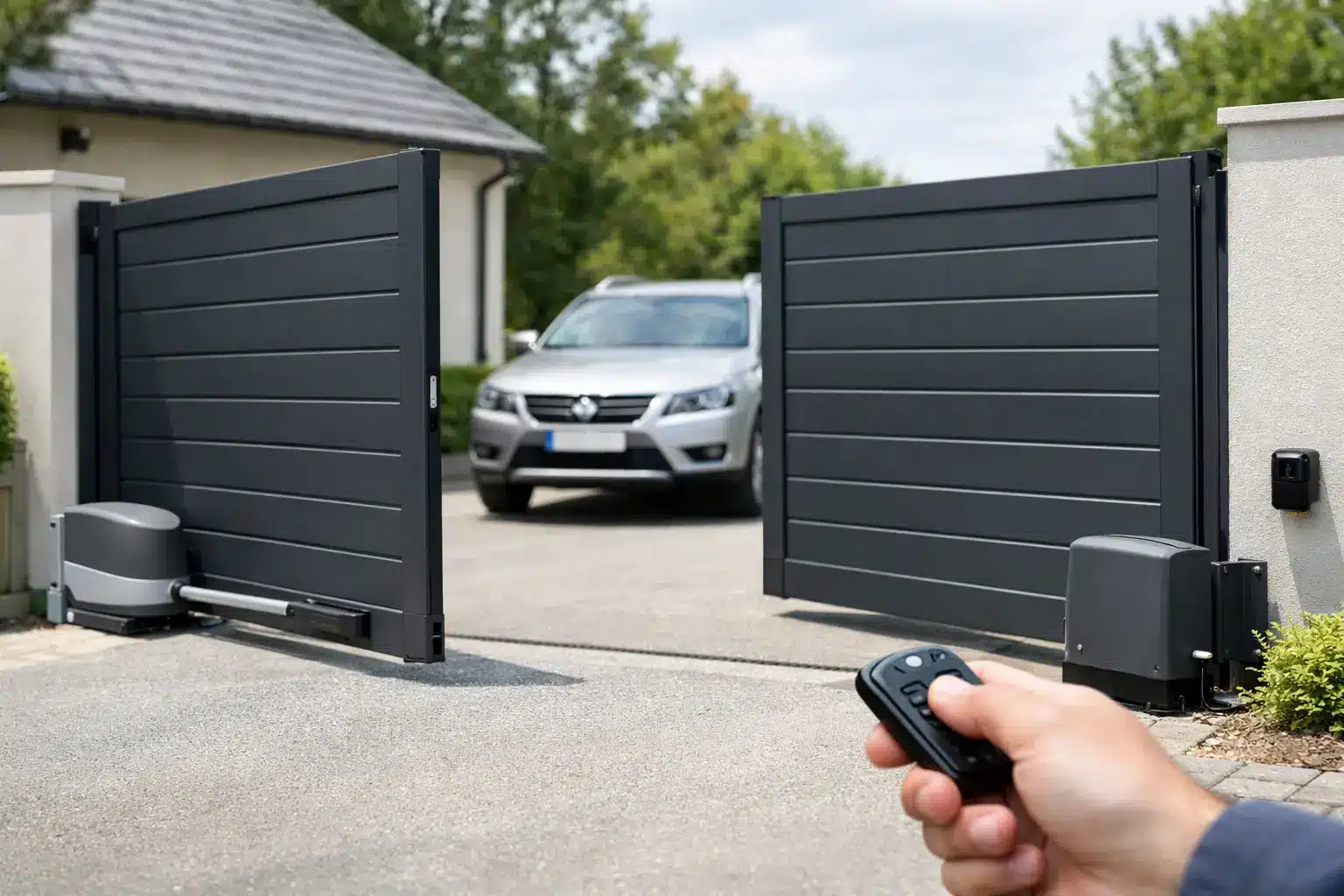
A driveway gate should not force you to stop in the rain, step into traffic or leave your vehicle to let visitors in. For homeowners and commercial sites alike, automated access brings a clear improvement in convenience and security. But can aluminium gates be automated? Absolutely – provided the gate, opening layout and automation equipment are specified as one considered system.
Aluminium is particularly well suited to electric operation. It is strong without carrying the excessive weight of many steel or timber alternatives, it does not swell or rot, and its low-maintenance finish helps keep the gate moving as intended over years of daily use. The right result is not simply a gate with a motor attached. It is a made-to-measure entrance designed for dependable movement, safe operation and a finish that complements the property.
Can aluminium gates be automated safely?
Yes. Both aluminium swing gates and sliding gates can be automated safely with correctly matched equipment and professional installation. The gate’s size, weight, construction, frequency of use and exposure to wind all influence the motor and safety specification.
A premium fully welded aluminium gate offers an excellent starting point. Its rigid frame helps maintain alignment, while aluminium’s lighter weight can reduce the load placed on hinges, tracks and motors. That does not mean every aluminium gate needs the same operator. A broad, solid-panel gate on an exposed rural driveway behaves very differently from an open-slatted pedestrian entrance in a sheltered town setting.
Safe automation also relies on more than the motor. A properly specified system includes controls that limit force, safety photocells that detect people or vehicles in the gate’s path, and a suitable method of releasing the gate manually if there is a power failure. The final installation should meet the relevant UK safety requirements for powered gates. This is why the design stage matters as much as the product choice.
Start with the way your entrance needs to work
The best automation system follows the site, rather than forcing a standard arrangement onto it. Before choosing a gate style, consider how vehicles approach, where they wait, how much space is available behind the gate and who will use it.
Automated swing gates
Swing gates create a traditional, imposing entrance and work well where there is clear space inside the property for the leaves to open. They can be configured as a single leaf or a pair, depending on the width of the opening and the desired appearance.
Underground motors are often chosen for a refined, uncluttered look because the mechanism is concealed below ground. Above-ground arm or ram motors can be a practical choice where access for servicing is preferred or where ground conditions make underground equipment less suitable.
The key consideration is clearance. A swing gate must never open into a public highway, pavement or shared access route. It also needs enough room to travel without meeting parked cars, slopes, planting or walls. On rising driveways, the gate geometry needs especially careful planning.
Automated sliding gates
A sliding gate is often the answer when inward swing space is limited. Instead of opening into the drive, the gate moves sideways along the boundary. This suits shorter or sloping driveways and can provide a strong, contemporary entrance statement.
There must be enough lateral run-back space for the gate when open. A tracked sliding gate requires a stable, level track across the opening, while a cantilever design runs above ground and can be useful where leaves, gravel, snow or uneven surfaces could obstruct a track. Cantilever systems generally require more return space, so they are not ideal for every plot.
For commercial premises, sliding gates can be particularly effective at wider openings and higher usage levels. The correct operator should be selected for the gate’s duty cycle, not merely its weight. A gate used a few times each day has different demands from one serving a busy yard, office car park or managed development.
Bi-folding and telescopic options
Where space is extremely limited but fast opening is valuable, bi-folding or telescopic aluminium gates may be worth considering. These specialist formats reduce the space needed for a gate to open and can improve traffic flow. They demand precise fabrication and careful automation design, making bespoke manufacture especially valuable.
What makes an aluminium gate suitable for automation?
A motor can only perform as reliably as the gate it moves. The gate should be purpose-designed for automated use, with the right frame strength, hinge points, reinforcement and hardware. Retrofitting automation to an existing gate can be possible, but only after a thorough assessment of its condition and structure.
Weight is one of aluminium’s practical advantages. A well-engineered aluminium gate can be significantly easier to move than a comparable solid timber or steel gate, while retaining a substantial, premium feel. Lower weight can support smoother operation and reduce strain on components. Yet lightness alone is not the objective. The gate must be engineered to resist flexing, sagging and twisting, particularly across wide openings.
Wind loading is another essential factor. Closeboarded or solid aluminium panels offer privacy and a striking architectural finish, but they present a larger surface area to strong winds. In exposed locations, this can affect motor choice, post design and the gate’s operating limits. Open slatted designs allow more air to pass through, although the final decision should balance privacy, appearance and site conditions.
Posts and foundations deserve equal attention. Whether the gate is fixed to masonry piers or purpose-made aluminium posts, the supporting structure must carry the load without movement. For sliding gates, the base and track or cantilever foundation are central to long-term performance. A beautifully fabricated gate will not compensate for unstable groundwork.
Choosing access control that suits daily life
Automation is most useful when entry feels intuitive. A simple remote control may suit a private driveway, while a keypad, proximity reader or GSM system can offer more flexible access for family members, staff or regular visitors. Video intercoms, including Akuvox systems, allow you to see and speak to callers before granting access.
Think beyond arriving by car. A separate pedestrian gate is often a sensible addition, allowing people to enter without operating the main driveway gate. It can reduce unnecessary cycles, make deliveries easier and provide a coordinated entrance solution. Matching fencing and side panels can then carry the same design language around the boundary.
For commercial settings, access permissions and visitor management may be more important than visual convenience alone. A system can be configured around staff access, timed operation, delivery periods and emergency release requirements. The principle remains the same: select the controls around the people using the site, not simply the features available.
Power, maintenance and long-term reliability
Most automated gates use a mains electrical supply, planned discreetly from the outset. This allows dependable operation and supports accessories such as intercoms, lighting and safety devices. Where running a cable is difficult, solar-powered automation may be viable for certain gates and usage patterns, but it depends on available daylight, gate size and the expected number of cycles. It should be assessed honestly rather than treated as a universal substitute for mains power.
Aluminium gives owners a low-maintenance advantage. It will not need the routine staining, painting or rot repairs associated with timber, and a quality powder-coated finish is designed to retain its appearance with straightforward cleaning. However, low maintenance does not mean no maintenance.
Keep tracks and drainage areas clear, inspect hinges and fixings, and arrange periodic checks of the operator, safety devices and controls. A gate that begins to drag, make unusual noise or stop inconsistently should be inspected promptly. Small alignment issues are far simpler to resolve before they create wear in the motor or hardware.
A bespoke gate system delivers the better result
Automation is most successful when it is considered before fabrication begins. Gate dimensions can be tailored to the opening, reinforcement can be positioned where the operator requires it, and the design can account for the exact swing path or sliding run-back. That protects both the clean visual finish and the practical performance of the entrance.
At Alu-Gate, made-to-measure aluminium gates are designed around the property, the access requirements and the desired level of privacy. Fully welded construction, premium finishes and a 20-year guarantee provide the quality foundation an automated entrance deserves.
The most effective next step is a site-led conversation: measure the opening, understand the ground conditions and decide how the entrance needs to perform every day. From there, the right aluminium gate and automation system can be specified with confidence – designed to impress, and built to last.