
A driveway gate should not become the least reliable part of your arrival home. Yet many electric sliding gate review searches begin after a timber gate has warped, a motor has struggled in winter, or an off-the-shelf system has failed to suit the width, slope or character of a property. The right sliding gate is a long-term entrance solution, not simply a moving barrier.
For UK homes and commercial sites, an electric sliding gate can deliver exceptional security, privacy and kerb appeal. Its value, however, depends on the quality of the gate structure, the accuracy of the survey and the automation specified for the job. A handsome gate with an underpowered operator is a compromise. So is a powerful motor attached to a poorly constructed frame.
Electric Sliding Gate Review: What Makes a System Worth Buying?
A premium electric sliding gate should feel composed in daily use. It should open at a measured pace, close accurately, respond reliably to controls and remain visually straight and stable through changing weather. Those outcomes are determined well before installation, beginning with the gate design and its supporting groundworks.
Aluminium is particularly well suited to this application. Unlike timber, it will not absorb moisture, swell or require routine painting. Unlike untreated steel, it will not develop surface rust. A properly fabricated aluminium gate provides a strong yet comparatively lightweight leaf, reducing strain on the automation while allowing for clean, substantial designs.
Construction matters as much as the material itself. Fully welded frames offer greater long-term rigidity than gates assembled from multiple mechanical joints. This is especially relevant on wide driveway openings, where movement, vibration and wind loading can expose weaknesses over time. Precision welding creates a cleaner, more durable structure and helps the gate retain its alignment.
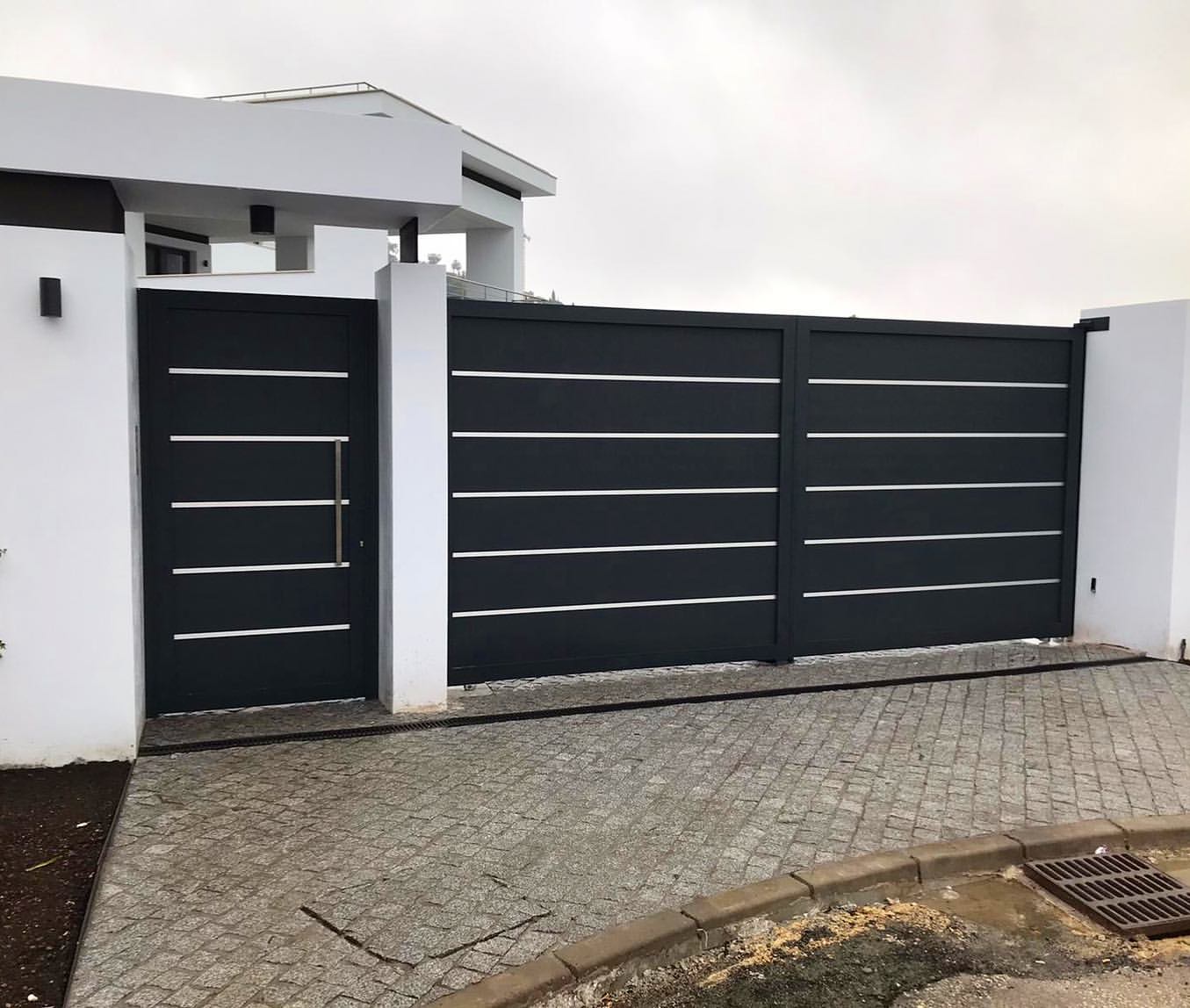
Finish quality also deserves close attention. A premium powder-coated finish gives aluminium its refined appearance and creates a protective outer layer suited to British weather. The colour, texture and infill style should be selected as part of the wider exterior scheme, whether that means contemporary horizontal slats, solid privacy panels, decorative detailing or coordinated fencing.
Sliding Gates Solve Problems Swing Gates Cannot
The best gate format depends on the site. A sliding gate is often the stronger choice where a drive rises behind the entrance, where vehicles need to stop close to the gate, or where inward-opening leaves would consume valuable parking space. It is also an effective solution for broad entrances that would make a pair of swing gates excessively heavy.
Because the gate travels sideways, the available run-back space is critical. A single sliding leaf needs sufficient clear room along the fence line or boundary to park when open. If that space is limited, a telescopic sliding design may be more appropriate. It uses multiple leaves that overlap as they open, making it possible to secure a wide opening within a shorter return area.
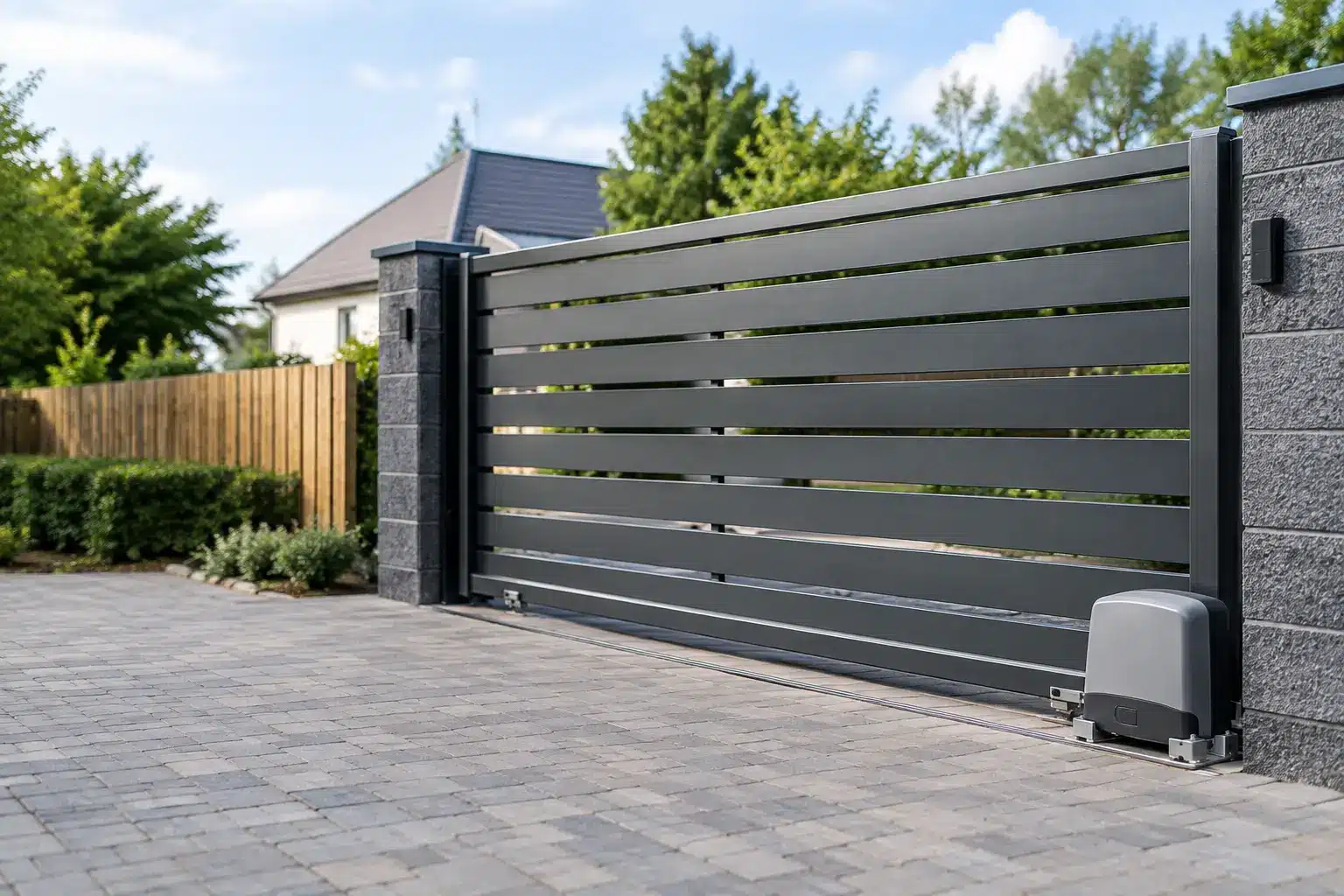
There are two principal operating arrangements. A tracked gate runs on wheels over a ground track, providing a straightforward and dependable solution when the driveway surface is suitable. It does require the track to be kept clear of leaves, gravel, ice and accumulated debris.
A cantilever sliding gate travels above ground, supported by a counterbalanced section and specialist hardware. This avoids a track across the driveway and can be advantageous on uneven surfaces or entrances exposed to debris. It typically needs more space to one side and a carefully engineered support structure. Neither option is universally better. The correct choice follows the site survey, intended usage and finish level expected.
Automation Is Only as Good as Its Specification
Electric operation brings genuine convenience, particularly in poor weather and on busy roads. A remote control, keypad, intercom or smartphone-enabled access system allows drivers and visitors to enter without unnecessary delay. For a home, that means a calmer arrival. For a commercial site, it can support better control of staff, deliveries and authorised visitors.
The operator must be matched to the gate’s true weight, length, frequency of use and exposure. It should have sufficient capacity in reserve rather than being selected at the edge of its capability. A domestic gate used a handful of times each day has different demands from a shared development, warehouse entrance or office premises with regular vehicle movements.
Ask how the system will perform during a power cut. A manual release mechanism should allow authorised access when electricity is unavailable. Battery backup can be worthwhile where continuity is important, while a professionally planned electrical supply protects against avoidable faults and unsightly retrofitted cabling.
Access control should be specified around the way the property is used. Simple remote fobs may be ideal for a private drive. A video intercom can add reassurance where homeowners want to verify visitors before granting access. For larger sites, keypad entry, proximity credentials and timed controls can make access more manageable without compromising the entrance’s appearance.
Safety Cannot Be Treated as an Add-On
An automated gate is machinery, and it must be designed to protect people, vehicles and pets. Safety begins with identifying potential trapping, crushing and shearing points around the moving gate, posts, track and surrounding boundary.
Photocells are commonly used to detect an obstruction in the gate’s path and prevent closure. Sensitive safety edges can provide further protection on leading edges or areas where a person could become trapped. The gate’s force settings, stopping behaviour and clearance around fixed structures all need professional attention. A safe system is not merely one with sensors fitted. It is one whose gate, controls and safety devices work together as intended.
This is also why a low-cost online gate package can become expensive once the missing elements are added. The advertised price may not account for foundations, posts, ground track, electrical works, control equipment, safety devices, installation or commissioning. Comparing complete specifications is far more useful than comparing a headline figure.
The Details That Separate a Premium Gate From a Basic One
A bespoke gate should fit the property rather than force the property to fit a standard size. Accurate measurements account for the opening, levels, side room, existing walls, vehicle approach and any gradients that influence the design. The result is a gate with correct proportions and a more convincing relationship to the building and boundary.
Privacy is another design decision rather than an afterthought. Closely spaced slats or solid aluminium infills can shield a driveway from view, while more open designs maintain sight lines and create a lighter visual effect. Taller gates may improve privacy and deterrence, but their wind loading, planning considerations and structural support require careful assessment.
Hardware is equally important. Quality rollers, guide assemblies, rack systems and stoppers do quiet, repetitive work that owners rarely notice until something fails. Selecting durable components and allowing for adjustment helps preserve reliable movement over years of use.
At Alu-Gate, made-to-measure aluminium sliding gates are designed around these practical requirements as well as the desired appearance. Fully welded construction, premium finishes and a 20-year guarantee reflect the standard expected of an entrance intended to serve a property for the long term.
What Maintenance Should You Expect?
Aluminium reduces the maintenance burden considerably, but low maintenance does not mean no maintenance. Wash the gate periodically with clean water and a mild, non-abrasive cleaner to remove road film, salt deposits and general dirt. Avoid aggressive chemicals or abrasive pads that can mark the finish.
For tracked systems, keep the running track clear and check that leaves, stones and compacted debris are not affecting travel. Inspect visible fixings, rollers and safety devices periodically, particularly after severe weather. Automation should be serviced in line with the manufacturer’s recommendations, with any faults addressed promptly rather than ignored.
A gate that begins to move noisily, stops intermittently or closes unevenly is asking for attention. Early adjustment is normally simpler and less costly than allowing a small alignment issue to place strain on the operator and mechanical components.
The Verdict: Choose the System, Not Just the Gate
An electric sliding gate is a strong investment when space, security and daily convenience point towards a sideways-opening design. The most successful installations pair a well-engineered aluminium gate with correctly rated automation, considered safety measures and a layout designed for the particular site.
Before choosing a style, arrange a detailed discussion around how the entrance is used, where the gate can travel and what must happen when power is unavailable. A gate designed to impress should also be built to perform quietly, safely and reliably every day it is asked to open.