
A commercial gate is rarely just a boundary feature. It controls who enters, how vehicles move, how secure staff and assets feel, and what visitors see before they reach the building. This commercial gate specification guide sets out the decisions that matter before a gate is designed, priced or manufactured.
For commercial premises, the right answer is not simply the strongest or largest gate available. It is a made-to-measure system that suits the site layout, traffic pattern, security risk and architectural finish, while remaining dependable through daily use.
Start with the site, not the gate style
The best specification begins with a clear picture of how the entrance works on an ordinary busy day. Consider the width of the opening, the road position, gradients, available run-back space and where vehicles can wait without obstructing public highways or internal routes.
A gate that looks impressive on a plan can be impractical if a delivery vehicle cannot clear the entrance before the gate closes, or if a swing leaf opens into a sloping drive. Measure the clear opening rather than relying on the distance between existing posts. Also allow for hinges, guide posts, safety clearances and any future changes to surfacing.
Traffic type matters as much as volume. A small office car park with predictable employee access has different requirements from a depot receiving frequent lorries, a school entrance at peak times or a private development with visitors and contractors arriving throughout the day. Establish the largest vehicle, busiest access period and expected daily cycle count early. These details influence the gate format, automation equipment and supporting structure.
Choose a gate format that works with the layout
Sliding gates for constrained or high-use entrances
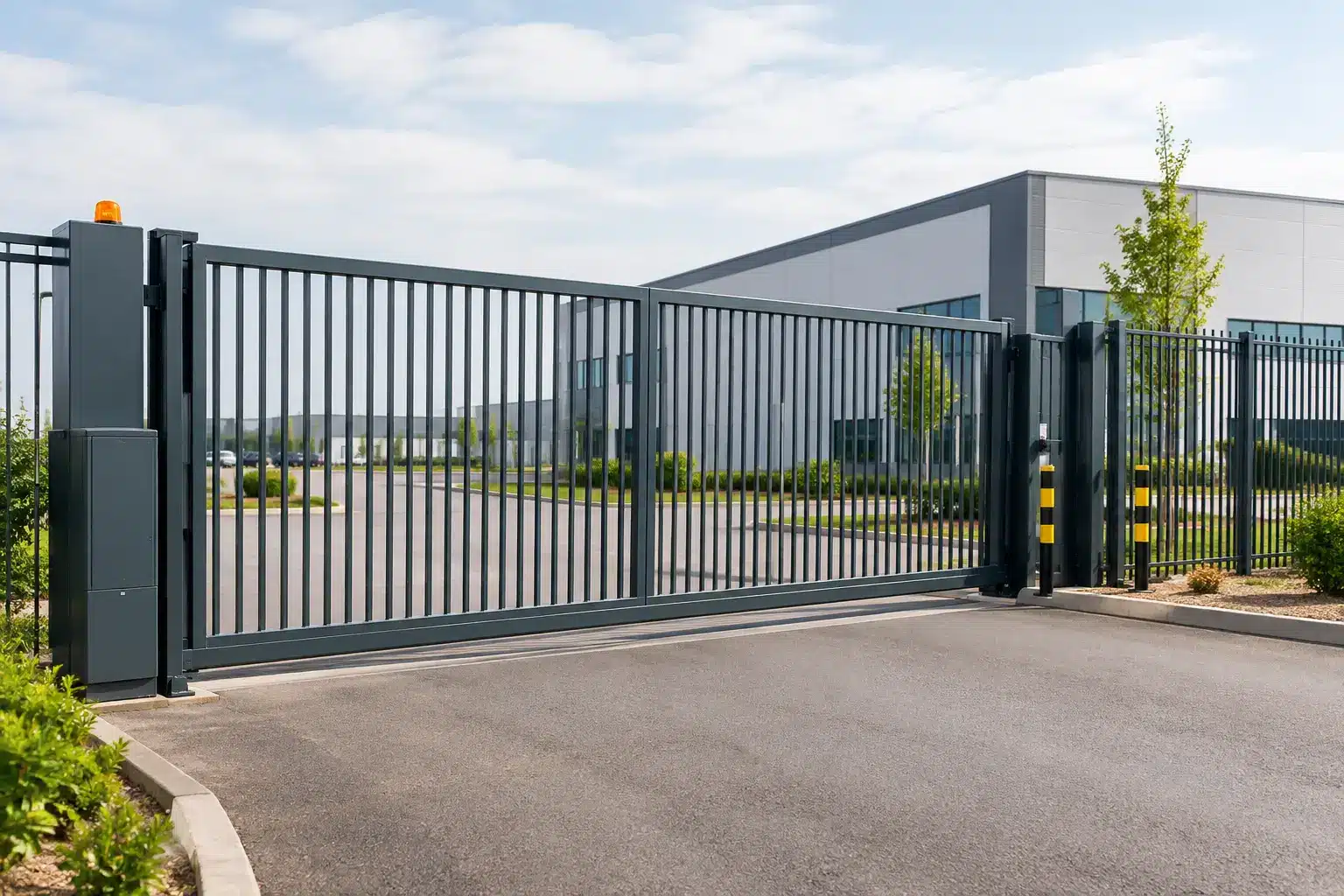
Sliding gates are often the strongest choice where frequent vehicle movements, wide openings or limited space behind the entrance make swing gates unsuitable. A tracked sliding gate can be a practical option on level, well-prepared ground. A cantilever sliding gate avoids a ground track, which can be beneficial where debris, uneven surfaces or regular vehicle use would make track maintenance less convenient.
The trade-off is run-back space. A sliding gate needs sufficient clear area alongside the opening for the leaf to travel when open. On a restricted site, a telescopic sliding design can reduce the required run-back length by using overlapping leaves. This is particularly valuable where the entrance is wide but the available side space is limited.
Swing gates for a more formal entrance
Swing gates give commercial entrances a strong, architectural presence and can suit lower-traffic premises with adequate internal space. They work especially well for offices, flat developments, showrooms and gated business parks where design is central to the arrival experience.
Their suitability depends on the ground levels and leaf size. Large leaves create considerable loading at hinges and posts, particularly in exposed locations. Inward opening is normally preferred so gates do not encroach on a pavement or carriageway, but it must be checked against the fall of the driveway and vehicle manoeuvring area.
Bi-folding gates for speed and limited space
Bi-folding gates are designed for sites where opening speed is a priority and a conventional sliding gate cannot run back far enough. They fold as they open, reducing the space required and helping to keep traffic moving at busy access points.
They involve more moving components than a single-leaf sliding gate, so quality fabrication, precise installation and an appropriate maintenance plan are essential. For a high-security or high-cycle site, specification should focus on the complete engineered system rather than the gate leaf alone.
Specify the structure before the finish
A commercial gate must carry its own weight, resist wind loading and tolerate repeated movement without losing alignment. The framework, welding, posts, hinges, rollers and foundations all need to be considered as one system.
Fully welded aluminium construction offers a clean, premium appearance with lasting strength and none of the rot, splitting or routine repainting associated with timber. Aluminium is also naturally corrosion resistant, making it well suited to UK weather and locations exposed to moisture. The exact section sizes and reinforcement required will depend on leaf dimensions, infill design, automation and local exposure.
Open slatted designs allow wind to pass through more readily, which can reduce loading in exposed areas. Solid or closely boarded designs deliver greater privacy and a more imposing perimeter, but they present a larger surface to the wind. There is no universal right choice. A coastal or open-site installation may need a different structural approach from a sheltered urban courtyard.
Posts and foundations deserve equal attention. Even a beautifully fabricated gate will not perform as intended if its supports are undersized or set into inadequate groundworks. Where existing brick piers are being retained, their condition, dimensions and capacity should be assessed before committing to a heavy automated gate.
Build security into the complete entrance system
The gate leaf is one layer of security, not the entire solution. A well-specified entrance controls access, discourages opportunistic intrusion and avoids creating weak points at the sides, beneath the gate or through poorly considered release arrangements.
Start by defining the security objective. Is the aim to mark a boundary, prevent unauthorised vehicle access, restrict pedestrian entry, protect valuable stock or manage access to a residential development? The higher the risk, the more closely the gate, fencing, pedestrian access and control equipment should be coordinated.
Height, infill spacing and the relationship between the gate and surrounding fencing all affect performance. A gap beside the gate or a lower adjacent panel can undermine an otherwise secure frontage. Matching aluminium fencing and purpose-designed pedestrian gates create a continuous perimeter that looks considered rather than pieced together.
Access control should be chosen around the people who use the site. Keypads may suit staff and regular contractors; fobs provide simple controlled access; video intercoms give reception teams or residents visual verification before releasing a visitor. Akuvox intercoms can form part of a refined access strategy where video calling, remote management and a premium entrance experience are required.
Make automation safe, reliable and maintainable
Automated gates should be specified for the duty they will perform, rather than fitted with a domestic operator simply because the gate is small. The motor, controls and safety equipment must match the gate weight, leaf configuration, expected use and site conditions.
Safety is fundamental. Risk assessment should account for trapping, crushing, shearing, impact and entanglement hazards around the gate’s full travel path. Appropriate safety devices may include photocells, safety edges, force limitation and emergency release arrangements. The exact combination depends on the gate design and how pedestrians and vehicles use the entrance.
Plan for failure as carefully as normal operation. Consider how authorised users will enter during a power cut, what happens if a vehicle stops in the opening and who is responsible for isolating or releasing the system. For critical premises, backup power, monitored access control or alternative entry procedures may be justified.
Commercial gate automation also needs sensible servicing. High-use sites benefit from scheduled inspections that check alignment, fixings, safety devices, moving parts and control equipment before minor wear becomes disruptive downtime.
Specify appearance as part of the investment
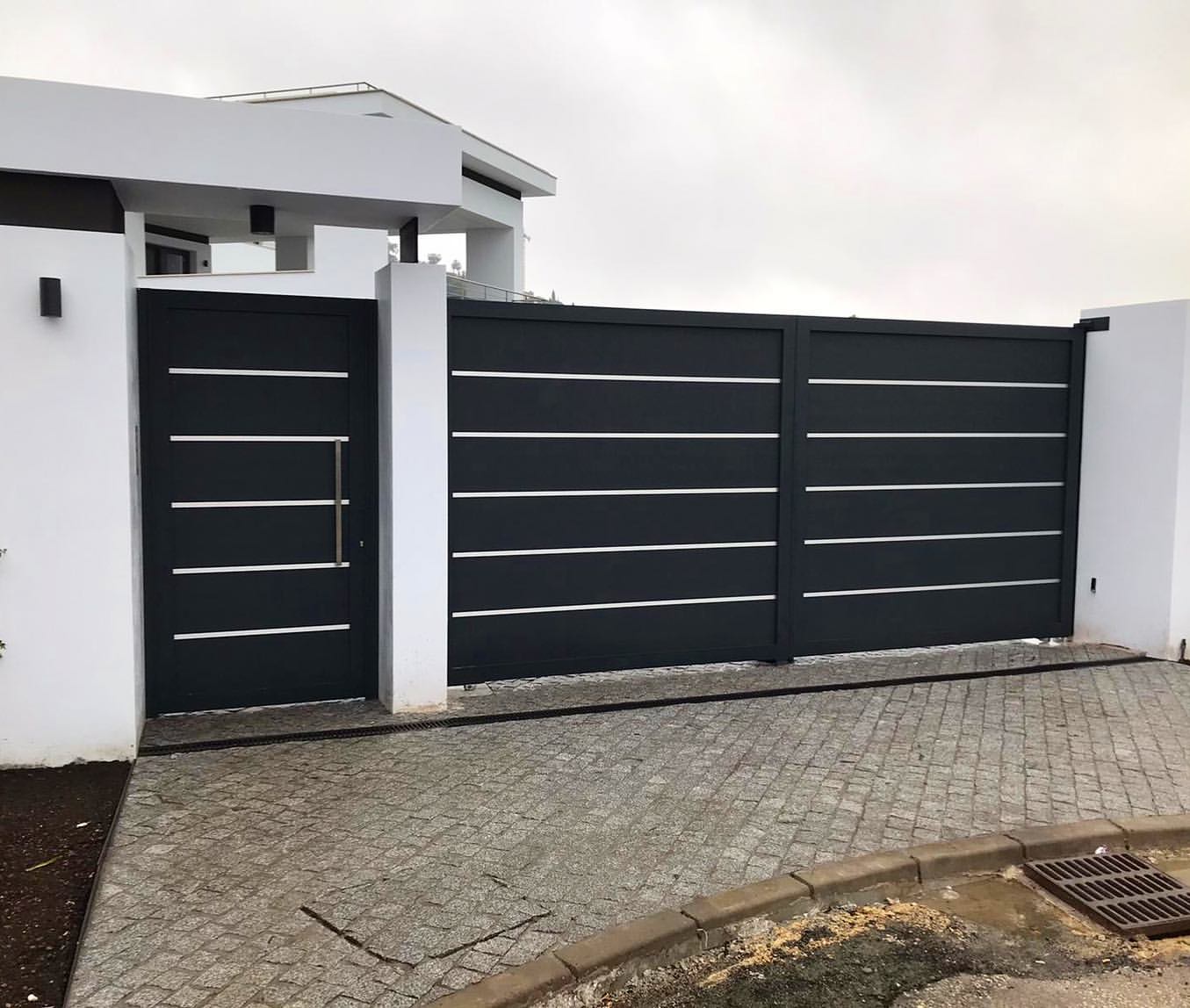
A commercial entrance should reinforce the quality of the business or development behind it. Aluminium gives designers freedom to create horizontal slats, vertical lines, solid privacy panels, perforated patterns or coordinated fencing in proportions that suit the architecture.
Powder-coated finishes provide long-lasting colour and a refined surface with low maintenance requirements. Dark contemporary tones remain popular, but the right colour should complement the building materials, signage, boundary treatment and surrounding streetscape. A bespoke gate can be practical without looking purely industrial.
At Alu-Gate, each made-to-measure design is considered around the opening, access requirements and desired visual impact, with fully welded construction and a 20-year guarantee supporting long-term ownership confidence.
Questions to resolve before approving a specification
Before fabrication begins, make sure the proposal answers the practical questions that can otherwise become costly late changes. Confirm the clear opening and available space, the gate travel direction, finished ground levels, largest vehicle dimensions, pedestrian routes, access control method and power supply location.
You should also establish responsibility for civils, drainage, electrical works and ongoing servicing. If the entrance connects directly to a public road, check that the gate position and operation do not force vehicles to wait in an unsafe location. Planning requirements, lease conditions and any site-specific security policies should be reviewed before work is commissioned.
A premium commercial gate should feel effortless for the people using it, but that result comes from careful decisions behind the scenes. Specify around the real demands of the site, invest in properly engineered construction and choose a design that gives the entrance the authority it deserves.