
A gate can look impressive on a drawing yet disappoint at the point of installation. When you specify welded gates, the decisions made before fabrication determine whether the finished entrance feels quiet, secure and proportioned to the property – or becomes a compromise that needs attention far too soon.
For a premium driveway, garden boundary or commercial entrance, welded construction is not simply a manufacturing detail. It influences strength, alignment, appearance and the confidence you have in the system over years of daily use. The right specification begins with the site, then brings together gate format, material, finish, access and installation requirements into one considered design.
Why specify welded gates rather than assembled frames?
A fully welded aluminium gate is fabricated as a complete structure, with the frame and infill sections permanently joined. This creates a clean, purposeful form that is particularly well suited to made-to-measure entrance systems. There are no visible corner brackets or bolt-on frame connections interrupting the design.
The practical benefit is rigidity. A well-engineered welded frame is designed to retain its shape under regular opening and closing, while supporting the chosen infill pattern, locks, automation components and access equipment. That matters for a wide driveway gate, a tall pedestrian entrance or any design with closely spaced horizontal slats, where movement can quickly affect the visual lines.
Mechanical assembly has its place, particularly where a lightweight, standard-sized solution is the priority. But it can introduce more visible fixings and connection points. For homeowners and commercial buyers investing in a bespoke exterior scheme, a fully welded construction offers a more refined finish and a stronger foundation for long-term performance.
Welding alone is not a guarantee of quality. The profile dimensions, joint preparation, fabrication accuracy and finish all matter. Ask how the gate is engineered for its size and intended operation, rather than comparing products only by the word “welded”.
Start with the entrance, not the gate style
The strongest specifications begin with a site survey or detailed site information. Measure the clear opening, but also consider the space around it. Gate leaves need room to swing without meeting rising ground, walls, parked vehicles or landscaping. Sliding systems need sufficient run-back space, while bi-folding and telescopic gates require their own clearances and operating geometry.
The approach matters as much as the opening. A steep or uneven drive can limit swing-gate options. A busy commercial access point may need faster operation and controlled vehicle flow. For a garden gate, the priority may be privacy and a coordinated fence line rather than vehicle access.
Existing posts, piers and walls should be assessed honestly. Attractive brick piers are not automatically suitable for the loads imposed by a substantial driveway gate, especially an automated one. In some cases, purpose-designed aluminium or steel posts, correctly founded, will provide a more reliable result and preserve alignment over time.
This early assessment also establishes the right gate format. Swing gates bring symmetry and a traditional sense of arrival. Sliding gates are often the practical choice where drive depth is limited or a slope prevents a leaf from opening cleanly. Pedestrian gates offer everyday convenience and can match the driveway gate precisely. The best choice depends on how the property is used, not just which format looks most dramatic in a photograph.
Specify welded gates around proportion and privacy
Made-to-measure fabrication allows the design to respond to the property rather than forcing the property to accept standard panel sizes. This is where a bespoke welded gate earns its place.
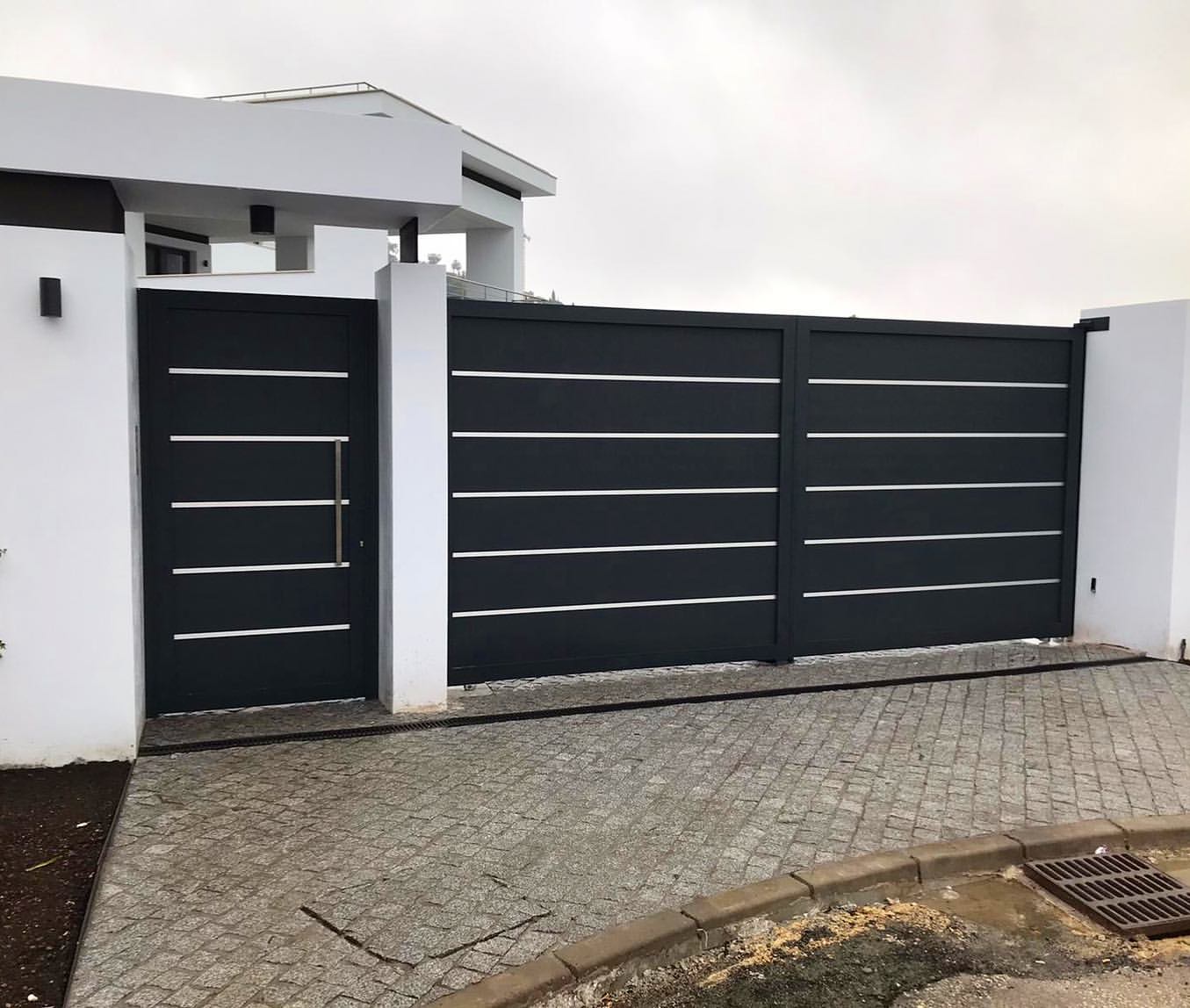
Consider the relationship between the gate height, the width of the opening and the scale of the house. An overly tall gate in a narrow opening can feel defensive, while a low, open design may not provide the privacy or boundary definition required. Horizontal aluminium slats create a contemporary, architectural effect, but their spacing should be selected with care. Wider gaps can soften the elevation and allow light through. Tighter spacing gives greater screening and a more private arrival.
Solid or near-solid infill designs offer a bolder statement and stronger visual privacy. They may also experience greater wind loading than a more open design. On exposed sites, that affects the frame, hinges, posts and automation specification. This is not a reason to avoid a solid gate. It is a reason to engineer the supporting system for the conditions it will face.
Colour and surface finish should be chosen as part of the wider exterior palette. A deep anthracite tone can complement contemporary windows and cladding, while black gives a sharper, more classic outline. Textured finishes can be forgiving in high-touch areas, whereas smoother finishes deliver a crisp, refined appearance. The right powder-coated finish provides durable colour and helps aluminium retain its low-maintenance appeal.
Build security into the design
Security should feel integrated, not added after the gate has been made. Start by deciding who needs access and how they will use it. A family home may need vehicle entry, a separate pedestrian route and visitor calling. A commercial site may need controlled access for staff, deliveries and authorised contractors at different times of day.
For pedestrian gates, specify quality latching and locking arrangements appropriate to the gate’s use. For driveway entrances, automation can be paired with remote controls, keypads, vehicle detection and video intercoms. An Akuvox intercom, for example, can provide a more considered visitor experience than a basic standalone call point, particularly where the entrance is set back from the building.
Do not overlook the details that discourage opportunistic access. Hinge arrangements, the location of release mechanisms, gate gaps and the design of adjacent fencing all contribute to the overall result. A premium gate should create a coherent perimeter, not leave an obvious weak point beside an otherwise secure entrance.
Where gates are automated, safety is equally essential. The system must be selected and installed with appropriate safety devices, force settings and controls for the environment. A domestic driveway used only by one household has different risks from a shared development or a workplace with regular pedestrian movement. Good specification recognises those differences from the outset.
Match the structure to the operating method
A beautiful gate that is poorly matched to its hinges, track or motors will never provide the ownership experience it should. The operating system needs to be considered while the gate is being designed, not after fabrication is complete.
Swing gates require suitable hinges, accurate post alignment and motors sized for the leaf dimensions and anticipated wind exposure. Underground operators offer a discreet look but require appropriate drainage and service access. Above-ground motors are more visible, yet can be a practical, serviceable solution depending on the site.
For sliding gates, decide between tracked and cantilever arrangements according to the ground conditions, opening width and desired finish. A tracked gate can be highly effective where the driveway surface is stable and can accommodate a track. Cantilever gates avoid a ground track across the opening, which can be advantageous on sites affected by debris, uneven surfaces or frequent vehicle traffic. They do, however, need additional run-back space and a carefully designed support structure.
Cables, control equipment and drainage are easily overlooked during renovation projects. Planning them early avoids unnecessary surface trunking, disruptive excavation or last-minute changes to the gate position. It also produces a cleaner result – one that looks designed as a whole rather than fitted in stages.
Ask for proof of finish, fabrication and aftercare
A premium aluminium gate should look as good from the inside as it does from the road. Inspect the quality of the weld finishing, the consistency of panel lines and the care taken around edges, corners and hardware positions. These are the details that separate purposeful fabrication from a merely adequate product.
Aluminium is valued because it will not rust in the way untreated steel can, and it does not demand the regular staining or painting associated with timber. Even so, low maintenance does not mean no maintenance. Occasional washing with mild detergent, clearing debris from tracks and checking moving hardware will keep an entrance operating and looking its best. Coastal locations, heavily trafficked roads and shaded sites may call for more frequent cleaning.
Guarantee terms are also worth reading closely. They should reflect confidence in the gate structure and finish, while making clear what routine care and professional servicing are expected for automated components. At Alu-Gate, bespoke aluminium systems are supported by a 20-year guarantee, giving buyers assurance that the investment is intended for the long term.
Give the fabricator a complete brief
The most efficient route to the right gate is a clear brief. Share opening dimensions, photographs, levels, existing boundary details and how you expect the entrance to function each day. Include the preferred degree of privacy, the desired colour, whether automation is planned and any intercom or access-control requirements.
There is always a balance to strike. A minimal floating appearance may require more concealed engineering. Maximum privacy can increase wind loading. A wide single leaf may suit the visual concept but be less practical than a pair of leaves or a sliding arrangement. Expert guidance turns those trade-offs into deliberate design decisions rather than surprises on installation day.
A welded gate should do more than close an opening. Specified with care, it becomes a precise architectural feature: designed to impress on arrival, built to protect what matters and made to retain its character for years to come.