
A driveway gate is no longer just a boundary marker. It is often the first architectural feature visitors see, the point where security becomes visible, and a daily-use system that must work reliably in British weather. The strongest modern driveway gate trends bring those demands together: clean design, tailored proportions, intelligent access and materials chosen for decades of service rather than a short-lived visual upgrade.
For homeowners, self-builders and commercial property managers, the shift is clear. Off-the-shelf gates are giving way to made-to-measure entrance systems that complement the building, make access easier and create a stronger sense of arrival.
Modern Driveway Gate Trends That Add Lasting Value
The defining trend is not one particular colour, profile or opening mechanism. It is considered specification. A gate should suit the width and slope of the driveway, the available run-back space, the level of privacy required and the character of the property.
Contemporary homes often suit crisp horizontal lines, framed panels and understated finishes. Traditional stone, brick or rendered properties can benefit from the same materials with softer details, vertical profiles or a carefully selected colour. The objective is not to force a fashionable look onto a property. It is to create an entrance that feels designed as part of it.
Aluminium has become central to this movement. It offers a premium appearance without the ongoing cycle of sanding, staining and repainting associated with timber. Unlike steel, it does not rust, making it particularly well suited to exposed UK locations and properties near the coast. Quality still matters, however. The strength of the frame, the precision of the welds, the coating process and the gate’s engineering determine whether the finished result continues to look refined after years of use.
Linear slats remain a leading choice
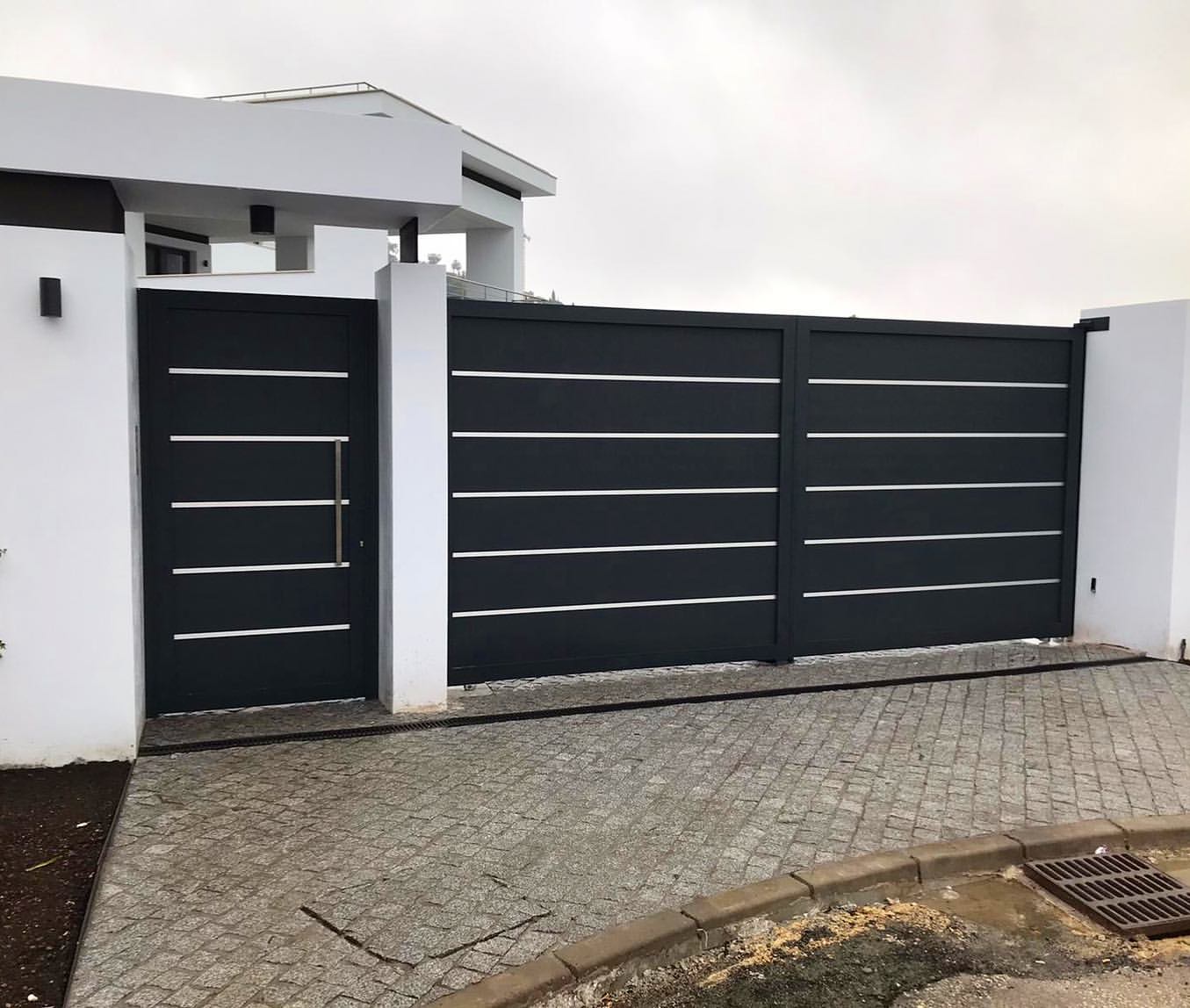
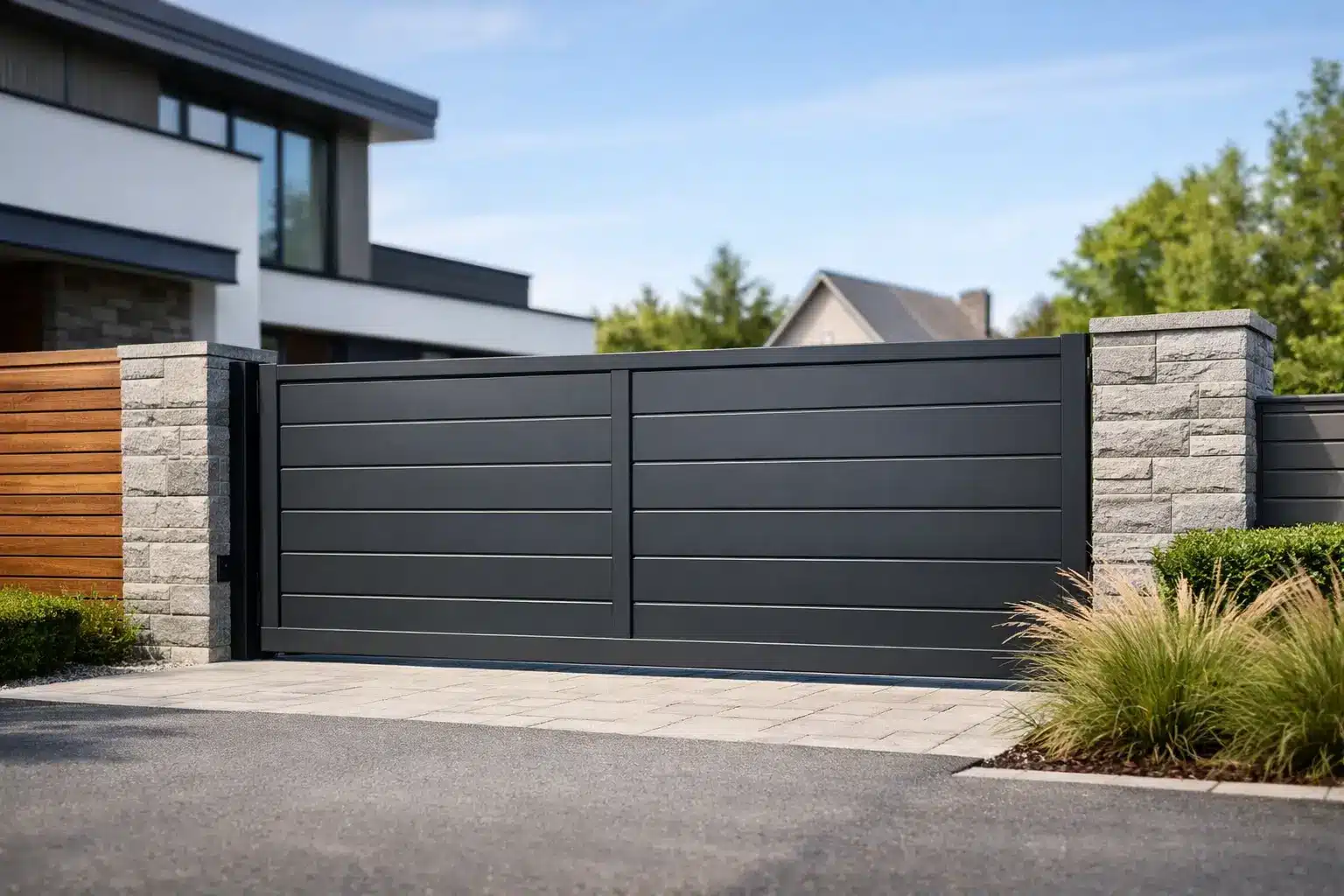
Horizontal aluminium slats are one of the most requested contemporary gate styles, and for good reason. They create a calm, architectural rhythm while allowing the level of privacy to be adjusted. Narrow gaps can soften the elevation and let light through; closer spacing gives a more private, more secure boundary.
This is where bespoke fabrication makes a visible difference. The slat spacing, frame depth and overall proportion should be considered in relation to the driveway opening, adjoining fencing and the scale of the house. A wide gate with poorly judged profiles can look flat and heavy. A properly proportioned design has presence without overwhelming the frontage.
Vertical slats are also gaining ground, especially where homeowners want to make a narrow frontage feel taller or introduce a more traditional visual rhythm. Both layouts can be highly contemporary. The decision comes down to the architecture, sightlines and the effect you want from the road.
Dark Finishes, Warm Neutrals and Coordinated Boundaries
Anthracite grey remains a popular choice for modern driveway gates because it works confidently with pale render, brick, timber cladding and black-framed glazing. It is not the only option. Black offers a sharper, more formal appearance, while muted greens, bronzes and warm neutral tones can sit more naturally alongside rural materials and established planting.
The most polished schemes treat the gate, pedestrian entrance, fencing panels and posts as one coordinated composition. This avoids the common issue of a premium gate being paired with mismatched boundary elements. Repeating a profile or finish across the frontage creates visual continuity and makes even a complex entrance feel ordered.
Wood-effect aluminium is another considered option. It brings warmth to a minimalist elevation without the maintenance demands of natural timber. The trade-off is stylistic: a convincing wood finish can soften a contemporary scheme, but a single powder-coated colour may be the better choice where the aim is a crisp, distinctly modern statement.
Concealed details create a cleaner result
Modern design is increasingly defined by what is not immediately visible. Concealed fixings, integrated handles, discreet hinges and carefully positioned automation equipment all reduce visual clutter. These details should never compromise access for maintenance or safe operation, but when planned properly they give the entrance a far more resolved finish.
Posts deserve equal attention. They can be designed to match the gate, finished in a contrasting colour or incorporated into masonry piers. Where access control is required, a purpose-designed post can neatly house an intercom, keypad, lighting and cabling rather than adding separate units as an afterthought.
Sliding, Swing and Bi-Folding Gate Design
The best opening format is driven by the site, not by fashion. Sliding gates are increasingly specified for driveways that rise towards the property, where swing gates may be impractical, or where owners want to avoid a leaf opening into the usable driveway area. They create a controlled, efficient entrance and suit broad openings particularly well, provided there is sufficient space alongside the opening for the gate to travel.
Cantilever sliding gates offer a clean solution where a ground track would be undesirable, such as uneven surfaces, gravel driveways or areas prone to debris. They require more structural planning and a longer run-back area, so they are not automatically the right answer for every site.
Swing gates retain considerable appeal. They can frame a driveway beautifully, work well with traditional gate piers and usually require less lateral space than a sliding system. For restricted sites, bi-folding or telescopic gate configurations can reduce the space needed for opening. These formats are particularly valuable where a full sliding gate is not possible but speed and compact operation are priorities.
Automation should be considered at the design stage, not added at the end. The gate weight, hinge arrangement, opening geometry, wind exposure and daily usage all influence the correct system. A premium automated gate should open smoothly, stop safely and remain dependable through regular use. Correct installation, safety devices and commissioning are essential, especially for commercial entrances and shared access points.
Smart Access Without a Cluttered Entrance
Access control is moving from simple key fobs towards flexible, connected systems. Video intercoms allow occupants to see and speak with visitors before granting entry, whether they are at home, in the garden or away from the property. Keypads, proximity readers and app-based controls can also make access easier for family members, deliveries, staff and approved contractors.
The benefit is not technology for its own sake. It is greater control over who enters the site and how. A well-specified system can reduce the need to leave the house to open the gate, provide clearer visitor verification and give commercial managers a more practical way to manage regular access.
There are sensible limits. Reliable connectivity, thoughtful cabling and a clear plan for manual release during a power cut matter as much as the intercom screen or app. For many homes, a high-quality video intercom and safe automated operation will offer more lasting value than an unnecessarily complicated collection of devices.
Security That Still Looks Refined
A solid boundary is a visual deterrent, but real security is built into the complete system. Gate height, infill design, locking points, hinges, automation controls and the resilience of posts all affect performance. Gaps should be selected with privacy and security in mind, while still allowing safe visibility where vehicles join a public road.
Fully welded aluminium construction is a key marker of quality. It creates a rigid, cleanly finished structure that is suited to regular operation and avoids the weaker visual and structural compromises that can come with heavily assembled designs. Combined with a durable powder-coated finish, it provides an entrance solution engineered for low-maintenance ownership.
For commercial sites, the specification may need to account for higher traffic, access permissions, delivery vehicles and stronger perimeter requirements. Residential projects can place more emphasis on kerb appeal and privacy. In both cases, the right answer comes from assessing how the entrance will actually be used.
Choose a Trend That Suits Your Property
The most successful gate designs will still look right when short-lived fashions have moved on. Start with the practical constraints: driveway width, gradients, parking patterns, available opening space and desired level of privacy. Then consider the architecture, existing boundary treatment and how visitors will gain access.
A bespoke aluminium gate gives you the freedom to make those decisions deliberately, rather than accepting the limitations of a standard size or generic design. At Alu-Gate, that means looking beyond the gate itself to create an entrance with the right proportions, operation and finish for the property.
Choose a design that earns its place every time you arrive home: precise in its detail, reassuring in its security and built to retain its presence for years to come.