
A powered driveway gate should never leave safety to chance. Smart gate sensors provide the awareness that turns an automated entrance into a properly considered access system – helping it detect vehicles, pedestrians and obstructions before a gate moves or closes.
For homeowners and commercial sites alike, the right sensors protect more than the gate itself. They reduce the risk of impact, prevent avoidable call-outs and make everyday entry feel controlled rather than cumbersome. The best specification depends on the gate style, driveway layout, traffic levels and how the entrance will be used.
What do smart gate sensors do?
Smart gate sensors monitor the area around an automated gate and send a signal to the control system when something is present, moving or approaching. Depending on the equipment selected, that signal may stop the gate, reverse its movement, hold it open or trigger it to open for an authorised vehicle.
The word “smart” can mean different things. At its most useful, it describes sensors that work intelligently with a gate controller, access control system or connected app. A vehicle may be recognised at a designated point on the drive; a closing gate may reverse when its safety beam is interrupted; a monitored safety edge may react immediately when it meets resistance.
This is not simply about adding technology. It is about specifying an entrance that responds appropriately to real life: children walking through, deliveries arriving, visitors using an intercom and vehicles waiting on a sloping or narrow driveway.
The main types of smart gate sensors
Different sensor types solve different problems. Many premium automated gate systems use more than one, because no single device can cover every hazard area or access requirement.
Photocells and infrared safety beams
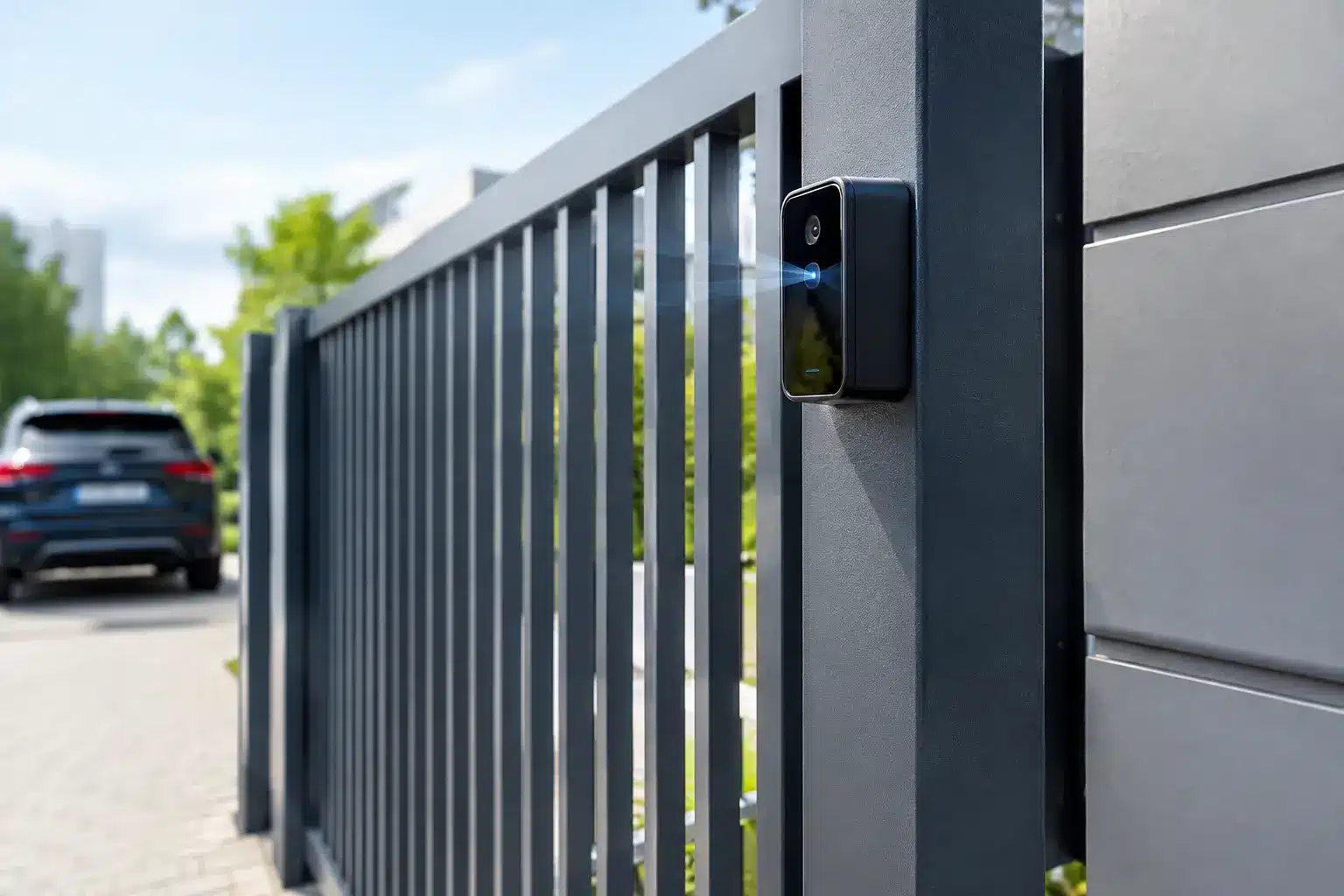
Photocells create an invisible infrared beam between a transmitter and receiver. If a person, animal or vehicle breaks that beam while the gate is closing, the controller can stop and reverse the gate.
They are a familiar and highly effective safeguard for the opening between gate posts. On a sliding gate, additional photocells may be needed to cover the area behind the gate as it travels. On swing gates, positioning matters just as much, particularly where leaves open towards a parking area, footpath or landscaped space.
Photocells are discreet and dependable, but they need a clear line of sight. Heavy rain, dirt, cobwebs, misalignment or a poorly positioned planting scheme can affect performance. Choosing quality components and allowing for easy inspection makes a real difference over time.
Safety edges
A safety edge is a pressure-sensitive strip fitted to the leading edge of a gate or other potential contact point. When it meets an obstruction, it sends an immediate stop or reverse command to the operator.
Safety edges are especially valuable where the moving gate creates a trapping or crushing risk that cannot be fully protected by photocells alone. This may include the leading edge of a sliding gate, the closing edge of a swing gate or sections around a telescopic system.
Wired safety edges offer a direct connection, while wireless versions can simplify installation on moving gate leaves. Wireless units do require battery monitoring, so they should be part of a planned maintenance routine rather than an afterthought.
Induction loops and vehicle detection
Induction loops are installed beneath the driveway surface to detect metal vehicles above them. They are commonly used to hold a gate open while a car is in its path, prevent closure onto a waiting vehicle or provide exit activation from inside the property.
For a busy residential entrance, a well-positioned exit loop can make leaving the property straightforward without relying on a remote control. For commercial premises, loops can help manage frequent vehicle movements with far greater consistency.
Their main trade-off is that installation is most convenient before a driveway is finished, or when resurfacing is planned. Retrofitting may involve cutting channels into existing paving or tarmac. That work can be worthwhile, but it should be considered early in the design process.
Radar and presence sensors
Radar sensors detect movement or presence without needing a loop cut into the ground. They can be useful where a surface-mounted or above-ground solution is preferable, and where the system needs to distinguish an approaching vehicle from background activity.
The advantage is flexibility. The sensor can often be adjusted for detection range and direction, helping to avoid unnecessary activation from passing traffic. However, poor set-up can lead to false triggers, especially near public roads, turning areas or active pedestrian routes. Calibration should be treated as part of the installation, not a final tick-box exercise.
Integrated access and camera systems
An intercom with a camera does not replace a safety sensor, but it adds a valuable layer of control. Video access systems allow a property owner or site manager to see who is at the entrance, speak with them and grant access remotely where appropriate.
When paired with smart controls, the gate can also provide useful status information: open, closed, moving or held open due to an obstruction. This is particularly helpful for second homes, commercial sites and properties with long driveways where the gate cannot be seen from the building.
Smart gate sensors for swing and sliding gates
Gate format changes the sensor strategy. A pair of swing gates creates moving arcs, with potential pinch points at the hinge side and closing line. A sliding gate travels along a fixed path and introduces separate risks around the leading edge, rear run-back area and adjacent fencing.
For swing gates, photocells across the entrance and carefully considered safety edges are often central to the system. The available space behind each leaf matters. If vehicles park too close to the swing path, sensors alone cannot compensate for a layout that is fundamentally too tight.
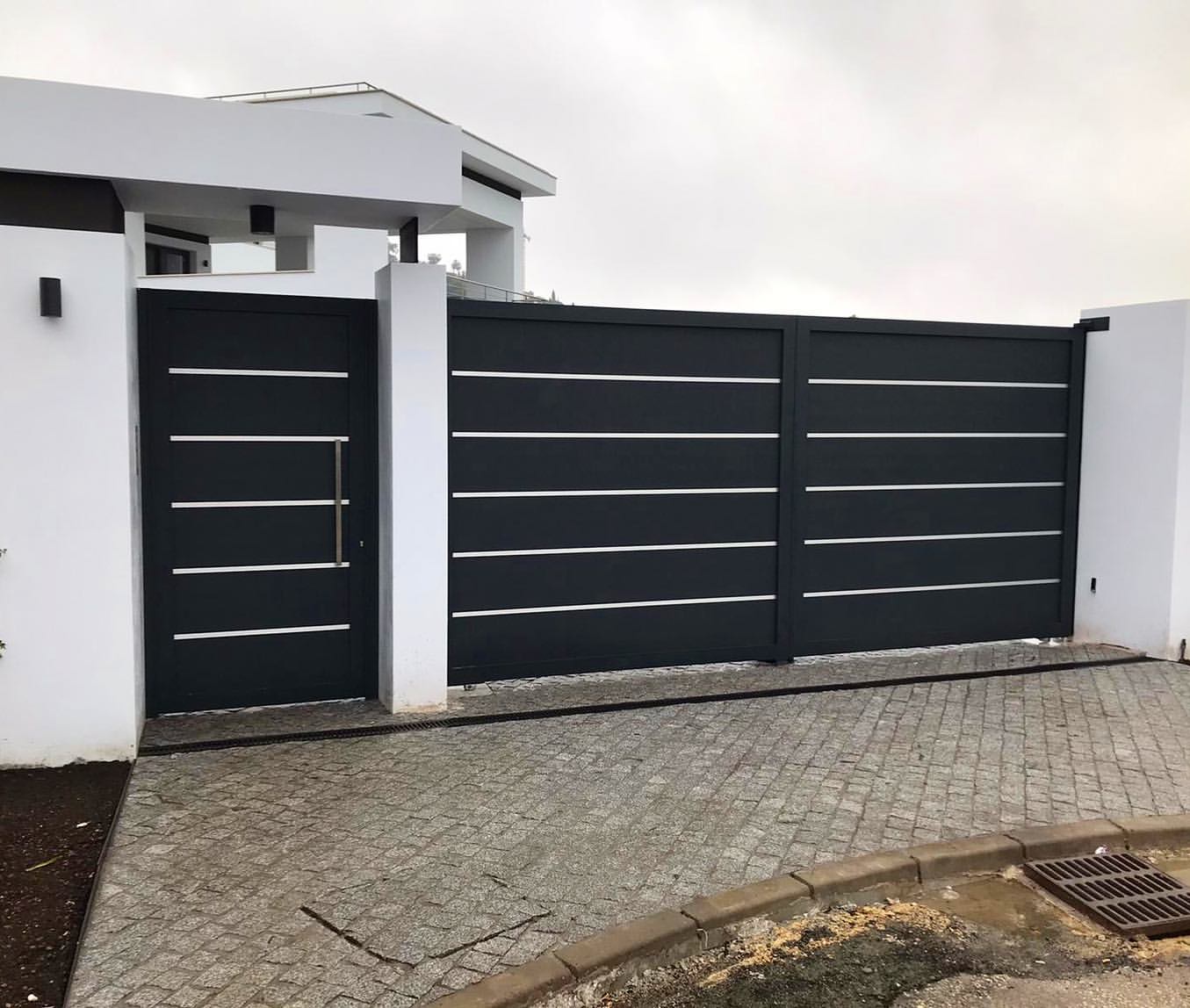
For sliding gates, the travel distance and run-back space need equal attention. A fully welded aluminium sliding gate can offer excellent security and a clean architectural finish, but its automation must be designed around the full movement zone. Safety devices should protect the clear opening as well as the areas the gate occupies when open and closed.
Bi-folding and telescopic gates move in more complex ways, so their sensor arrangement must reflect every moving section and potential contact point. This is one reason bespoke gates benefit from early technical consultation rather than a generic automation package.
How to specify the right system
The right question is not, “Which sensor is best?” It is, “What must this entrance do safely, every day?” Start with the traffic using the gate. A family home with occasional visitors has different demands from a shared development, school, warehouse yard or office car park.
Consider whether pedestrians regularly use the same opening as cars. If they do, a separate pedestrian gate can improve both convenience and safety. Think about deliveries, refuse collections, vehicle turning space, gradients and whether the entrance sits close to a public highway.
It also pays to decide how people will gain access. Remote controls, keypad entry, proximity tags, number plate recognition and video intercoms can all work alongside smart sensors. The aim is not to fit every available feature. It is to create a reliable sequence: identify the visitor, authorise access, open safely, hold safely, then close only when the passage is clear.
Do not treat safety equipment as an optional extra
Automated gates are machinery, and the safety measures must be appropriate to the installation. A premium gate leaf, precision welding and durable powder-coated finish deserve equally considered automation and protection.
A professional installer should assess risk across the whole entrance, not only at the closing point. That includes gaps around posts and hinges, the direction of travel, nearby walls, the gate’s weight and force, and how people are likely to behave around it. The final system should be commissioned, tested and explained clearly to the owner.
Reliability comes from design and upkeep
Even excellent smart gate sensors need periodic attention. Photocell lenses should be kept clean and aligned. Safety edges need functional testing. Wireless devices need battery checks, and any changes to the driveway, landscaping or parking habits should prompt a review of detection zones.
This is particularly relevant after winter. Fallen leaves, grit, standing water and shifting ground can affect both the gate’s movement and the performance of its safety devices. Low-maintenance aluminium reduces the burden of maintaining the gate structure, but the automation still benefits from professional servicing.
At Alu-Gate, a made-to-measure aluminium gate can be specified around the property rather than forced into a standard layout. The strongest result brings together the gate design, access control and safety technology from the outset, creating an entrance that looks exceptional and performs with confidence.
A well-planned gate should feel effortless to use, while quietly accounting for everything that could interrupt its path. That is the real value of smart sensors: considered protection that lets a premium entrance do its job, day after day.