
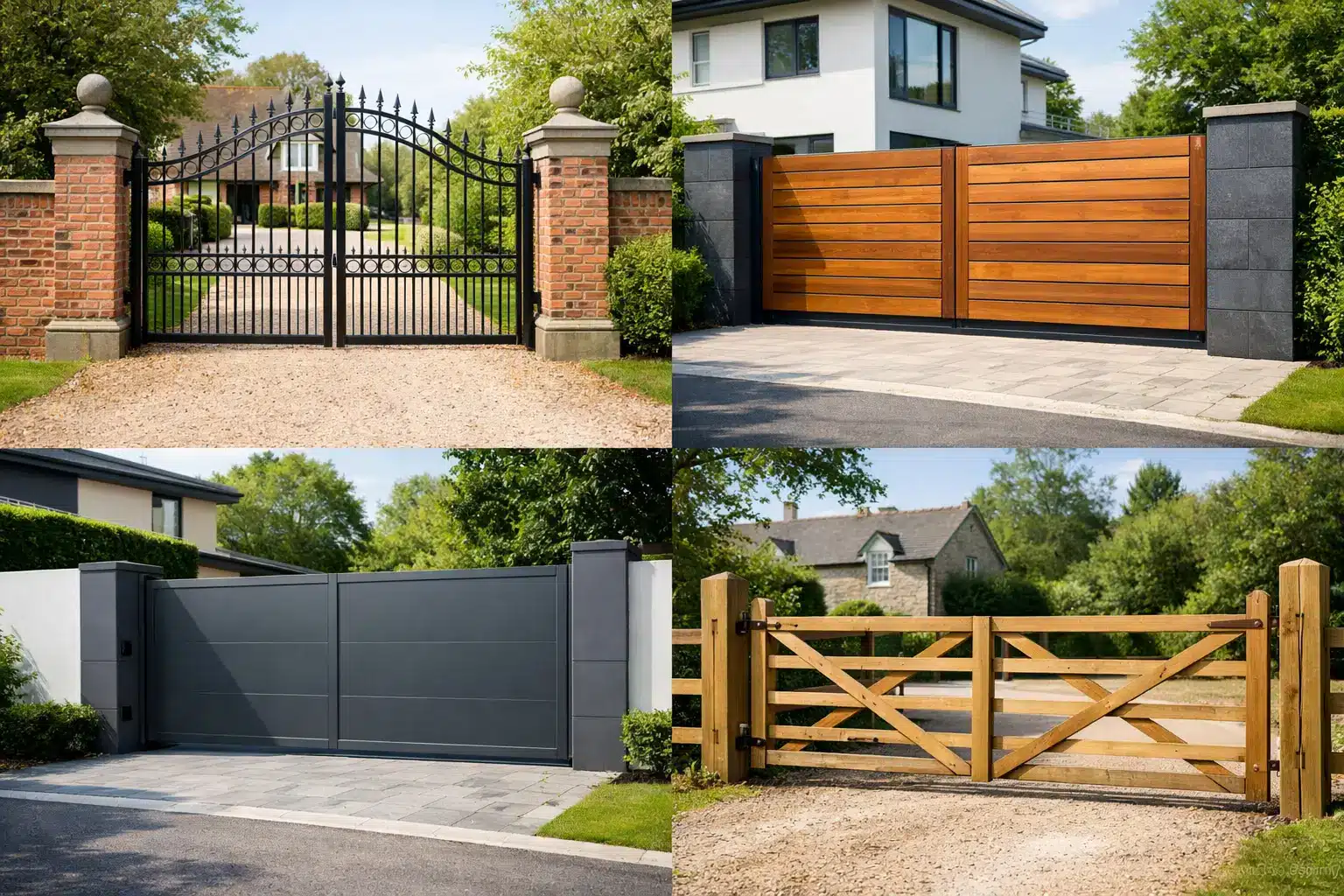
A gate is the first architectural statement your property makes. The best residential gate design examples do more than close off a driveway: they frame the home, strengthen boundary security and give an arrival a sense of purpose. Whether you are replacing tired timber gates or specifying an entrance for a self-build, the right design should suit the building, the space available and the way you use it every day.
Aluminium gives homeowners considerable freedom here. It can be made to measure, finished in a wide range of colours and fabricated into clean, precise forms without asking for the ongoing painting, staining or treatment associated with timber. The important decision is not simply which style looks good in a brochure. It is choosing a gate format and design language that will still feel right on your property years from now.
12 residential gate design examples worth considering
1. Horizontal slatted driveway gates
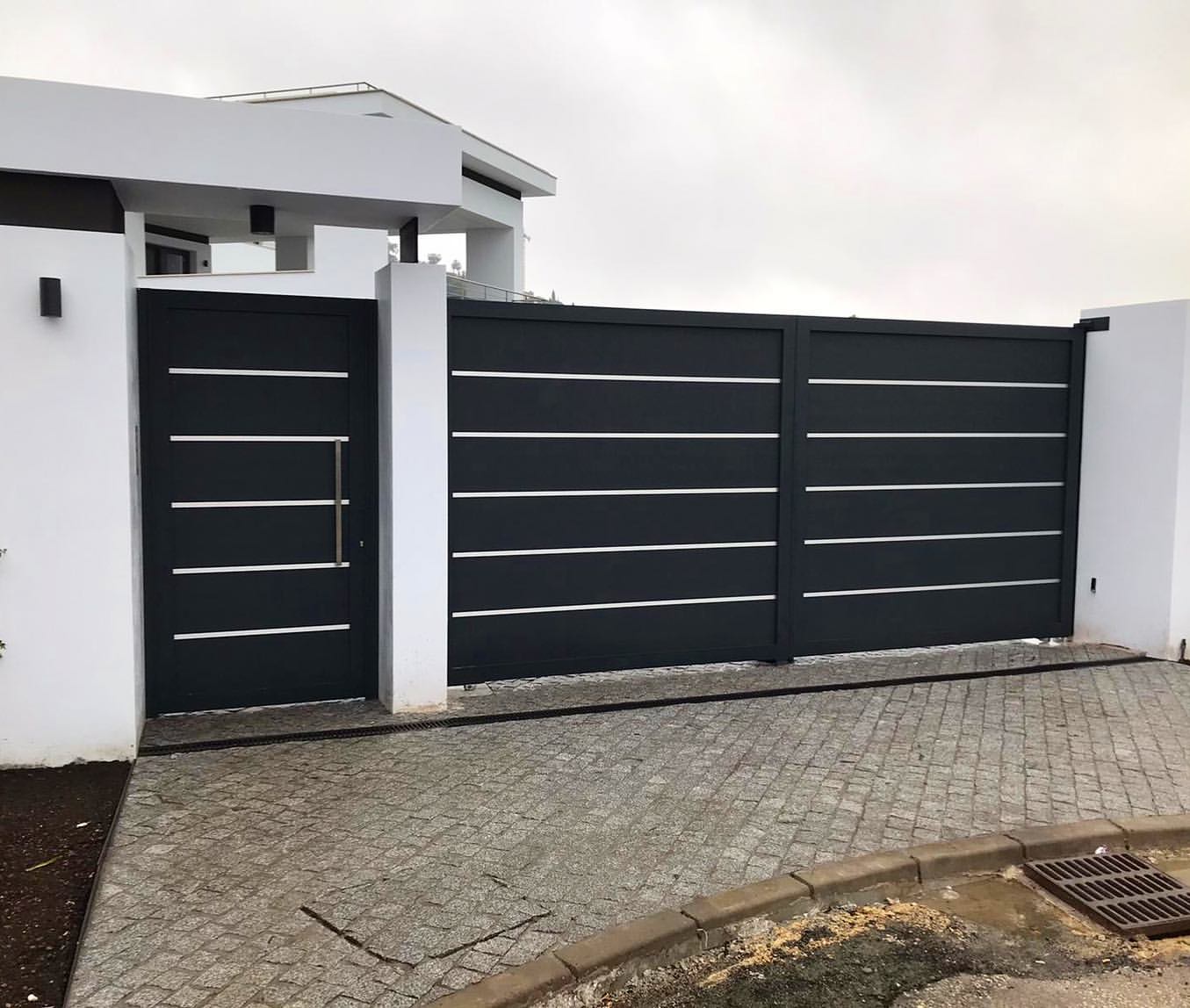
Horizontal slats are a confident choice for contemporary homes and renovated properties with a clean exterior palette. Evenly spaced aluminium sections create a crisp, architectural frontage while allowing light and air to pass through.
The spacing changes the character of the gate. Tighter gaps provide greater privacy, while wider gaps feel lighter and offer a clearer view towards the house. This design works particularly well when continued across matching fence panels, creating one considered boundary rather than a gate that feels added as an afterthought.
2. Vertical slatted gates
Vertical slats bring height and rhythm to a frontage. They can make a low, wide entrance appear more proportioned, and they complement properties with vertical cladding, tall windows or traditional brickwork.
For homes on busier roads, vertical slats with modest gaps can soften views into the driveway without creating a heavy, solid wall. The result is private enough for everyday comfort but not overly defensive.
3. Solid privacy gates
A solid-panel gate is designed for discretion. It is a strong option for homes close to a pavement, properties with vehicles parked near the entrance or gardens where privacy matters as much as access control.
A plain solid gate need not look plain. Subtle shadow gaps, a framed perimeter, a contrasting post colour or a refined satin finish can add depth without compromising the calm, minimal look. Dark grey, black and muted bronze tones are popular, but the finish should relate to the window frames, front door and surrounding materials rather than follow a trend blindly.
4. Gates with integrated pedestrian access
Many driveways benefit from a separate pedestrian gate placed alongside the main vehicle entrance. It prevents the inconvenience of opening large gates for post, visitors or a quick walk out, while retaining a coordinated appearance.
The strongest schemes make the pedestrian entrance look intentional, not like a narrow leftover space. Matching slats, rails, frame lines and colour help it sit naturally beside the driveway gates. An integrated intercom or access control panel can keep the approach uncluttered and easy to use.
5. Contemporary swing gates
A pair of swing gates remains one of the most recognisable residential entrance formats. They suit level driveways with enough internal space for the leaves to open safely, and their balanced form gives even simple designs a formal, considered presence.
Swing gates can carry almost any visual treatment, from slender horizontal slats to fully private panels. They are especially effective on wider entrances, where two equal leaves reinforce symmetry. On a sloping driveway, however, clearance and opening geometry need careful assessment before this option is specified.
6. Sliding gates for compact driveways
Where a driveway rises immediately behind the entrance, opens onto a busy road or has limited swing clearance, a sliding gate can be the more practical answer. It travels sideways along the boundary, leaving the approach clear and avoiding the outward sweep of gate leaves.
A sliding system needs enough run-back space beside the opening, or a suitable tracked arrangement where site conditions allow. It also requires a properly engineered foundation and accurate installation. These are not details to leave until late in a project: the practical layout should shape the design from the outset.
7. Cantilever sliding gates
Cantilever gates slide without a track across the driveway opening. Their ground clearance is valuable where leaves, gravel, standing water or uneven surfaces could interfere with a tracked system.
This format often suits premium contemporary homes and exposed sites because it delivers a particularly clean opening. The trade-off is the additional side room required for the counterbalanced section, so it is best considered where the boundary layout can accommodate it.
8. Telescopic gates for restricted side space
A telescopic gate uses overlapping leaves that slide and stack together. It is a smart solution where a conventional sliding gate would need more side run-back than the site can offer.
It is not the simplest mechanism, and precision matters. Yet on narrow plots or entrances constrained by a garage, retaining wall or planting, telescopic operation can make an otherwise impossible automated gate scheme achievable.
9. Bi-folding driveway gates
Bi-folding gates fold back in sections, reducing the space needed inside the driveway and allowing a rapid opening cycle. They are a practical choice for homes where residents arrive and leave frequently, or where depth behind the entrance is limited.
Their more technical operation makes build quality and correct specification essential. A fully welded aluminium structure helps retain alignment and gives the gate the strength needed for regular use, particularly when automation is involved.
10. Aluminium gates with feature infill
Not every design needs to rely on repeated slats. Feature infill can introduce a more individual appearance through geometric patterns, perforated aluminium, laser-cut detailing or contrasting sections within an otherwise simple frame.
The most successful feature designs are restrained. A pattern that relates to the architecture of the house or nearby metalwork will feel bespoke; one used only to be decorative can quickly date. Consider sightlines too, as intricate cut-outs may offer less privacy after dark when interior or driveway lighting is on.
11. Traditional-inspired aluminium gates
Period homes do not have to default to timber or wrought iron. Aluminium can be fabricated into designs with vertical rails, shaped tops, restrained decorative details and proportions suited to Victorian, Georgian or country properties.
The advantage is the ability to retain a more traditional silhouette while gaining a low-maintenance finish. Avoid copying historic metalwork too literally if the wider frontage is modernised. Often, a simplified interpretation with quality proportions looks more convincing and is easier to live with.
12. Coordinated gates, fencing and posts
Some of the most impressive residential gate design examples are not defined by the gate alone. They use coordinated fencing, side screens, posts and pedestrian access to create a complete entrance composition.
This approach is particularly valuable on corner plots and long front boundaries, where a beautiful gate can appear isolated if the surrounding fencing is mismatched. Continuing the same aluminium profile and finish creates visual continuity, while masonry piers, rendered walls or lighting can provide contrast and weight.
How to choose the right gate format
Begin with movement, not colour. Measure the clear opening, the driveway depth, slope, turning space and available room along each boundary. A design may be visually perfect but unsuitable if a vehicle must stop in the road while the gate opens, or if an opening leaf obstructs a parked car.
Then decide how much privacy you need. Solid panels offer the greatest screening, while slatted designs bring lightness and partial visibility. If security is the priority, remember that a gate should form part of a wider approach that includes suitable locks, automation, access control, boundary treatment and lighting.
Finally, consider proportion. Tall gates can feel imposing on a modest frontage, while short gates may appear insubstantial beside substantial brick piers. Made-to-measure fabrication allows rail spacing, leaf widths, heights and frame details to be adjusted to the property rather than forcing the property to suit a standard size.
Finish, fabrication and everyday ownership
A premium gate earns its place through the details that are less visible on day one. Fully welded aluminium construction provides a cleaner, stronger alternative to assembled sections, helping the frame retain its form through regular operation and changing weather. A high-quality powder-coated finish gives lasting colour and reduces the burden of maintenance.
For most homeowners, low maintenance means occasional cleaning rather than annual repainting. That is a major attraction when gates are wide, automated or difficult to reach. It also makes aluminium a considered long-term investment for coastal areas, shaded driveways and properties exposed to rain and road debris.
Automation should feel equally considered. Remote controls are useful, but keypad entry, vehicle detection and video intercoms can make daily access more secure and convenient. Plan cable routes, power supply and visitor access early, particularly where gate posts, lighting and an Akuvox intercom are intended to work together.
At Alu-Gate, each entrance can be specified around the property rather than selected from a one-size-fits-all range, with precision-welded aluminium fabrication and a 20-year guarantee supporting long-term ownership.
The right gate does not need to shout for attention. It should make the approach to your home feel more secure, more composed and unmistakably yours – every time you arrive.