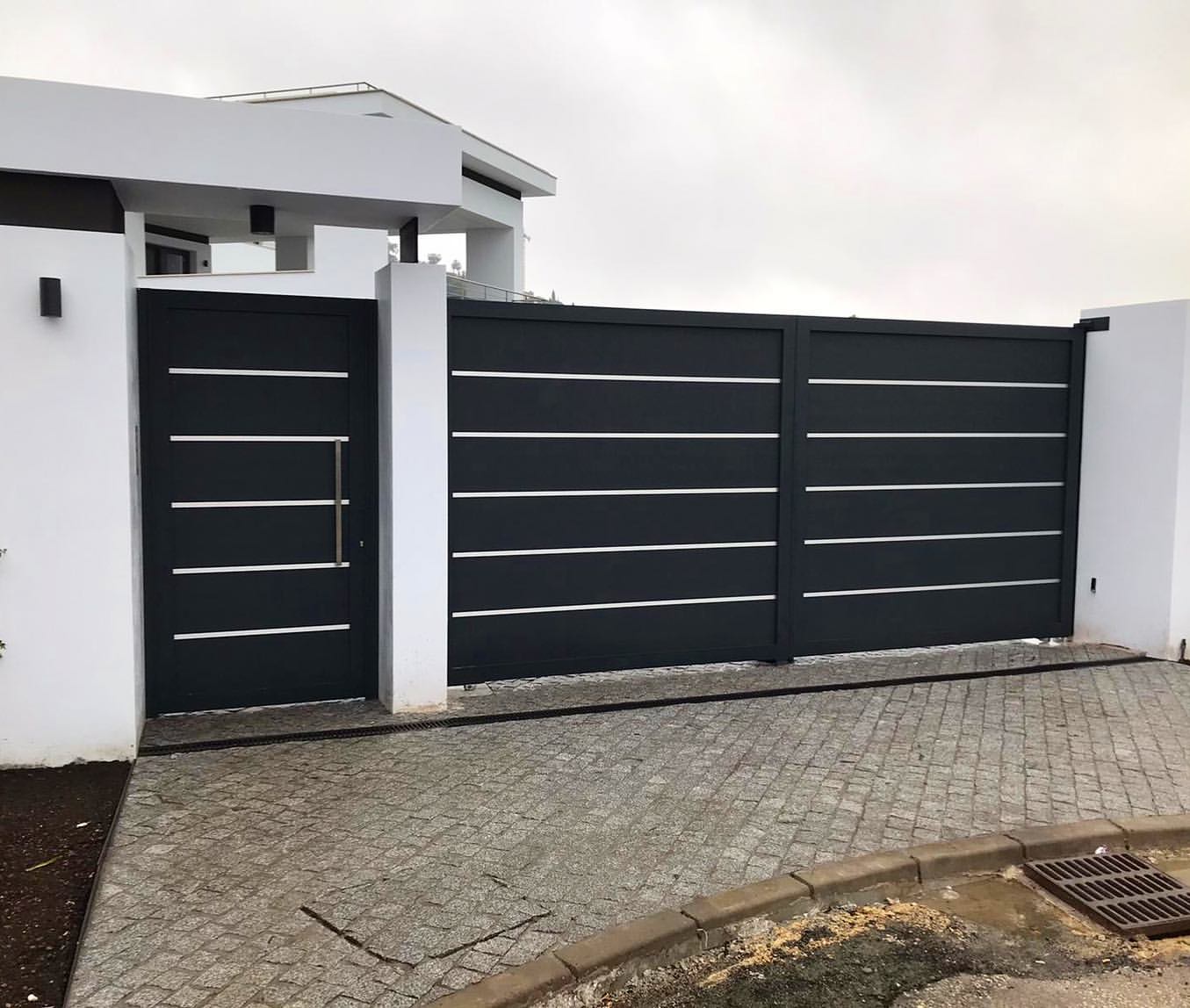

A wide driveway entrance can make conventional swing gates impractical. When space behind the gate is limited, or you need a fast, controlled opening cycle, the choice often comes down to bi folding vs telescopic gates. Both systems offer a premium alternative to a single sliding or swinging leaf, but they solve the space question in very different ways.
The right answer depends on more than the width of your opening. You need to consider available run-back room, gradients, usage levels, access control and the visual statement you want your entrance to make. A made-to-measure aluminium system allows those details to be resolved properly rather than compromised.
Bi Folding vs Telescopic Gates: the Core Difference
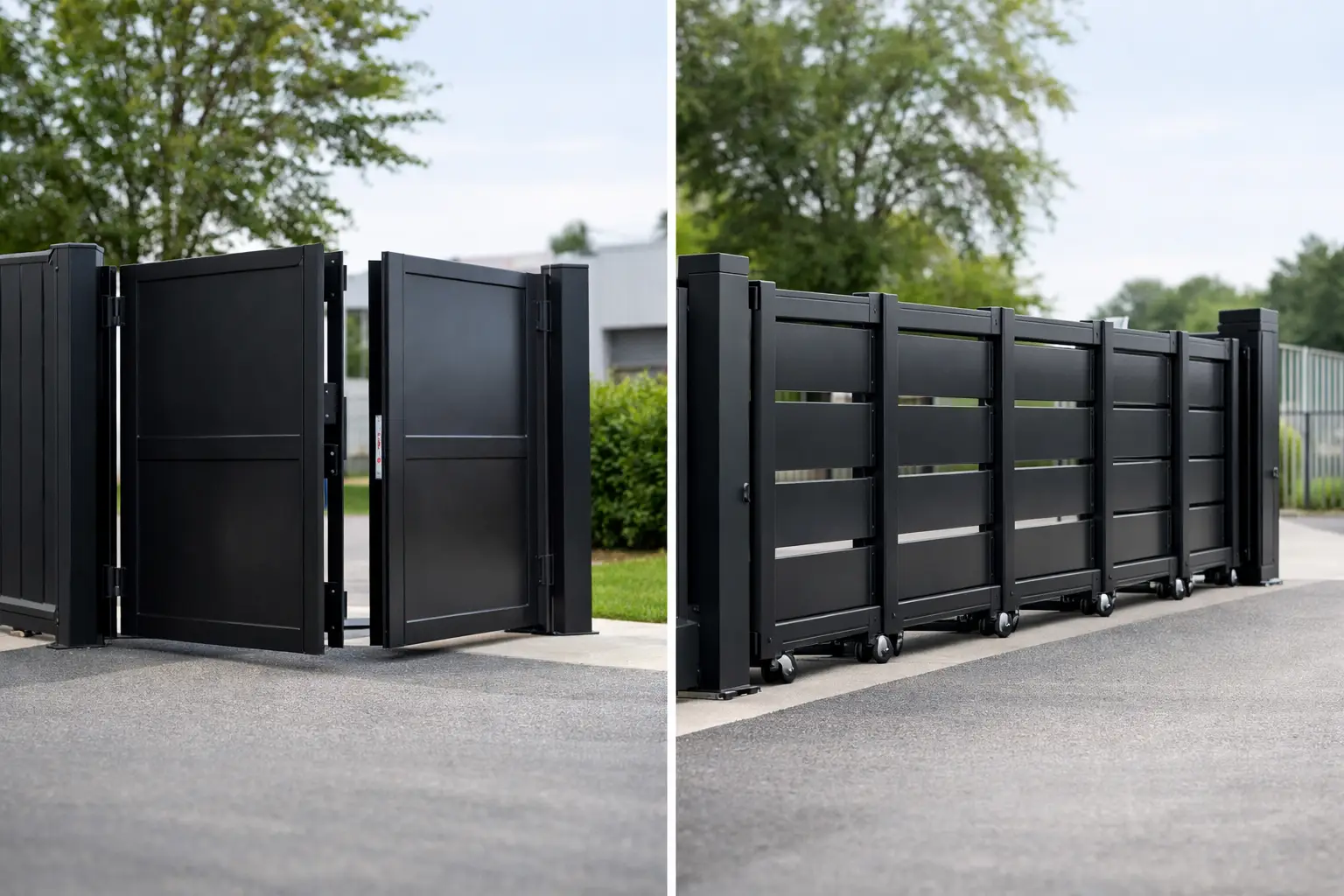
Bi-folding gates consist of two leaves that fold in the middle as they open, much like a folding door. The leaves can open inwards or outwards, depending on the site layout, and typically create a compact folded stack at each side of the entrance.
Telescopic gates are sliding gates made from two or more overlapping panels. As the gate opens, the panels move in sequence and stack behind one another along the fence line. This means they need less lateral run-back space than a single sliding gate of the same opening width.
Both formats are well suited to wide driveways and commercial entrances. The practical distinction is simple: bi-folding gates use space within or immediately around the driveway, while telescopic gates use space along the boundary.
When Bi-Folding Gates Are the Better Choice
Bi-folding gates are particularly effective where a property has a broad entrance but no clear fence line for a sliding gate to travel along. They deliver a quick opening action and require far less swing clearance than traditional double driveway gates.
For residential properties, this can be a significant advantage. A pair of full-width swing gates may need several metres of unobstructed driveway to open safely. Bi-folding leaves reduce that requirement considerably, leaving more usable space for vehicles, planting and turning areas.
They also make a confident architectural statement. When fabricated in aluminium with clean horizontal profiles, vertical slats or a solid contemporary design, bi-folding gates suit modern homes, renovated period properties and design-led developments alike. The folding action feels purposeful and impressive without becoming overly complicated for the user.
Consider the ground and operating area
A bi-folding system does need a clear area for the folded leaves to move into. Parked vehicles, raised kerbs, drainage channels, steep slopes and landscaping can all affect the available operating zone. Opening direction matters too. In many domestic settings, gates should open into the property so they do not obstruct the pavement or carriageway.
The gate’s travel must be assessed alongside the approach to the driveway. If a car needs to wait in a narrow road while the gates operate, speed and automation become especially important. A professionally specified system will account for safe opening speed, photocells, safety edges and the position of intercom or keypad access.
Where bi-folding gates stand out
Bi-folding gates are often the strongest option for entrances with limited depth but adequate space to each side of the opening. They are also well suited to sites where fast access is a priority, such as busy private driveways, managed developments and commercial premises with regular vehicle movement.
Their main trade-off is mechanical complexity. Folding systems have more moving points than a conventional swing gate, so precision fabrication, quality hinges and careful installation are essential. Premium aluminium construction helps keep the leaves stable, corrosion-resistant and manageable in weight, supporting reliable automated operation over the long term.
When Telescopic Gates Are the Better Choice
Telescopic gates are designed for sites where sliding is the most logical movement, but the boundary does not offer enough room for one full-length gate leaf. A 6-metre entrance, for example, would normally require around 6 metres of clear run-back space for a single sliding gate. A two-panel telescopic design can reduce that requirement to roughly half the opening width, subject to the final layout.
This makes telescopic gates an excellent choice for properties with a usable side return, fencing line or boundary wall, but restricted land beyond it. They keep the driveway itself clear during operation because the panels travel sideways rather than folding into the entrance.
For commercial sites, telescopic systems can be particularly compelling. They can secure wider openings without demanding excessive land at the side of the gate, helping maintain efficient vehicle access for staff, visitors and deliveries. Their linear movement also works well with controlled entry systems, including intercoms, keypads, fobs and vehicle detection.
A strong solution for slopes and constrained driveways
Sliding and telescopic gates do not sweep across the driveway in the way swing or bi-folding gates do. That makes them a practical option where the driveway rises immediately behind the entrance, where there is limited manoeuvring space, or where vehicles need to park close to the gate line.
However, the side run must be genuinely clear. Posts, mature trees, service cabinets, uneven walls and changes in level can all limit what is possible. The panels also need a carefully designed track or cantilever arrangement, depending on the specification. This is not a detail to leave to guesswork, particularly on a premium entrance installation.
The visual character of telescopic gates
Telescopic gates tend to create a composed, linear look. When closed, the overlapping panels read as one refined gate face. When open, they stack neatly at the side rather than presenting folded leaves within the driveway.
This format works exceptionally well with coordinated aluminium fencing and side panels. Matching colours, profile spacing and privacy levels can carry the design across the full frontage, creating a complete boundary rather than a gate that looks added as an afterthought.
Space Is Not the Only Decision Factor
It is tempting to decide purely on measurements: choose bi-folding gates if there is no side run, choose telescopic gates if there is. That is a useful starting point, but it is not the whole specification.
Think about how the entrance will be used every day. A private home with two cars may prioritise quick access and kerb appeal. A commercial site may need dependable repeated cycles, clear sightlines and controlled pedestrian separation. A shared development may require a system that accommodates frequent arrivals without holding vehicles on the road.
Security should also shape the decision. Both gate types can be specified as strong physical boundaries, particularly with fully welded aluminium frames and well-designed infill profiles. The perceived level of privacy will depend on whether you choose open slats, semi-private spacing or a more solid panel design. Automation and access control then add another layer of convenience and oversight.
Why Aluminium Is Suited to Both Systems
Gate movement places constant demands on the frame. Heavy materials can place greater stress on hinges, motors, tracks and supporting posts, especially on wide openings. Aluminium offers an excellent balance of strength and manageable weight, making it well suited to both folding and telescopic configurations.
It also avoids the routine upkeep associated with timber gates, which may need regular staining, sealing and repair as they weather. Premium powder-coated aluminium provides a durable finish with a broad choice of contemporary colours, while the material itself is resistant to rust and rot.
At Alu-Gate, bespoke fabrication means the gate format, profile design and supporting structure can be considered together. Fully welded construction is particularly valuable on a moving gate system, helping deliver the clean finish and structural integrity expected from a long-term investment.
Specify the System Before Choosing the Style
The strongest results come from resolving the engineering first, then refining the appearance. Measure the clear opening, but also assess the driveway depth, side run, slope, turning circle, parking positions, utilities and pedestrian route. These practical details determine whether the gate will feel effortless to use once installed.
Automation should be planned at the same stage. The motor type, safety equipment, release mechanism and access control all need to suit the gate’s movement and expected frequency of use. A premium entrance should look elegant when closed and operate with equal confidence every day.
For a driveway with limited side run and a need for swift opening, bi-folding gates can be the right answer. Where the driveway must remain clear and there is enough boundary length for panels to stack, telescopic gates offer a precise, space-efficient solution. The best gate is the one designed around your property rather than forced into it.