
A boundary should do more than mark where your land ends. It should give you privacy where it matters, make unwanted access more difficult and complement the architecture of the property. Secure boundary fencing solutions achieve all three when they are specified around the site, rather than selected from a standard-size catalogue.
For a driveway, garden or commercial perimeter, the right fencing creates a clear first line of protection without turning the property into a fortress. The material, panel design, height, fixing method and relationship with gates all affect the finished result. A considered system feels composed from the pavement, yet performs reliably every day.
What Makes Boundary Fencing Secure?
Security begins with construction. A fence that can be pushed, climbed, lifted or worked loose is unlikely to provide lasting reassurance, no matter how substantial it appears on installation day. The strongest schemes consider the whole boundary: panels, posts, ground fixings, gates, locks and access points.
Fully welded aluminium fencing offers a particularly refined answer for properties where appearance and long-term performance carry equal weight. Unlike lightweight, sectional alternatives, a precision-welded panel has a unified structure. There are fewer components to loosen over time, and the clean lines suit both contemporary homes and more traditional settings when the profile and colour are chosen carefully.
Height also needs judgement. Taller fencing can increase privacy and discourage casual access, but it may be subject to planning rules, particularly beside a highway or near a listed building. For many homes, a balanced design using a solid lower section with carefully spaced upper slats provides definition and screening without making the frontage feel closed in. Commercial sites may need a more overtly security-led specification, but should still account for visibility, access and the day-to-day needs of staff and visitors.
Why Aluminium Is a Stronger Long-Term Choice
Timber fencing has a familiar appeal, but it asks for ongoing attention. Moisture, movement, rot, fading and regular treatment can gradually change both its appearance and performance. Steel can be highly capable, yet its long-term finish depends on proper protection against corrosion, especially in exposed or coastal locations.
Premium aluminium fencing does not rust and is naturally suited to the British climate. With a high-quality powder-coated finish, it retains a crisp, consistent appearance with very little maintenance. Routine cleaning is usually enough to remove surface dirt and keep the fencing looking its best.
That low-maintenance ownership is not simply a convenience. It protects the investment in the wider exterior scheme. A boundary fence is often installed alongside a new driveway, landscaping, entrance gate or rendered façade. Choosing a material that will not demand repainting and repair every few years helps the whole property continue to look considered.
Aluminium is also exceptionally adaptable. Panels can be made to measure around changes in level, awkward returns, existing walls and non-standard openings. Rather than relying on visible filler sections or compromised cuts, bespoke fabrication allows the design to follow the boundary properly.
Secure Boundary Fencing Solutions Need a Joined-Up Design
A fence can only be as secure as the gaps around it. This is why the relationship between fencing and gates deserves attention at the earliest stage of a project. A beautifully made driveway gate loses some of its purpose if a neighbouring side access or low panel creates an obvious weak point.
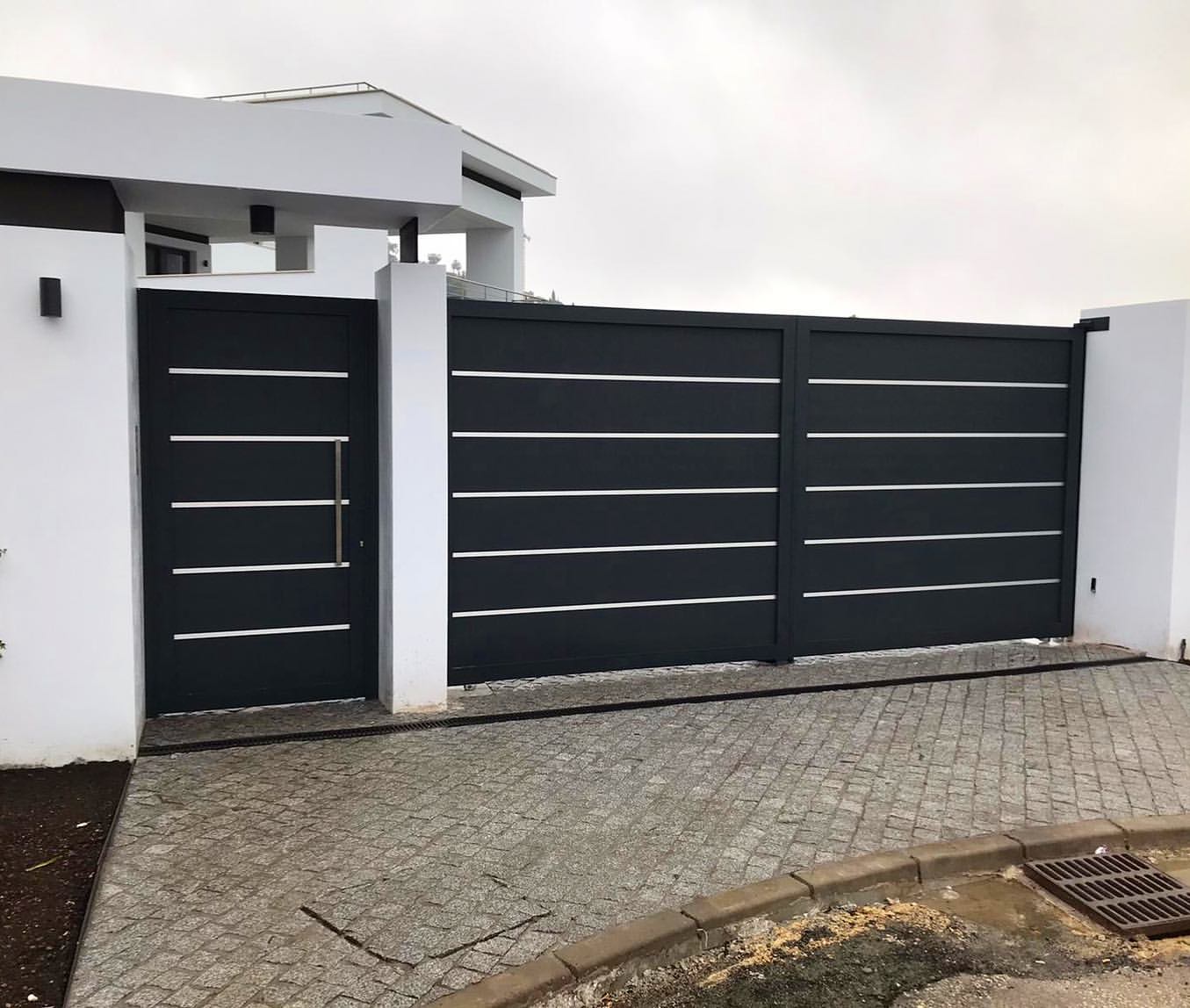
For residential properties, coordinated fencing and gates create a consistent perimeter. Matching horizontal slats, vertical bars or solid privacy panels can be carried from the driveway entrance to garden boundaries and pedestrian access. The result is more than visual continuity. It makes the boundary easier to read and reduces opportunities for poorly considered transitions.
Where pedestrian access is required, a matching aluminium garden gate or side gate can be specified with dependable hinges, a suitable latch or lock and an opening direction that works naturally with the site. On larger driveways, sliding, swing, telescopic or bi-folding gates may each be appropriate depending on available space, gradient and how vehicles approach the entrance.
Automation and access control add another layer. An intercom system allows residents or site managers to identify visitors before granting access, while controlled vehicle gates can remove the need to leave a car unattended at the entrance. These features should support a secure physical boundary, not compensate for a weak one.
Choosing the Right Panel Style
The most suitable fencing style depends on what the boundary needs to achieve. Privacy is usually the deciding factor for gardens and roadside frontages. Security and sightlines can take priority around commercial premises, shared access routes or properties where visibility from the house is valuable.
Slatted fencing for privacy with presence
Horizontal aluminium slats create a modern, architectural finish and can be spaced to control views in and out. Closer spacing gives stronger privacy, while a more open arrangement admits light and allows sight through the boundary. This format works particularly well when carried into a matching sliding or swing gate.
Vertical bar fencing for visibility
Vertical bars offer a more open, formal appearance. They define the perimeter clearly without concealing the property, making them a practical option where natural surveillance matters. The spacing and height should be selected with security in mind, avoiding designs that are easy to climb or create large access gaps.
Solid or mixed panels for exposed boundaries
A solid panel can provide welcome screening from a busy road, neighbouring windows or an exposed garden edge. Combining solid sections with slatted or bar detailing often produces a lighter visual result while protecting the areas that need most privacy. It is a useful approach where one boundary performs several roles.
Colour has a similar effect. Anthracite grey, black and darker architectural finishes give a strong, contemporary definition, while lighter colours can soften a long run of fencing. The best choice usually relates to window frames, brickwork, cladding and the gate finish rather than following a passing trend.
The Details That Determine Performance
Premium fencing is defined by the elements that are easiest to overlook. Posts must be correctly sized and securely fixed for the panel span, ground conditions and local exposure. A long, wind-facing run requires different consideration from a short sheltered garden boundary. Poor alignment or inadequate foundations can undermine even the finest panels.
Drainage and levels matter too. Fencing should follow a sloping site in a deliberate way, either stepping cleanly or raking where the design permits. A panel that sits too close to the ground may trap debris and moisture, while inconsistent clearances can make the installation look unfinished.
Finish quality deserves equal scrutiny. Powder coating should be applied to carefully prepared aluminium for durable colour retention and an even surface. At Alu-Gate, bespoke aluminium systems are precision welded and made around the individual project, with a 20-year guarantee providing added confidence in their long-term value.
Before placing an order, take time to assess the full boundary rather than only the most visible elevation. Consider delivery access, existing walls, services below ground, gate opening arcs, vehicle turning space and how the fence will meet adjoining structures. A detailed consultation at this stage prevents costly adjustments later.
Security Without Sacrificing Kerb Appeal
The strongest boundary schemes do not rely on intimidating features alone. They use proportion, material and detail to make the property feel private, protected and well cared for. A low front wall with taller aluminium panels behind it, for example, can add depth and security while maintaining an inviting street presence.
For commercial properties, the same principle applies. Entrance fencing should communicate that the site is professionally managed, while allowing legitimate visitors to understand where to go. A coordinated gate, access control point and clearly defined pedestrian route can improve security and make arrivals more straightforward.
A well-designed boundary becomes part of the property’s architecture, not an afterthought added once a problem arises. Choose secure boundary fencing solutions that are made for the dimensions, conditions and character of your site, and the result will provide reassurance every time you arrive home or open for business.