
A driveway gate should not make you stop in the rain, leave the car running or compromise the security of your property. Gate automation turns a well-designed entrance into a controlled, convenient point of access – opening precisely when authorised and closing with confidence behind you.
For homeowners, this is often the final detail that makes a driveway upgrade feel complete. For commercial premises, it can be a practical way to manage traffic, protect assets and maintain a professional arrival experience. The best result is never simply a motor fitted to a gate. It is a made-to-measure system in which gate design, operating method, safety equipment and access control are specified to work together.
What gate automation should deliver
A premium automated gate should make access easier without drawing attention to itself. You should be able to arrive, enter and leave without unnecessary delay, while retaining control over who can reach the property. It should also complement the architecture of the home or site, rather than looking like an afterthought attached to the driveway.
Security is central, but convenience matters too. Remote controls, keypad entry, video intercoms and smartphone-enabled systems allow access to be managed in ways that suit daily life. A family home may need straightforward operation for several drivers, deliveries and visitors. A commercial site may need timed access, individual credentials or a way to verify visitors before allowing entry.
Long-term reliability depends on the entire installation. The gate must be strong enough for its size and use, correctly balanced and supported by suitable posts, foundations, hinges or trackwork. The automation equipment then needs to be matched to the weight, travel and frequency of operation. Choosing components in isolation can lead to slow operation, premature wear and avoidable call-outs.
Choosing the right automated gate format
The physical constraints of the site usually determine the best starting point. Driveway depth, gradient, available run-back space, traffic flow and local wind exposure all influence the right gate format.
Automated swing gates
Swing gates remain a popular choice for residential driveways because they create a classic, substantial entrance and can be designed in a wide range of contemporary or traditional styles. They open inwards or, where the site allows, outwards, using articulated, underground or ram-style operators.
They need sufficient clear space for the leaves to move. This is particularly important where a driveway slopes towards the road or where vehicles need to wait off the public highway while the gates open. Wider or heavier leaves also place greater demands on hinges, posts and automation, so fully welded aluminium construction and careful engineering are valuable from the outset.
Sliding, telescopic and bi-folding gates
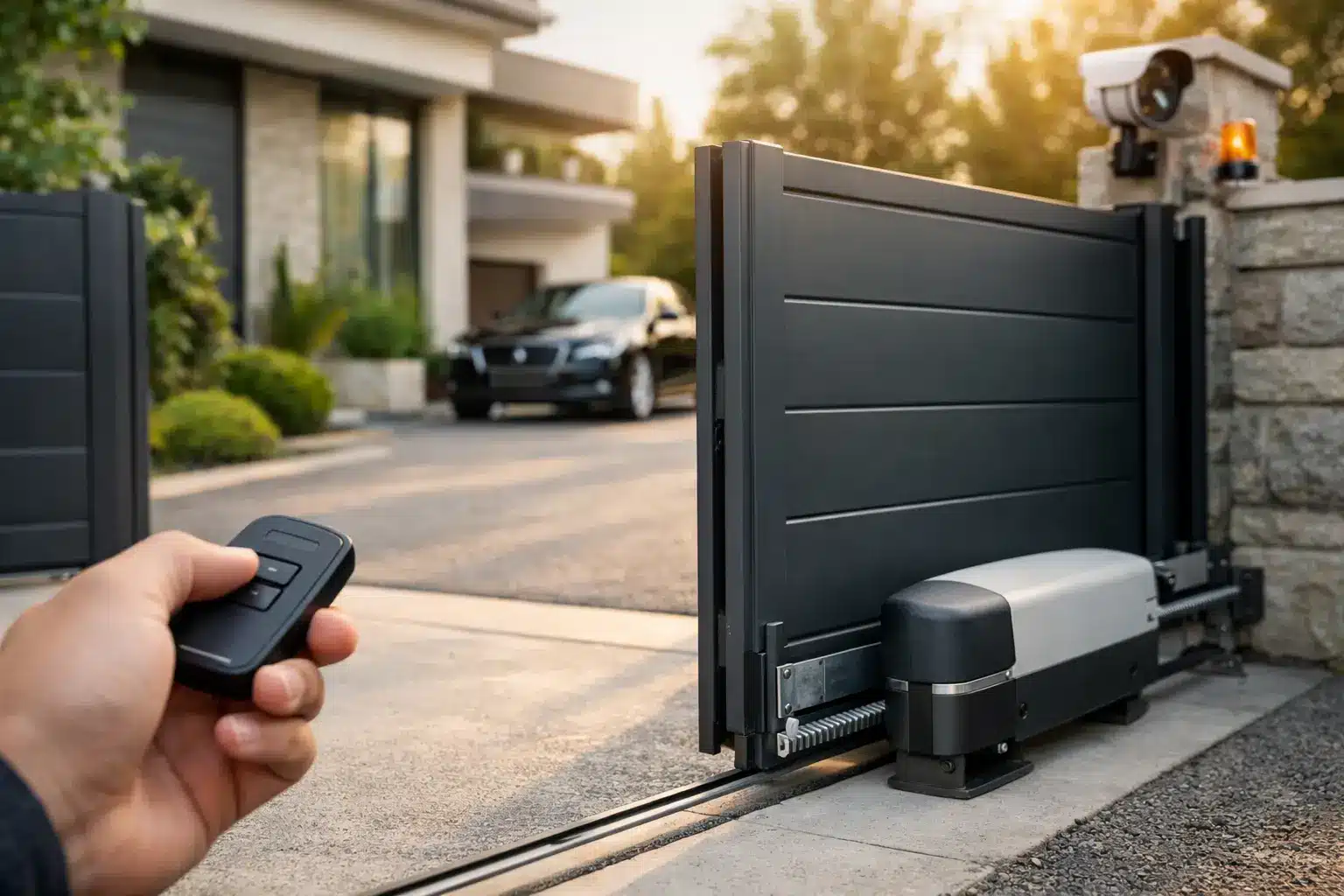
A sliding gate is often the practical answer when there is limited depth behind the entrance, a steep approach or a requirement to keep gate movement within the property boundary. A single sliding leaf moves horizontally along a track or cantilevers above the driveway surface, depending on the system specified.
Where full run-back space is unavailable, telescopic gates divide the opening across two or more leaves that travel together. Bi-folding gates offer another compact option, opening quickly and folding back within a smaller area. These formats can be particularly effective for busy commercial entrances, though each has different requirements for foundations, guide hardware and maintenance access.
There is no universally superior choice. A swing gate can be ideal for a broad, level private driveway, while a sliding or telescopic system may provide a more efficient solution for a constrained urban site. A detailed survey prevents a visually impressive design becoming an impractical one.
Specify the gate before the motor
Gate automation performs best when it is designed around the gate, not retrofitted as a quick addition. The material, fabrication method and overall geometry affect how the system operates every day.
Aluminium is particularly well suited to automated entrances because it provides strength without the excessive weight associated with many steel or timber alternatives. A lighter gate can reduce strain on moving parts, while aluminium’s resistance to corrosion supports low-maintenance ownership in the British climate. This does not remove the need for quality engineering. Large gates still require appropriately sized frames, precision welding and correctly specified hardware.
A bespoke design also allows practical details to be resolved early. These include the location of posts, cable routes, drainage around sliding tracks, ground clearance, pedestrian access and the positioning of safety devices. Coordinating the gate with matching fencing, side panels and a pedestrian gate creates a more considered boundary while avoiding awkward compromises later.
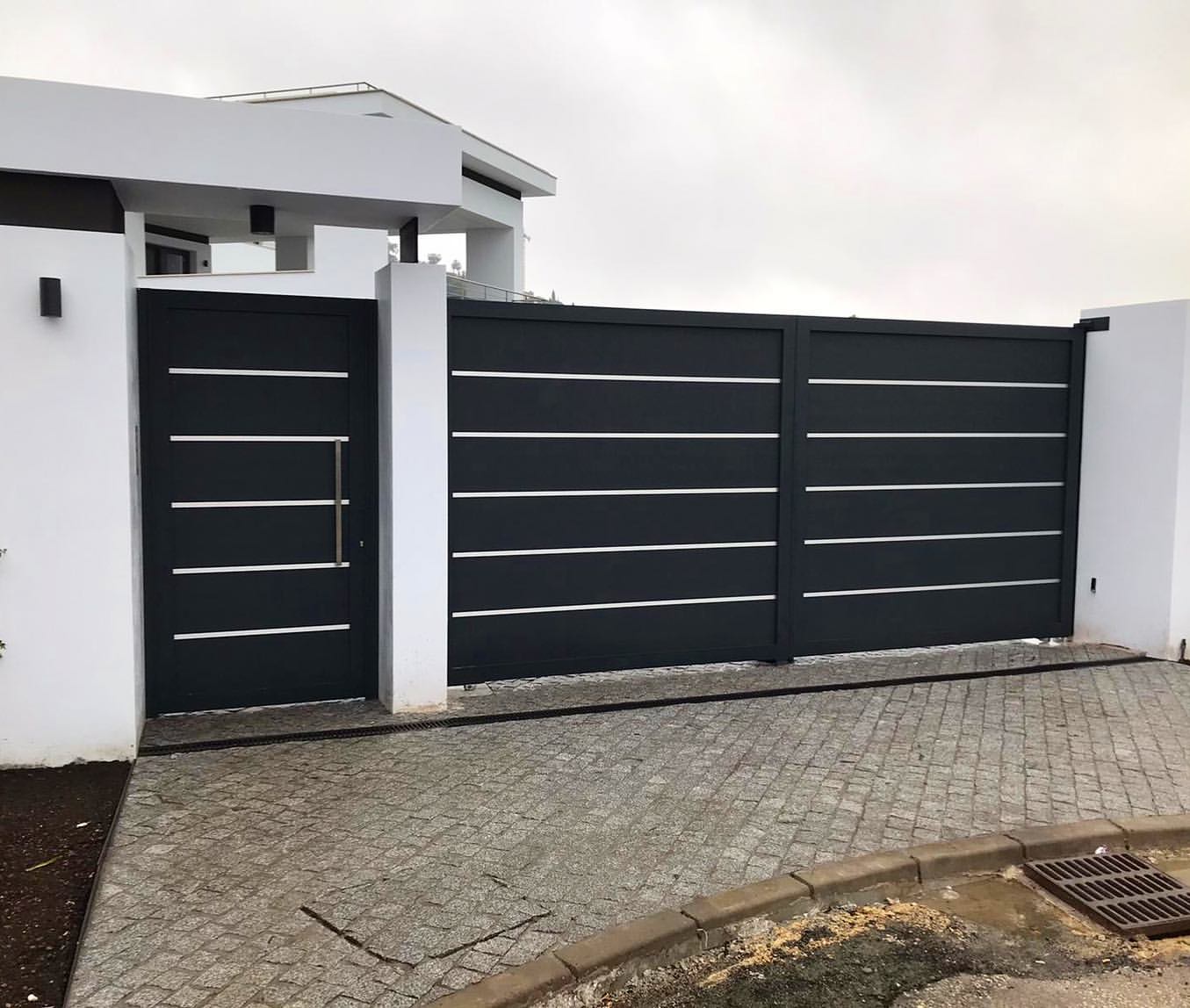
Finish deserves the same attention. A premium powder-coated aluminium gate can be specified in a colour and style that suits the property, from architectural dark tones to warmer, more traditional shades. The aim is durability as well as kerb appeal. An entrance is one of the first things visitors see, but it must withstand regular use, changing weather and everyday contact.
Access control that fits how you use the property
The simplest automated gates operate from hand-held remotes. They are reliable and familiar, but may not offer the control needed for frequent visitors, tradespeople or a multi-user commercial site. A keypad can provide a practical secondary method of entry, particularly for trusted guests and service providers.
For many premium homes, video intercoms offer the strongest balance of convenience and oversight. An Akuvox intercom, for example, can allow residents to see and speak to a visitor before releasing the gate, whether they are inside the house or away from the property. The right system depends on network availability, how many users require access and the level of control expected.
Commercial buyers may need a more structured arrangement. Proximity fobs, access cards, vehicle detection and programmed opening times can reduce reliance on a staffed entrance. However, more features are not automatically better. A system should be easy for authorised users to understand, straightforward to maintain and proportionate to the site’s actual risks.
Safety is part of the specification, not an add-on
An automated gate is a moving piece of machinery. Its safety design must account for people, vehicles, pets and objects entering or passing through the opening. This requires more than a basic obstruction setting on the motor.
The exact safety measures depend on the gate type, layout and risk assessment, but they can include photocells, safety edges, force limitation, warning lights and emergency release mechanisms. Photocells can detect an obstruction across the entrance, while safety edges help protect potential trapping or crushing points. A competent installer will identify hazards around hinges, closing edges, gaps, guide rollers and the surrounding boundary.
Manual release is also essential. In the event of a power cut or equipment fault, authorised users need a safe way to operate the gate. Battery backup may be appropriate for some properties, especially where access is critical, but it should be specified according to the expected use rather than assumed as standard.
Safety equipment must be kept functional after installation. Landscaping changes, impact damage, dirt on photocells and poorly planned alterations to the entrance can all affect how the system performs. Periodic inspection is a sensible part of responsible ownership.
Plan for installation and ownership
A high-quality automated entrance begins with an accurate site assessment. Measurements alone are not enough. The installer or supplier needs to understand levels, driveway width, ground conditions, mains power availability, drainage and how vehicles approach the entrance. If the gates sit close to a public road, the space available for a vehicle to wait is especially important.
Electrical work should be planned early, including protected cable routes and the location of controls, intercoms and isolation points. Retrofitting power after landscaping, paving or walls are complete can add disruption and cost. Equally, foundations and posts should be designed for the gate system, not treated as minor groundwork.
Ownership is generally straightforward when the system has been properly specified. Keep tracks clear where applicable, check that safety devices are clean and unobstructed, and arrange servicing at suitable intervals based on frequency of use and the manufacturer’s guidance. Gates at a lightly used home will have different needs from those at a busy business premises.
It is worth considering the value of a long guarantee too. A 20-year guarantee on a premium aluminium gate speaks to confidence in the material and fabrication, although motors, controls and moving hardware will have their own service expectations. Asking clear questions about each part of the system gives a more realistic picture of lifetime value.
Gate automation that looks as good as it performs
The most successful automated entrance feels intentional from every angle. Its proportions suit the opening, its finish works with the property, and its operation is quiet, controlled and dependable. That result comes from considering the gate, structure, access control and safety equipment as one design decision.
For a new-build, renovation or commercial upgrade, take time to define what the entrance must achieve before choosing the mechanism. A well-planned automated gate does more than open and close. It sets the standard for the property beyond it – secure, considered and built to last.