
A well-planned entrance does more than mark the edge of a property. When you design gated entrances around the way a site is used, they create a strong first impression, improve security and make everyday access feel effortless. The best results come from treating the gate, fencing, access control and surrounding architecture as one considered system – not as separate purchases.
For a driveway renovation, self-build or commercial perimeter, the aim is simple: an entrance that looks exceptional on day one and continues to perform through years of British weather, regular use and changing security needs.
Start with how the entrance needs to work
Before choosing a gate style or colour, consider the practical demands of the site. Who uses the entrance, how often, and in what vehicles? A gate serving one family car has different requirements from one used by delivery vehicles, visitors or a busy commercial site.
Measure the clear opening rather than relying on the width of an existing gate. Also allow for pillars, posts, hinges, automation equipment and the path each gate leaf will travel. A visually impressive design can become frustrating if it restricts turning space, narrows access or requires drivers to stop in the road while it opens.
The ground level matters just as much. A sloping driveway may rule out a conventional pair of swing gates unless their opening direction and ground clearance have been carefully planned. In these settings, sliding, telescopic or bi-folding gates can provide a more practical answer without compromising the appearance of the entrance.
For commercial premises, plan for the largest legitimate vehicle likely to need access. It is usually more cost-effective to specify suitable clear widths at the outset than to alter a finished entrance after installation.
Choose the right gate configuration
There is no universal best gate format. The right choice depends on available space, access patterns, the gradient of the site and the architectural character of the property.
Swing gates for a balanced, traditional approach
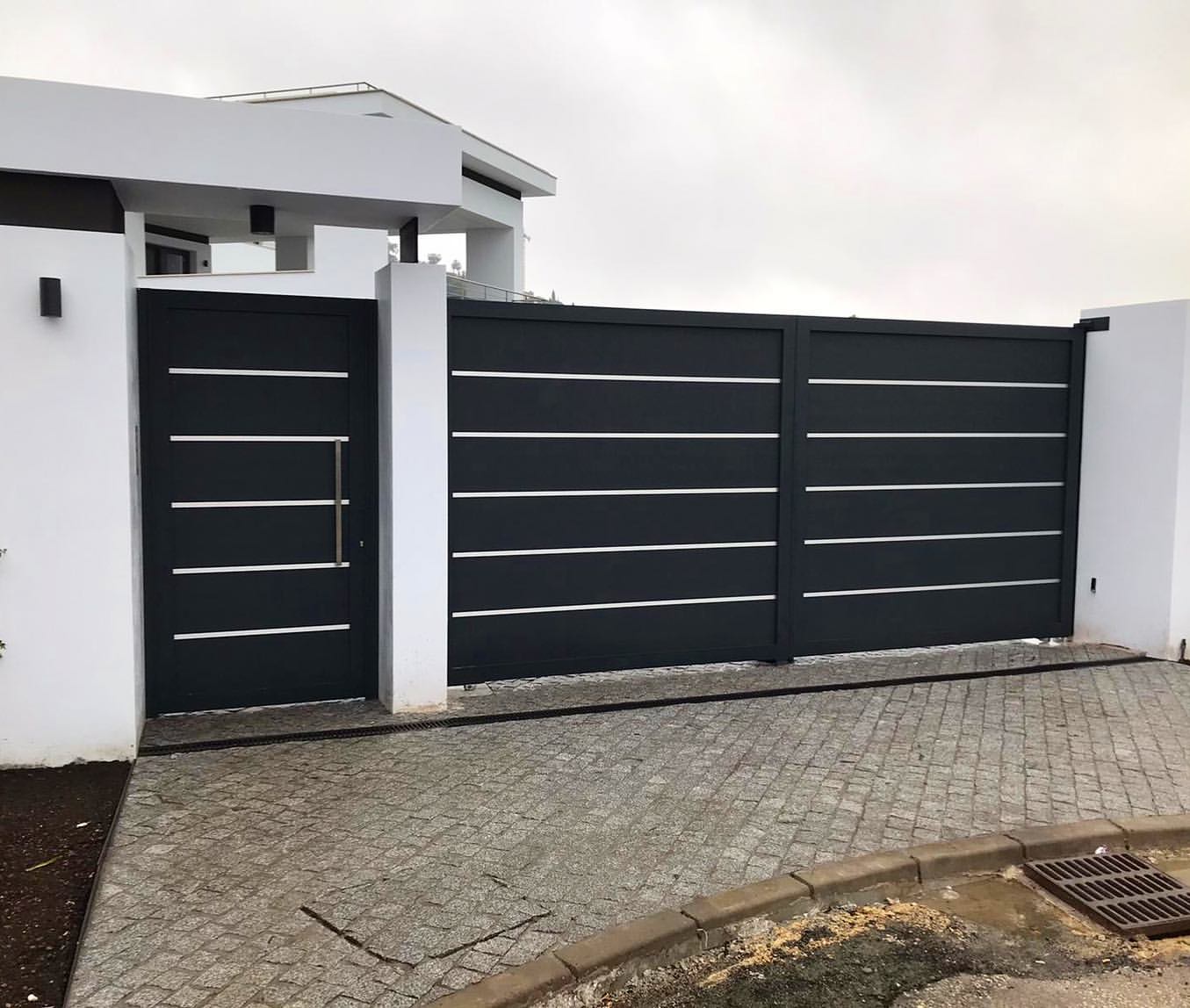
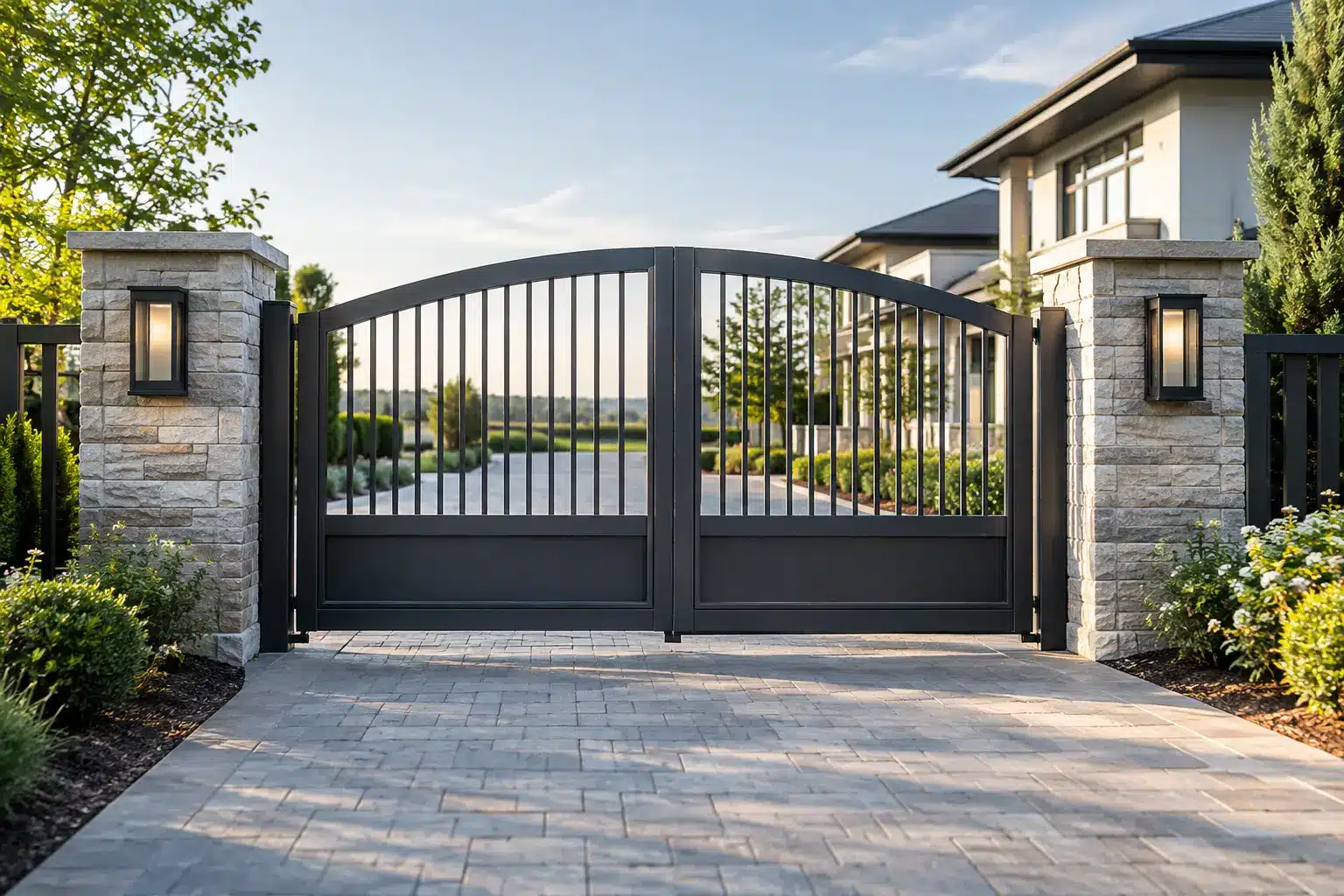
Swing gates remain a popular choice for wide, level driveways. A pair of gates creates a formal, symmetrical entrance and works especially well with substantial masonry pillars or coordinated side panels. They can be designed in sleek horizontal lines for contemporary homes, or with more detailed arrangements for a classic frontage.
They do need sufficient clear space behind or in front of the opening area. Wind loading should also be considered, particularly on exposed sites or with solid, privacy-led gate designs. Professional specification of hinges, posts and automation is essential here, because the gate’s visual weight is only one part of the engineering requirement.
Sliding gates where space is limited
A sliding gate is often the most efficient solution when a driveway rises immediately behind the entrance or where gate leaves cannot safely swing into the property. It travels parallel to the boundary, keeping the driveway clear and providing an assertive, contemporary look.
This format requires enough run-back space along the fence line for the gate to open fully. Where that space is restricted, a telescopic design can be a highly effective alternative. Its overlapping sections reduce the run-back distance while retaining a generous vehicle opening.
Bi-folding gates for faster access
Bi-folding gates are designed for sites where opening speed is a priority. Their folding action makes them well suited to busy residential entrances and commercial settings where vehicles should not wait unnecessarily at the boundary.
Their compact opening footprint is valuable, but the mechanism must be matched to the expected use. Frequent operation calls for quality components, accurate fabrication and a support structure capable of handling the demands placed on it.
Design gated entrances around the property, not a catalogue
The strongest entrance schemes take their cues from the building itself. Look at the lines of the façade, the window frames, cladding, brickwork and existing boundary treatments. A gate should feel intentional from the street, rather than added as an afterthought.
For contemporary properties, horizontal aluminium slats, crisp framing and a restrained palette often create the right effect. Vertical infills can make an entrance feel taller, while wider boards or solid panels offer greater privacy. The spacing between slats is a small decision with a noticeable result: open spacing gives a lighter, more welcoming feel, while tighter spacing strengthens screening and boundary security.
Colour should support the wider exterior scheme. Anthracite grey, black and bespoke powder-coated shades can complement modern joinery and architectural metalwork, but a contrasting finish can also give a gate its own presence. The choice depends on whether the entrance should blend into the property or become a defining feature of it.
Coordinated fencing and pedestrian gates are worth considering early. Matching elements provide a more complete finish and avoid the disjointed look that can arise when the driveway gate is premium but adjacent boundaries are left unresolved.
Specify security without making the entrance feel hostile
A secure entrance begins with the physical structure. Fully welded aluminium construction provides a rigid, durable framework, with no reliance on decorative fixings to hold the main gate together. Quality fabrication, correctly sized posts and secure foundations all contribute to long-term stability.
Privacy is only one aspect of security. Sightlines need careful thought too. A solid gate may conceal a driveway, but it can also limit visibility when vehicles exit onto a public road. Where necessary, choose a design that balances screening with safe views of pedestrians and passing traffic.
Access control should be planned as part of the system, rather than added at the end. A video intercom allows residents or site managers to identify callers before granting entry, while keypad, fob and remote access can suit regular users. Systems such as Akuvox intercoms can bring calling, video and gate release together in a discreet, integrated arrangement.
Automation adds convenience, but it must be specified responsibly. Safety features, reliable controls and an appropriate manual release are fundamental. For commercial gates, usage levels and safety obligations may demand a more tailored approach than a domestic installation.
Why aluminium is suited to premium entrances
Timber can be attractive, but it needs regular protection against moisture, movement and fading. Steel is strong, yet coatings require attention if corrosion is to be avoided. Aluminium offers a compelling balance for made-to-measure gates: it is lightweight, corrosion-resistant and well suited to precision fabrication.
A premium powder-coated finish provides lasting colour and helps keep maintenance straightforward. In most cases, occasional cleaning with mild soapy water is enough to remove surface dirt and maintain the appearance. That low-maintenance ownership is particularly valuable for large driveway gates, where repainting or repairing traditional materials can become a significant expense.
Not all aluminium gates are made to the same standard. The thickness of the material, quality of welding, reinforcement where needed and accuracy of fabrication all affect how a gate feels and performs. A gate should close cleanly, align correctly and remain stable under everyday use. These details are rarely obvious in a photograph, but they define long-term value.
Plan for the details that protect the investment
A premium entrance deserves careful preparation. Drainage around posts and tracks, suitable groundworks, cable routes for automation and the location of power supplies should be resolved before the gate is fabricated. Retrofitting these elements is possible, but it can add cost and compromise the neatness of the finished project.
It is also sensible to check whether planning restrictions apply. Listed buildings, conservation areas, new developments and properties beside highways can have additional requirements. Gate height, outward opening and visibility from the road may all need consideration. Early checks prevent unnecessary delays once a design has been approved.
A detailed consultation should cover dimensions, levels, desired privacy, operating method, finish, access control and anticipated use. At Alu-Gate, bespoke aluminium entrance systems are made to suit these exact requirements, supported by precision welding, premium finishes and a 20-year guarantee.
The right entrance is not simply a barrier at the end of a drive. It is a daily-use architectural feature that should feel secure, operate reliably and set the standard for everything beyond it. Give the design the same attention as the property it protects, and the result will remain a source of confidence and kerb appeal for years to come.