
A rural entrance has to work harder than a town driveway. It may face wind, rain, mud, uneven ground, long approach roads and wider vehicles, while still setting the tone for the property beyond it. The best gates for rural properties balance practical access, dependable security and a design that belongs in its setting – without creating another maintenance job.
For many country homes, farms and private estates, a made-to-measure aluminium gate system offers that balance. It delivers the strength and clean finish expected at a premium entrance, while avoiding the regular painting, swelling and eventual decay associated with timber.
Start with how the entrance is used
The right gate is not defined by appearance alone. Before choosing a style, consider who uses the entrance, how often it opens and the vehicles that need to pass through. A family home with daily car movements has different requirements from a working smallholding, an estate entrance or a property accessed by delivery lorries and contractors.
Measure the clear opening, rather than relying on an approximate driveway width. Account for gate posts, hinges, the turning circle from the road and room for vehicles to wait safely while the gate opens. On rural lanes, where visibility can be limited, this detail matters. A gate positioned well back from the carriageway gives visitors space to pull in without obstructing traffic.
Ground conditions deserve equal attention. Sloping drives, loose surfaces and drainage channels can influence the most suitable operating system. A carefully specified gate should suit the site as it is, not demand compromises from it.
Best gates for rural properties: choose the format first
Swing gates for traditional driveways
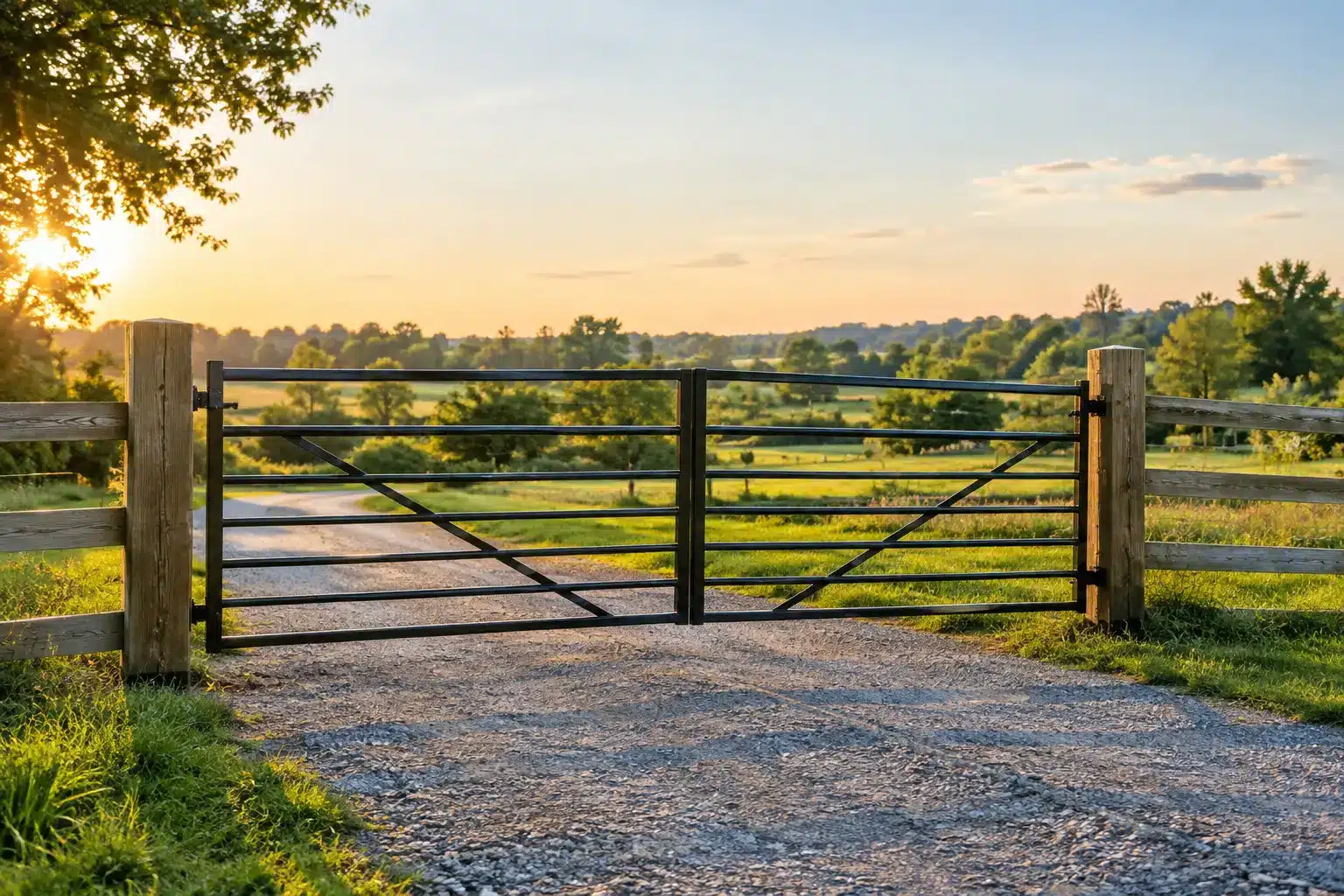
Swing gates remain a natural choice for many rural homes. Their familiar movement suits country entrances, period properties and long driveways, and they can be designed in anything from an open, estate-inspired layout to a more private contemporary profile.
A pair of aluminium swing gates creates a strong sense of arrival and can be tailored to wide openings. They are particularly effective where there is level ground behind the gates and enough space for the leaves to open without blocking vehicles, paths or planting.
The trade-off is clearance. Inward-opening gates need room on the driveway, while outward-opening gates may not be appropriate where they could move towards a public road or footway. Strong posts, correctly engineered hinges and professional automation specification are essential on exposed sites, especially where wind loading is a concern.
Sliding gates for restricted or sloping sites
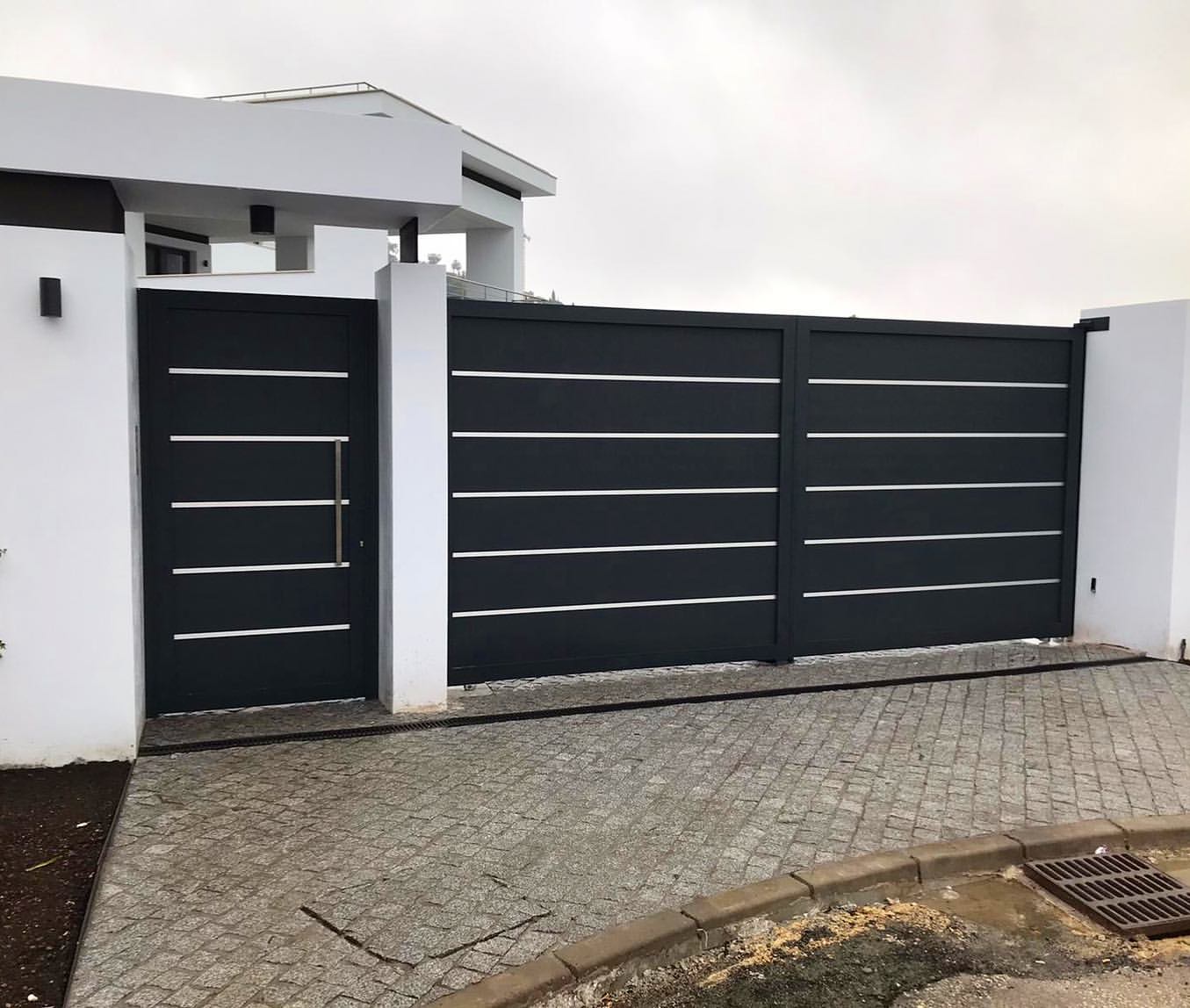
Where a driveway rises immediately behind the entrance, or there is insufficient room for swinging leaves, a sliding gate is often the more practical answer. It travels sideways along the boundary, keeping the approach clear and giving a crisp, modern finish to a rural property.
Sliding systems can work particularly well for wider openings and entrances used frequently. They are also a considered choice where an automated gate needs to open quickly and consistently during poor weather. However, the gate requires adequate run-back space along the fence line, and the track or cantilever arrangement must be designed around the ground, drainage and surrounding landscape.
A sliding gate should never feel like an industrial afterthought. With bespoke aluminium fabrication, the profile, colour and infill can be selected to complement stone walls, timber cladding, brickwork or a more contemporary rural build.
Pedestrian gates that complete the entrance
A separate pedestrian gate is easy to overlook, but it can prevent unnecessary operation of the main driveway gates and give visitors a clear, secure route to the property. It is useful for dog walkers, postal deliveries, gardeners and guests arriving on foot.
Matching the pedestrian gate to the driveway gates and fencing creates a coordinated boundary rather than a collection of unrelated elements. For properties with frequent callers, an integrated intercom and controlled release system adds welcome convenience without weakening security.
Material matters in the countryside
Timber has undeniable character, and it can suit certain heritage settings. Yet exposed rural locations are demanding. Rain, frost, UV exposure and changing temperatures can lead to warping, cracking, peeling finishes and a regular cycle of sanding and repainting. Steel can provide strength but may require vigilant protection against corrosion, particularly where the coating is damaged.
Premium aluminium is a compelling long-term alternative. It does not rot or rust, is comparatively light for its strength and can be finished in a wide range of durable powder-coated colours. That lower weight also places less strain on moving components than many heavier gate materials, which is valuable for automated systems.
Construction quality is what separates a gate that merely looks good on installation day from one built for years of service. Fully welded aluminium frames offer a clean, precise appearance and avoid the movement that can develop in poorly assembled systems. At Alu-Gate, bespoke gates are fabricated to the individual opening and backed by a 20-year guarantee, giving owners confidence in both the finish and the structure behind it.
Match privacy and security to the property
Rural properties do not all need the same degree of privacy. An isolated home may benefit from a more enclosed gate design that limits views from the lane. A house with open countryside beyond it may prefer spaced vertical or horizontal infills that retain sightlines and allow the entrance to feel connected to its surroundings.
Security is not simply about selecting the tallest, most solid gate. A well-designed entrance considers the entire boundary, the strength of posts and fixings, safe locking, lighting and how people gain access. A low, open-style gate with a reliable automated lock and video intercom may be more suitable than an imposing solid gate that feels out of place.
For commercial yards, private estates or properties storing valuable equipment, controlled access becomes more significant. Automated opening, keypad entry, fob control and intercom verification can be specified around the level of oversight required. The aim is controlled access that remains straightforward for residents, staff and trusted visitors.
Design for the landscape, not against it
The best rural gates have presence without looking imported from an urban development. Proportion is central. A very tall gate can overwhelm a modest cottage, while a narrow or lightweight-looking design may be lost at the entrance to a substantial house or estate.
Consider the materials already visible from the road. Black, anthracite and deep green aluminium finishes often sit comfortably beside hedging, stone and traditional brick, while warmer neutral tones can soften a contemporary elevation. The design does not need to imitate timber to feel appropriate in the countryside. Clean aluminium lines can provide a thoughtful contrast, particularly when paired with natural boundary materials.
Coordinated fencing and side panels are worth considering where the entrance includes uneven returns, existing walls or changes in level. They close off awkward gaps, improve security and give the whole frontage a deliberate, finished appearance.
Do not treat automation as an add-on
An automated rural gate should be specified from the start, not attached to a gate selected solely for its looks. The weight, width, opening method, wind exposure and expected daily use all affect the motor and safety equipment required.
Power supply is another practical question. A long drive may require trenching and cable installation, while solar-powered options can be suitable in the right location. Solar is not a universal answer: dense tree cover, persistent shade and frequent operation can limit performance. A proper site assessment will establish what is realistic.
Safety features are fundamental. Photocells, obstacle detection, safe force settings and a manual release for power cuts should all form part of the conversation. A well-specified system feels effortless in daily use because the engineering has been considered before installation.
A better way to choose your rural gate
Avoid choosing from a photograph alone. A rural gate should be designed around the opening, ground conditions, architecture and the way the property operates every day. Ask to see how the frame is constructed, how the finish is protected, what is included in the specification and how automation will be accommodated.
The most successful entrances do more than mark a boundary. They make arrivals easier, improve confidence in the security of the property and give the approach a considered sense of quality. Choose a gate system that earns its place in the landscape – designed to impress, and built to last.