
A gate should never make arriving home feel like a task. Smart gates bring together automated opening, controlled entry and made-to-measure aluminium design, giving your property a more secure, considered entrance from the moment you approach it.
For homeowners, that may mean opening the driveway gate from the comfort of the car, checking a visitor before granting access, or setting clear boundaries around a busy family home. For commercial sites, it can mean better control of vehicle movements and a more professional first impression. The right system does both without compromising the appearance of the property.
What are smart gates?
Smart gates are automated gates connected to an access control method that allows authorised people to enter safely and conveniently. Depending on the specification, access can be managed using remote controls, keypads, proximity tags, intercoms, mobile apps or video calling systems.
The word “smart” should not be confused with unnecessary complexity. A well-designed system is intuitive in daily use. It combines a correctly engineered gate, reliable automation and access controls suited to the people who will use it. The technology should support the entrance, not distract from it.
At its best, a smart gate system gives you greater control over who enters your property, when they enter and how easily you can respond. It also removes many of the frustrations associated with manual gates, particularly in poor weather, after dark or on a busy road.
Why smart gates are a worthwhile investment
Security is often the starting point, but it is rarely the only reason to automate an entrance. A substantial aluminium gate already creates a clear physical boundary. When paired with controlled access, it becomes an active part of your property’s security plan.
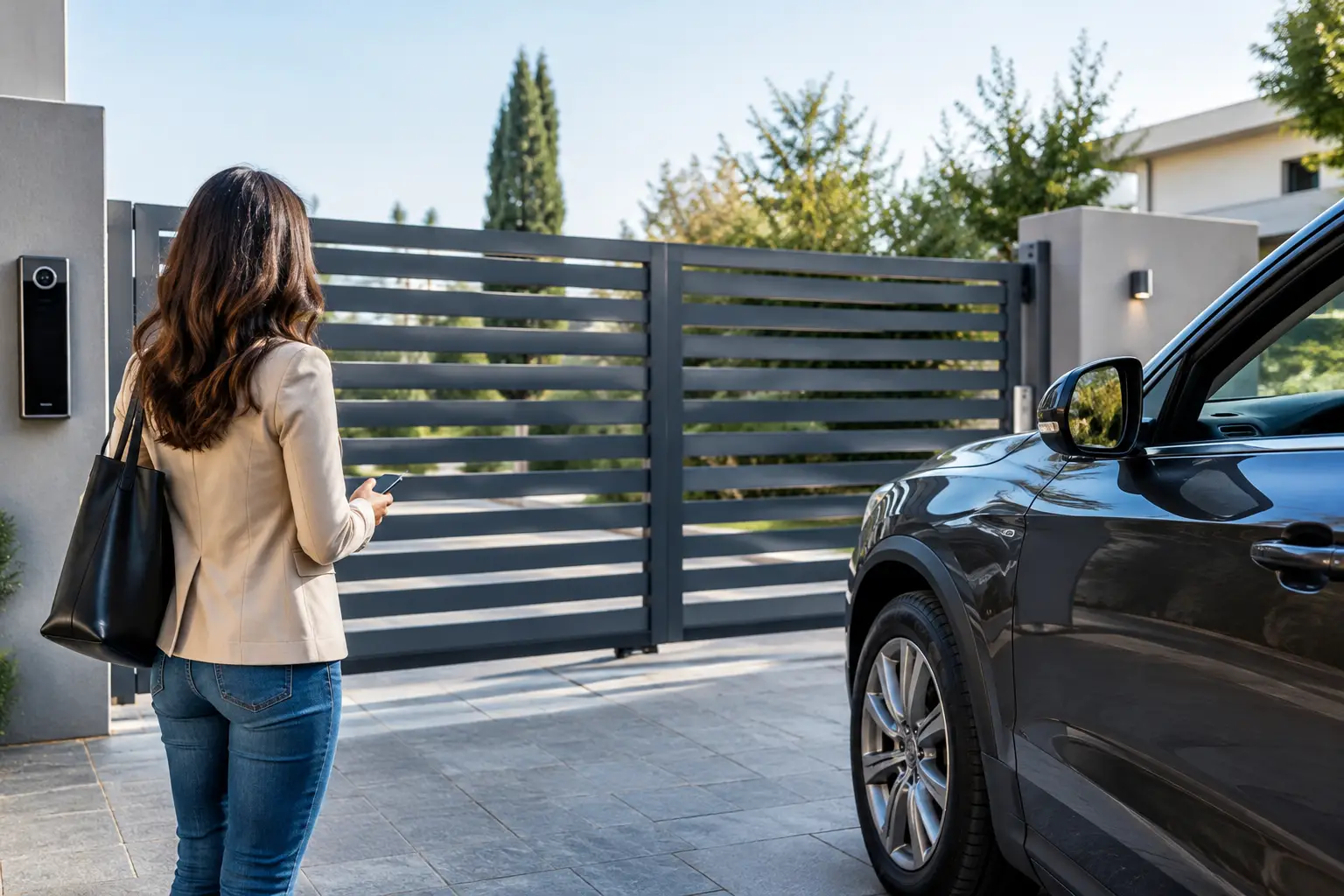
A video intercom, for example, lets you see and speak to callers before opening the gate. This is particularly valuable where the front door is set back from the road, where deliveries are frequent or where children and pets use the driveway. An Akuvox intercom system can provide a refined, practical way to manage visitors without needing to walk to the entrance.
Convenience matters just as much. A gate that opens on command avoids the need to leave the vehicle, while timed closing can prevent the entrance being left open accidentally. For properties with several residents, staff or regular visitors, access credentials can be organised around real use rather than relying on a single key.
There is also a visual benefit. Premium gates make a strong statement at the boundary of a home or business. Choosing a system designed as one complete entrance – gate, posts, fencing, finish and access control – creates a more intentional result than adding automation to an unsuitable existing gate.
Choosing the right smart gate format
The best gate configuration depends on the available space, the gradient of the driveway, the level of privacy required and how the entrance is used. There is no single format that suits every property.
Sliding gates for limited driveway depth
Sliding gates are often an excellent choice where a driveway rises behind the entrance or where there is insufficient room for leaves to swing inward. They travel horizontally along the boundary, making them well suited to busy driveways and more compact sites.
Cantilever sliding gates are particularly effective where a clear track across the driveway would be impractical. The gate is supported from one side and glides above ground level, reducing issues caused by leaves, grit or surface debris. However, this option needs sufficient run-back space alongside the opening.
Swing gates for a classic entrance
Automated swing gates suit many traditional and contemporary homes. They can be configured as a single leaf or as matching double gates, creating a balanced, architectural entrance. Their movement needs careful planning: the driveway must have enough clear space, and any slope must be assessed before finalising the design.
For some properties, outward-opening gates may appear to solve a space problem. In practice, this can be restricted where the leaves would open across a public pavement or highway. A professional survey is essential before selecting the operating direction.
Bi-folding and telescopic gates where speed matters
Bi-folding and telescopic gates are designed for sites where opening space is restricted but rapid access is useful. They are popular for commercial premises, flat developments and driveways with particular layout constraints.
These systems involve more moving components than a conventional swing gate. That does not make them unsuitable, but it does make precision fabrication, correctly specified automation and ongoing servicing especially important.
Aluminium makes smart gate ownership simpler
Automation places demands on a gate. It must be straight, stable and built to work consistently over many years. This is where aluminium has a clear advantage over timber and many steel alternatives.
Premium aluminium gates are lightweight relative to their strength, helping automation systems operate efficiently. They will not rot, warp or absorb moisture in the way timber can, and they do not require regular painting to maintain their finish. For a busy household or managed commercial site, lower maintenance is a genuine long-term benefit.
Construction quality still matters. A lightweight gate is not the same as a flimsy one. Fully welded aluminium frames provide the structural integrity needed for repeated powered operation, while powder-coated finishes offer a durable, refined surface in a wide choice of colours.
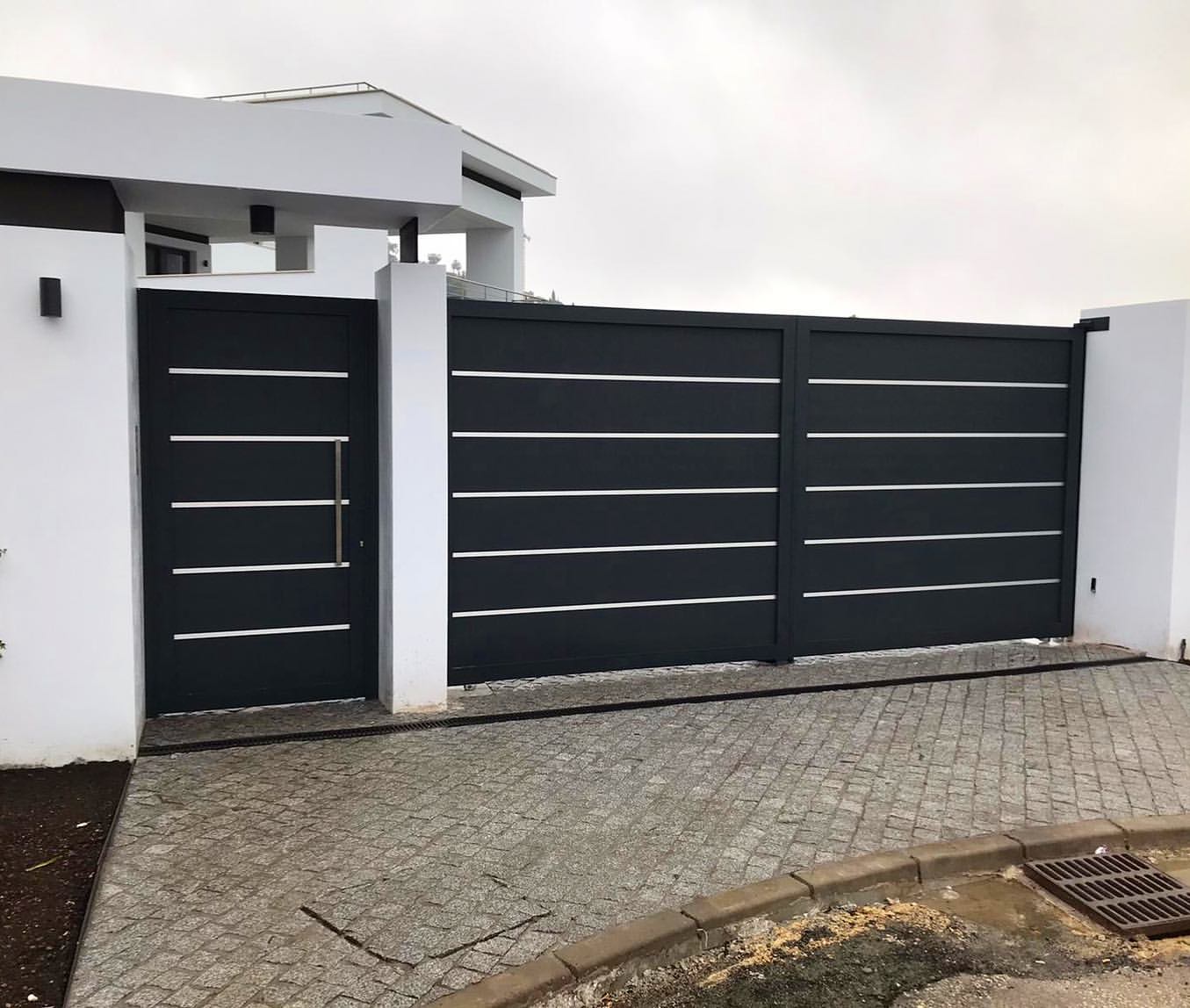
The design itself can be tailored to the setting. Horizontal slats offer a clean contemporary look, while privacy infills, open spacing and coordinated fencing can be selected to balance screening, airflow and visibility. A smart entrance should be secure, but it should also look right for the building behind it.
Access control should match how you live or work
The most advanced access system is not always the most useful one. Start with the everyday journey: who arrives, how often, in which vehicles and at what times?
A remote control may be ideal for a private driveway with one or two regular drivers. A keypad is useful for trusted tradespeople or staff who need access without carrying a fob. Video intercoms offer reassurance for homes with frequent deliveries, while app-based controls can suit owners who want to manage entry while away from the property.
Commercial sites may need a more structured approach, with different access arrangements for employees, visitors, contractors and delivery drivers. In these cases, the gate should be specified around operational needs, not simply chosen for its appearance.
It is also worth considering pedestrian access separately. A matching pedestrian gate with its own lock, keypad or intercom can reduce unnecessary use of the main driveway gate. This is more convenient for callers and may reduce wear on the automated system.
Safety is part of a premium specification
An automated gate must be designed with safety at its core. Properly installed systems use safety devices such as photocells, pressure protection and controlled force settings to help prevent contact with people, vehicles and obstacles.
The final specification should account for children, pets, public access and the gate’s position in relation to roads or footpaths. Safety features are not optional extras to consider later. They are integral to a dependable automated entrance.
Regular servicing also protects performance. Sensors can become obstructed, moving parts need inspection and automation settings may require adjustment over time. Choosing durable materials reduces maintenance demands, but every powered gate system benefits from professional checks.
Plan the entrance as a complete system
The strongest results come from considering the whole frontage before fabrication begins. Gate width and height, post positions, ground levels, cabling, drainage, fencing, lighting and access controls all influence the final installation.
This is particularly important when replacing older timber gates. The existing posts, hinges and driveway surface may not be suitable for a new automated aluminium system. Addressing those details at the design stage avoids compromises later and ensures the gate looks as good from inside the property as it does from the road.
At Alu-Gate, bespoke aluminium gates are fabricated around the exact requirements of the site, rather than adapted from standard sizes. That approach allows the design, opening method and access control to work together with confidence, supported by a 20-year guarantee.
A smart entrance is most valuable when it feels effortless: secure when it needs to be, welcoming when you arrive, and dependable every day in between. Begin with how you want the property to work, then choose a gate system built precisely to deliver it.