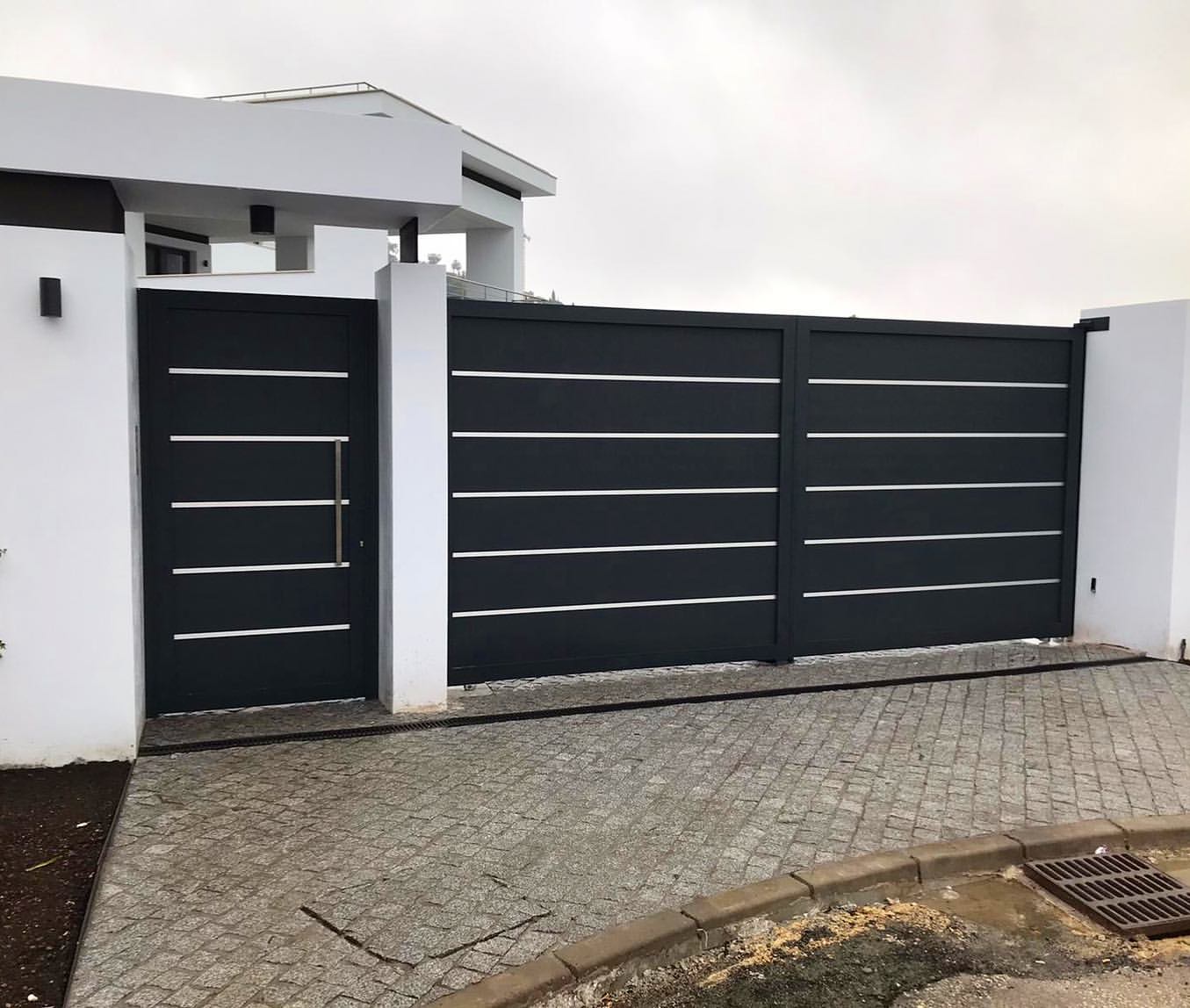

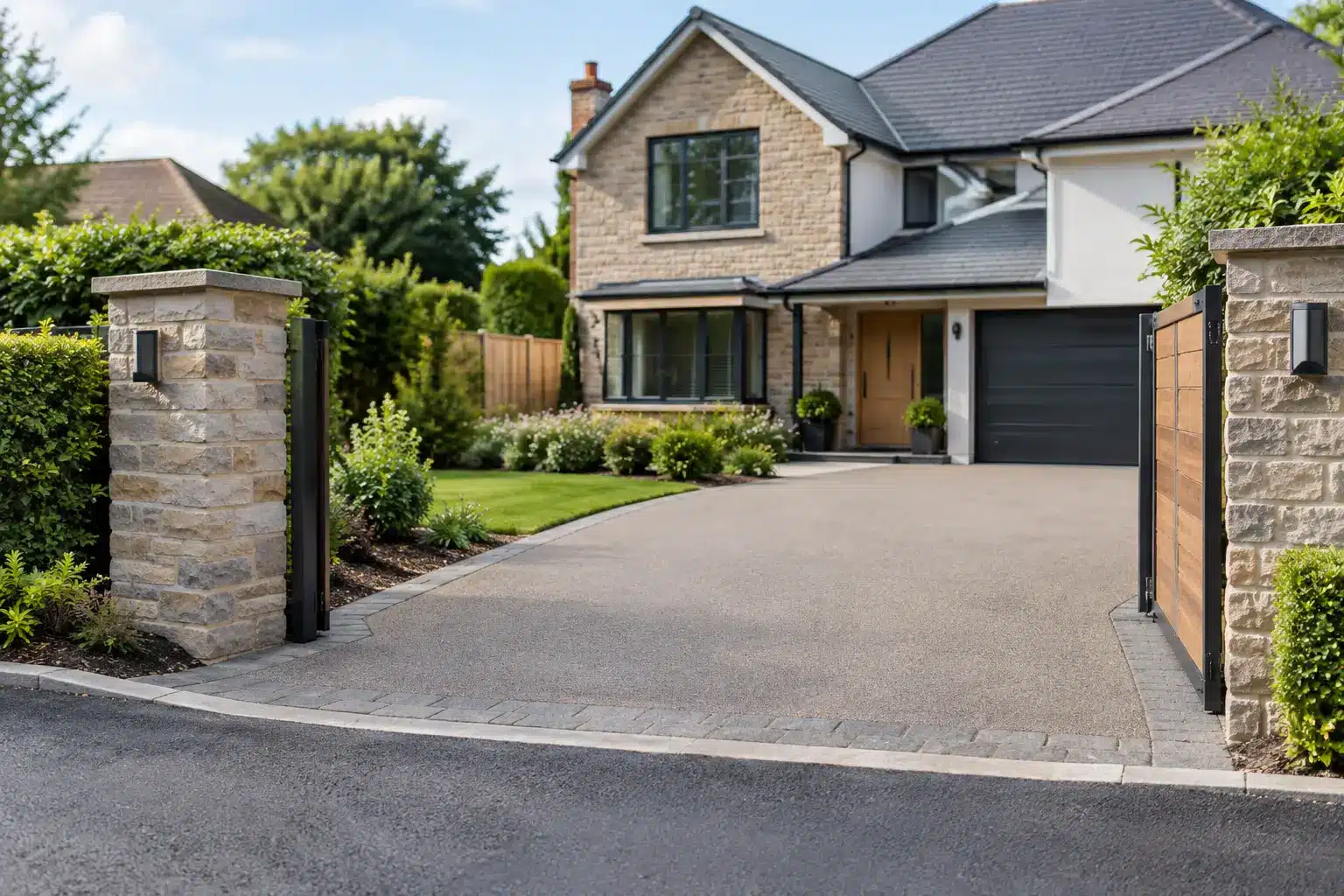
A driveway entrance has one job before anyone reaches the front door: it should make the property feel considered, secure and unmistakably yours. A successful driveway entrance planning guide begins with the practical realities of access, but it should end with an entrance that adds genuine presence and long-term value to the property.
The strongest schemes do not start with a gate style alone. They consider how vehicles arrive, how people enter on foot, where services sit, what the boundary can support and how the finish will sit against the architecture. Get those details right early and the final result will look purposeful rather than added on.
Start with how the entrance needs to work
Before choosing between sliding or swing gates, assess the daily movement through the entrance. Consider the number and type of vehicles using the drive, whether visitors need a separate pedestrian route, and whether deliveries or refuse collections require wider access. A gate that looks exceptional but creates an awkward turning manoeuvre will quickly become a frustration.
Measure the clear opening at the narrowest point, not simply the distance between existing posts. Account for kerbs, walls, slopes, drainage channels and the vehicle turning circle inside the boundary. If a family car can clear the opening comfortably but a larger SUV, van or occasional delivery vehicle cannot, the entrance may need a different configuration.
It is also worth deciding how the entrance will be used in five or ten years. A growing household, a new electric vehicle, regular trades access or a change in mobility needs can all affect the right specification. Bespoke planning gives you room to design for the property you will own, not only the one you use today.
Choose a gate format to suit the site
Every driveway places different demands on its gate system. The available depth, gradient and width will often determine the best format as much as visual preference.
Swing gates
Swing gates suit many traditional and contemporary homes, creating a balanced, substantial entrance. They require clear space for the leaves to open, either inward or outward, although inward opening is generally preferable where the gate meets a public highway. A level driveway immediately behind the gates makes operation simpler and helps create a clean, reliable installation.
Single-leaf swing gates can work well for narrower entrances, while double-leaf designs provide an elegant solution for wider openings. Their visual symmetry is particularly effective where the gate is framed by masonry piers or coordinated aluminium fencing.
Sliding gates
A sliding gate is often the practical choice for shallow driveways, sloping approaches or busy entrances where swing clearance is limited. It travels parallel to the boundary, preserving valuable parking space behind the entrance. This makes it especially suitable for commercial premises and contemporary residential projects with tight site constraints.
The trade-off is that a sliding system needs adequate run-back space along the fence line. Cantilever sliding gates also require carefully engineered foundations and a longer structural section than the clear opening alone. These are details best resolved before landscaping, paving and services are finalised.
Bi-folding and telescopic gates
Where space is limited but a fast opening cycle matters, bi-folding or telescopic gates can be an excellent answer. Their leaves fold or stack as they move, reducing the required run-back area and allowing wider openings to be secured efficiently. They are particularly useful for commercial access points, compact urban plots and driveways where every metre matters.
Plan security as part of the design
A premium entrance should feel welcoming to invited visitors and uncompromising to everyone else. Gate height, infill design, locking, automation and access control should be specified together, rather than treated as separate upgrades.
Solid or closely spaced aluminium infill provides increased privacy and reduces views into the drive. More open designs can maintain sightlines and a lighter architectural feel, but they should be considered alongside the wider boundary treatment. Matching fencing panels and pedestrian gates create a more secure perimeter while giving the property a calm, coherent appearance.
For automated gates, establish who needs access and how they should receive it. Key fobs, keypad entry, video intercoms and smartphone-controlled systems each serve different households and sites. A video intercom, such as an Akuvox system, offers particular reassurance where callers need to be identified before access is granted.
Safety is equally essential. Automated gates need correctly specified safety devices, including photocells and safety edges where appropriate, to detect people, pets and vehicles in the operating area. A professional design should also include manual release provision for power failures and a sensible arrangement for pedestrian entry, so people are not tempted to pass through a vehicle gate.
Get measurements, levels and groundworks right
This is where an impressive concept becomes a dependable installation. Accurate site measurement should capture opening width, post or pier dimensions, available hinge or track positions, driveway gradient, finished ground levels and the location of utilities.
A small fall across the entrance can affect ground clearance significantly, particularly with swing gates. Raising the gate to clear a slope may leave an undesirable gap beneath it; following the slope may require a more tailored fabrication approach. There is no universal answer, which is why made-to-measure gates offer a clear advantage over standard sizes.
Groundworks deserve the same attention as the gate itself. Posts, piers and sliding gate foundations must be capable of supporting the system over many years of use. Drainage should direct water away from moving parts and prevent pooling at the threshold. If automation is planned, arrange power and suitable cable routes before new paving is laid. Retrofitting them later can disrupt finished surfaces and add unnecessary cost.
Consider planning rules and highway safety early
Planning requirements vary according to the property, location and proposed boundary treatment. In many cases, gates and fences can be installed without a formal application, but there are important exceptions. Listed buildings, conservation areas, restrictive covenants and properties near certain roads may be subject to additional controls.
Height is a key consideration, especially where an entrance borders a highway used by vehicles. Visibility splays also matter. High solid gates, walls or planting positioned too close to a junction can obstruct drivers’ views and create a safety concern. Your local planning authority can clarify the rules that apply to a specific site.
Avoid allowing an automated gate to open across a public pavement or carriageway. Beyond the practical risk to passers-by, this can create compliance and safety issues. Where space is tight, a sliding, bi-folding or telescopic system may offer a more suitable solution than outward-opening swing gates.
Select materials for long-term ownership
A driveway gate is exposed to rain, frost, wind, road dirt and repeated daily operation. Material choice therefore affects not only the appearance on installation day, but the amount of maintenance and cost the entrance demands over its lifetime.
Timber offers warmth but usually requires regular treatment and can move as moisture levels change. Steel is strong, yet needs effective corrosion protection and ongoing inspection to prevent rust. Aluminium offers a compelling balance for premium entrances: it is naturally corrosion-resistant, stable, lightweight and well suited to precision fabrication.
The quality of construction matters as much as the base material. Fully welded aluminium frames deliver a cleaner, stronger structure than systems reliant on visible mechanical joints. A durable powder-coated finish in a carefully selected colour provides the final layer of protection, while allowing the gate to complement window frames, cladding, brickwork and fencing.
For design-conscious properties, think beyond the gate alone. Repeating the same profile, colour and spacing across driveway gates, pedestrian gates and fencing creates a tailored frontage with far greater impact than a standalone gate ever could.
Decide where to invest
Budgets should reflect the parts of the entrance that are hardest to alter later. Foundations, structural posts, quality fabrication, automation infrastructure and drainage are worth getting right from the outset. Decorative features can be adjusted more easily than a gate that is poorly proportioned, unsupported or unsuitable for the site.
A lower-maintenance material can also represent better value over time. The initial cost of a bespoke aluminium system may be higher than a basic timber or steel alternative, but reduced maintenance, lasting finish quality and dependable operation can make it the more considered investment.
At Alu-Gate, every entrance is approached as a complete system, balancing proportion, security, access and finish before fabrication begins. The aim is simple: a made-to-measure solution that looks right on day one and continues to perform for years.
The most successful driveway entrance is not defined by a single feature. It is the result of careful decisions made before the gate is manufactured – decisions that turn a boundary into a confident, secure and enduring first impression.