
A sliding gate should make arrival feel effortless, not create another maintenance task at the entrance. This cantilever gate buying guide is designed for property owners and commercial buyers who want a clean, secure, made-to-measure solution without a track set into the driveway.
Cantilever gates are a particularly strong choice where ground levels are uneven, gravel is present, or leaves, mud and winter debris would compromise a conventional tracked sliding gate. The right system can deliver an impressive wide opening, precise movement and a more refined frontage. It does, however, need careful planning from the outset.
What is a cantilever gate?
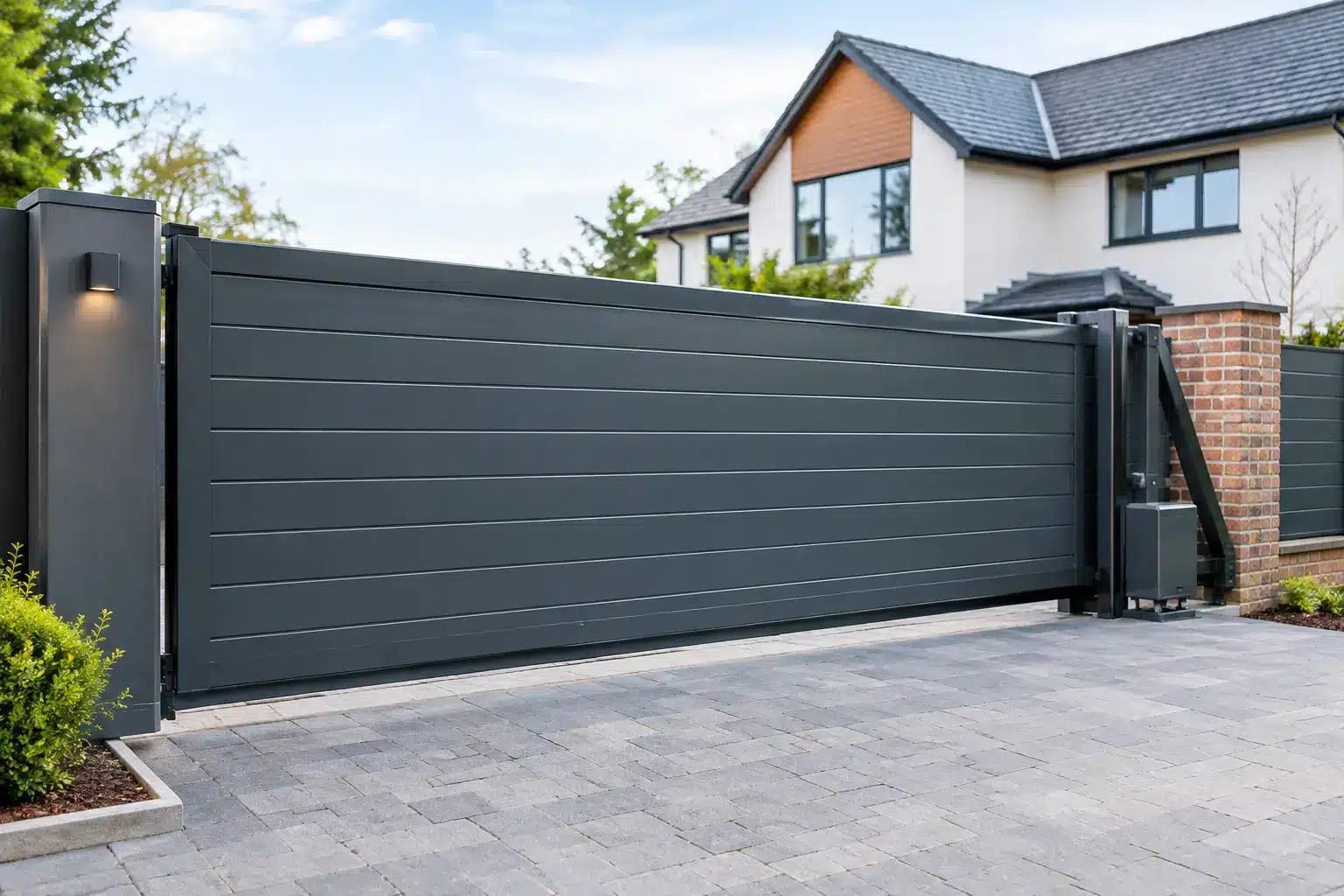
A cantilever gate slides horizontally across an opening but does not run on a ground track. Instead, the gate is supported above ground by roller carriages fixed to a substantial foundation on one side of the entrance. A counterbalance section, often called the tail or run-back, extends beyond the clear opening to keep the gate stable while it moves.
This trackless design is its defining advantage. There is no channel in the drive to fill with grit, stones or standing water, and no rail for tyres, heels or delivery trolleys to cross. For homes with gravel drives and commercial sites with regular vehicle movements, that can mean more dependable day-to-day operation.
The trade-off is space. A cantilever gate needs room beside the opening for the gate leaf and its counterbalance section when fully open. As a rule, the run-back length is greater than the driveway opening itself. The exact requirement depends on the system, opening width, gate weight and engineering specification, so it should be confirmed during the design stage rather than estimated from a photograph.
Cantilever gate buying guide: start with the site
The best gate design begins with measurements, levels and how the entrance is actually used. Width is only one part of the brief. Consider the driveway gradient, turning space, existing walls or pillars, nearby planting, overhead services and the position of incoming vehicles.
For a residential driveway, the clear opening must accommodate family cars, visitors, delivery vehicles and any future change in vehicle size. On commercial premises, consider vans, refuse collections, emergency access and peak-time traffic. A gate that looks proportionate but forces a driver to make an awkward turn will quickly become frustrating.
Ground conditions matter just as much. Cantilever systems place considerable forces into their support foundation, particularly on wide or solid-panel designs. The foundation needs to be designed for the gate, the soil conditions and local exposure, not treated as a minor preparatory job. A professional survey will identify whether existing hardstanding can be retained and where excavation, drainage or cable routes are needed.
It is also worth checking sightlines before choosing a solid infill. Privacy may be the priority, but a perforated, slatted or partially open design can improve visibility at the exit and reduce wind loading. There is no single right answer. A sheltered urban driveway has different demands from an exposed rural entrance.
Choose a material that suits the gate format
The material affects appearance, maintenance, weight and the long-term demands placed on the sliding hardware. Timber offers natural warmth but requires ongoing finishing and can move with weather. Steel can provide strength, although corrosion protection and weight must be managed carefully.
Premium aluminium is especially well suited to bespoke cantilever gates. It is naturally corrosion-resistant, considerably lighter than many steel alternatives and capable of carrying crisp contemporary detailing. Lower gate weight can support more efficient operation while reducing strain on moving components, provided the frame and hardware are correctly engineered.
Construction quality remains essential. Look beyond the surface finish to the gate frame, corner joints, internal reinforcement and method of fabrication. Fully welded aluminium construction provides a more substantial, permanent structure than a gate assembled from multiple loose sections. It is a sensible investment for a large moving gate exposed to wind, rain and daily use.
Powder-coated finishes offer extensive choice, from understated blacks and greys to colours selected to complement window frames, cladding or brickwork. Ask how the finish is prepared and applied, and whether the gate, posts and coordinated fencing will be matched as part of one exterior scheme.
Balance design, privacy and wind loading
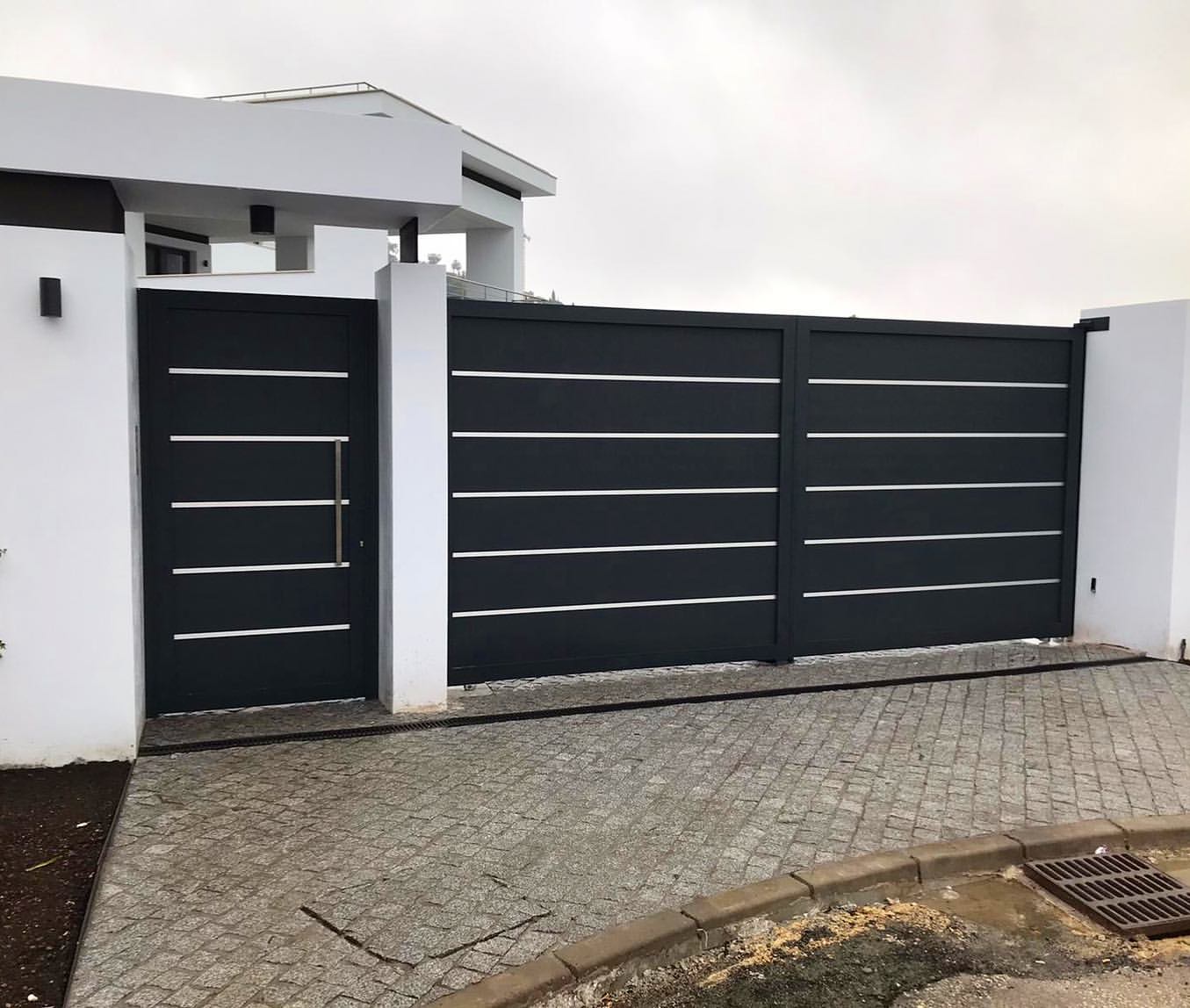
Cantilever gates are often chosen for their architectural impact. Horizontal aluminium slats create a contemporary, linear appearance, while vertical profiles can add height and definition to a narrow frontage. Flush panels provide strong privacy, and decorative screens can introduce pattern without compromising the overall design language.
Yet the most private design is not always the most practical. A solid gate catches more wind than an open slatted gate, which affects the required engineering, foundation and automation specification. In exposed locations, spacing between slats or a perforated pattern may be a better balance between privacy, strength and reliable movement.
Consider the view from both sides. From the street, the gate should give the property a clear sense of arrival. From inside, it should feel proportionate to the house and landscape rather than becoming an oversized barrier. Bespoke fabrication gives greater freedom to align rails, slat spacing and heights with adjacent fencing, pedestrian gates and boundary features.
Specify automation around real use
Most cantilever gates are automated, and the operator should be selected for the size, weight and usage of the gate. A lightly used domestic entrance and a busy commercial site do not need the same duty rating. Choosing an underspecified motor to reduce the initial cost is a false economy.
Think through the arrival sequence. You may want remote controls for household vehicles, keypad access for visitors, an intercom at the entrance and app-based control for greater flexibility. Video intercom systems, including options such as Akuvox, can make it easier to identify callers before granting access.
Safety is not an optional extra. A correctly specified automated gate system should include suitable safety devices, obstruction detection and a clear manual release arrangement for power failures. The exact configuration depends on the gate and site, but it should be planned as an integrated system rather than added after installation.
Do not overlook power and cabling. Bringing electrical supply, communications cables and conduits into the groundwork phase is cleaner and usually more cost-effective than lifting finished surfaces later. If mains power is impractical, solar may be considered in suitable locations, although performance depends on light levels, gate usage and the equipment fitted.
Understand the security details
A tall, well-made gate is a visible deterrent, but security comes from the whole entrance system. The gate should close accurately into a secure receiving post, with hardware that resists lifting and forced movement. Side gaps, climbing opportunities and the arrangement of nearby walls or fences all deserve attention.
For commercial buyers, access permissions and audit requirements may shape the specification. For homeowners, the priority may be keeping children and pets safely within the boundary while controlling visitor access. Both benefit from a gate system designed around the property rather than adapted from standard stock sizes.
If the entrance opens directly onto a public road, the gate must not swing outwards across the pavement or carriageway. Cantilever gates avoid that particular issue because they slide parallel with the boundary, but vehicle waiting space, visibility and safe operation still need to be considered.
Budget for the complete system, not just the gate leaf
A cantilever gate is a complete engineered installation. The headline price should account for the bespoke gate, support posts, cantilever hardware, foundations, groundworks, automation, safety equipment, access control, electrical works and commissioning. Removal of an existing gate, drainage adjustments and reinstatement of paving may also be relevant.
It is sensible to compare quotations on specification rather than price alone. Check the gate dimensions, material thickness, weld quality, finish, hardware capacity, automation brand, safety devices and warranty terms. A lower figure can conceal omissions that emerge once work is underway.
The value of aluminium is often clearest over time. It avoids the regular staining, repainting and rot repair associated with many timber gates, while a quality powder-coated finish is straightforward to clean. Periodic checks of rollers, safety devices and automation are still advisable, but low-maintenance should mean fewer avoidable chores, not no care at all.
Questions to settle before ordering
Before approving the design, make sure you can answer the practical questions: Is there enough run-back space? Has the foundation been engineered for the gate and site? Will the selected design suit wind exposure? Where will power, controls and safety devices sit? Who is responsible for groundworks, installation and commissioning? And what guarantee covers the gate structure and finish?
At Alu-Gate, made-to-measure aluminium gates are developed around these decisions, combining precision-welded construction with a tailored design and a 20-year guarantee. That level of specification gives an entrance the presence it deserves, while keeping ownership refreshingly straightforward.
A cantilever gate should not be chosen from dimensions alone. Give the site, the daily routine and the finish equal weight, and the result will feel less like a barrier at the edge of the drive and more like a confident first statement about the property.