
A driveway gate should improve the way a property feels every day, not become an awkward task in the rain or a feature that fails to suit the space. When weighing up manual gates vs electric, the right answer depends on more than budget. Your driveway layout, daily routine, security requirements and preferred finish all shape the best specification.
For some homes, a beautifully made manual aluminium gate is the cleanest, most dependable choice. For others, electric operation turns a gated entrance into a genuinely more secure and convenient part of the property. The key is choosing the gate format and operating method together, rather than treating automation as an afterthought.
Manual gates vs electric: the essential difference
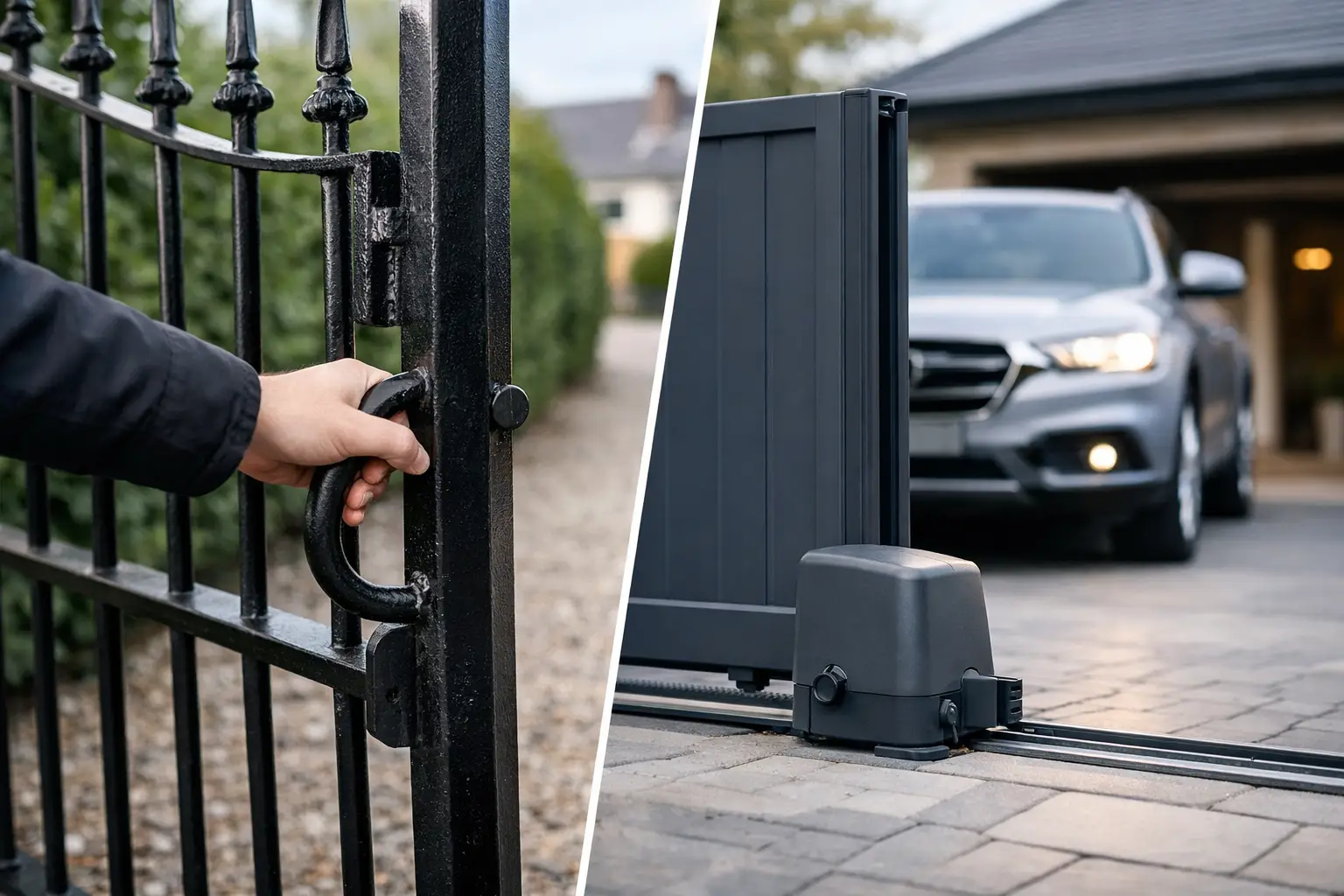
Manual gates are opened and closed by hand, using a latch, lock, drop bolt or magnetic catch depending on the design. They can be swing gates, sliding gates or pedestrian gates, although manual swing gates are especially common on smaller driveways and garden entrances.
Electric gates use motors, safety systems and controls to open automatically. They may be operated by remote fob, keypad, intercom, mobile app or vehicle detection. Electric swing gates, sliding gates, bi-folding gates and telescopic gates are all available, with the most suitable configuration determined by the room around and behind the entrance.
The distinction sounds straightforward, but premium gate design is rarely a simple choice between basic and advanced. A manual gate can be a highly considered architectural feature, fabricated to complement fencing, brickwork and the property’s overall style. An electric gate can be discreet and refined, with carefully positioned automation that protects the clean lines of the design.
Convenience: where electric gates earn their place
Electric gates are particularly valuable when the entrance is used several times a day. Arriving home after work, leaving early in the morning or returning during poor weather is simpler when you can enter without stopping, getting out of the car and securing the gate again.
This matters even more on busy roads, steep drives or properties where stopping outside the entrance feels exposed. Automatic operation helps keep vehicles moving off the road quickly and avoids the inconvenience of leaving children or belongings unattended in the car.
Access control adds another level of practicality. An intercom system allows you to speak with visitors before granting entry, while keypads and remote credentials can be issued to family members, employees, contractors or delivery teams as required. For commercial premises, this can make access more controlled without needing someone at the gate throughout the day.
Manual gates suit properties where vehicle access is occasional, where the gate is primarily decorative, or where a pedestrian entrance does most of the daily work. They are also a strong option for a side passage, garden boundary or secondary driveway where automation would add little practical value.
Security is about the complete entrance
An electric gate does not automatically make a property secure, just as a manual gate is not inherently less secure. The strength of the frame, hinges, posts, locking arrangement, visibility through the design and quality of installation all matter.
A fully welded aluminium gate provides a strong, stable structure without the swelling, splitting or decay associated with timber. The gate should be made to suit the opening precisely, with posts and foundations specified to support its size, weight and method of operation. A gate that looks substantial but has weak alignment or poorly planned hardware will not provide the confidence a premium entrance should deliver.
Electric systems can improve control over who enters. Closed-position locking, protected controls and video intercom access can make unauthorised entry more difficult and give occupiers greater visibility of visitors. However, automation also requires proper safety planning. Photocells, safety edges and force limitation are essential to reduce risk around people, vehicles and pets. Professional specification is not optional, especially for gates opening on to an active driveway or commercial site.
Manual gates can be highly secure when fitted with quality locks and reliable ground bolts. They are often easier to secure independently during periods when a property is vacant, and there are fewer electrical components to consider. The trade-off is that access depends on someone physically opening and closing the gate every time.
Cost: look beyond the initial gate price
Manual gates usually have a lower upfront cost because there are no motors, control panels, cabling, safety devices or access-control components to supply and install. If the opening is straightforward and access needs are limited, this can make manual operation the sensible investment.
Electric gates involve a higher initial outlay, particularly if the site needs new power provision, groundwork, safety equipment or specialist access control. Sliding, bi-folding and telescopic systems may also require more detailed engineering than a conventional pair of swing gates.
Yet the decision should be based on long-term value, not just the first invoice. A made-to-measure aluminium gate has low maintenance requirements and is designed to retain its appearance without the repeated sanding, staining or repainting often expected from timber. Choosing a durable gate structure from the outset means automation can be added to a quality entrance rather than attached to a gate that is already approaching the end of its useful life.
Electric systems do need periodic servicing. Motors, hinges, tracks, safety devices and controls should be checked to maintain reliable operation. This is a planned ownership cost, but it is also what protects the performance and safety of the system over time.
Driveway layout can decide the answer
The physical site often determines whether manual or electric operation is most appropriate. Swing gates need clear space inside the property to open. If the driveway rises sharply, slopes towards the entrance or has limited depth, standard swing leaves may not work as expected.
Sliding gates are often ideal where there is restricted depth behind the entrance, provided there is enough lateral run-back space along the boundary. They can be automated very effectively and offer a strong solution for driveways on busier roads. Cantilever sliding designs can also avoid a track across the driveway surface where ground conditions make a tracked system less suitable.
Where side room is limited, bi-folding or telescopic gates can deliver a wide opening while taking up less run-back space. These formats are usually selected for electric operation because their movement is more complex, although the right solution always depends on the available room, desired opening speed and level of use.
Manual swing gates remain excellent for compact, quieter entrances where there is sufficient clearance and the owner is happy to operate them by hand. Their apparent simplicity should not mean compromise. Correct hinge positioning, ground clearance, latching and post strength are what make the gate satisfying to use year after year.
Design and kerb appeal should not be secondary
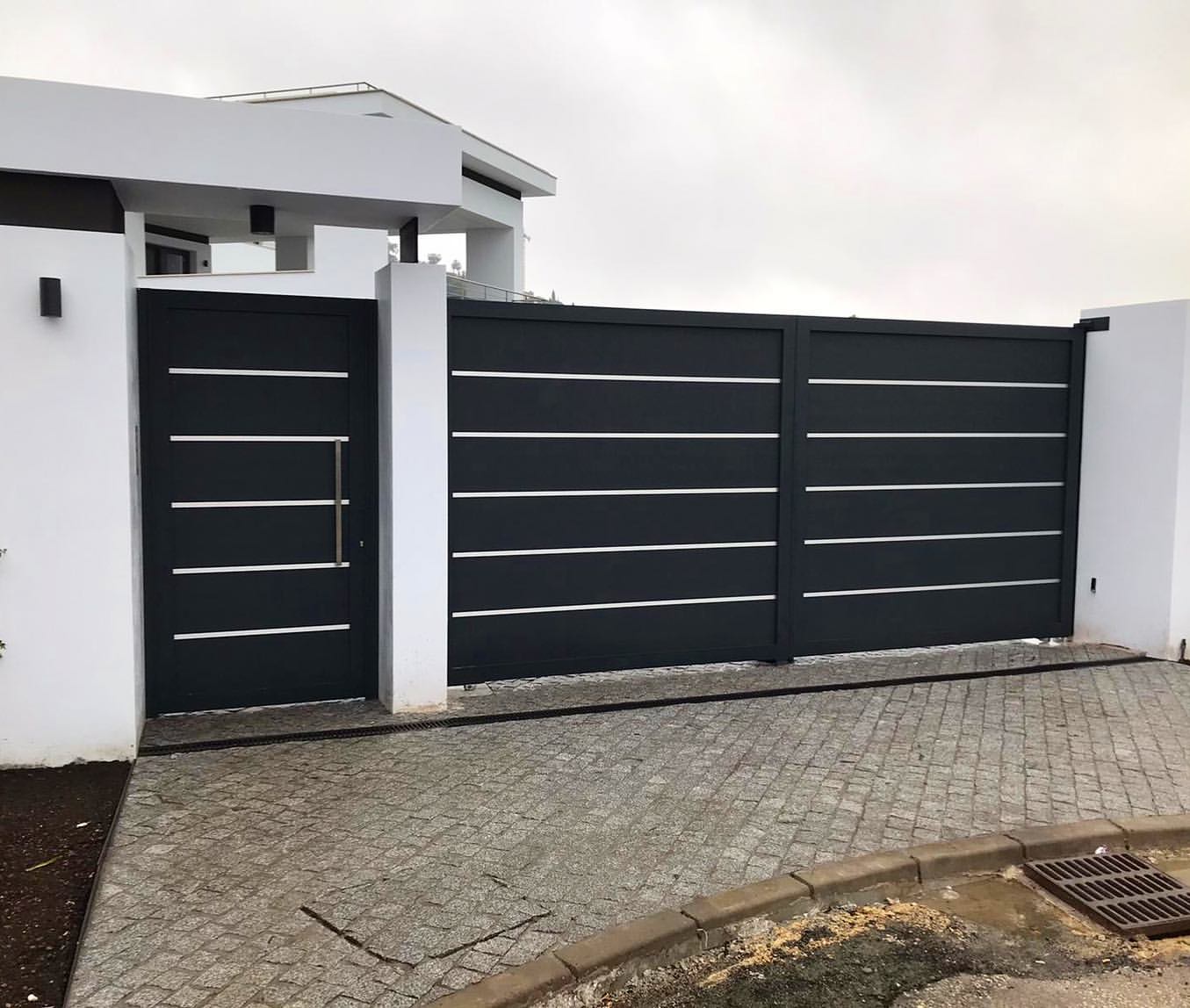
A front gate is one of the first things people notice about a property. The operating method should support the design, not dictate an off-the-shelf look. Aluminium offers considerable freedom in profile, spacing, privacy level and finish, whether the brief calls for horizontal slats, contemporary solid panels, vertical details or a more traditional entrance statement.
For homes seeking privacy, closer-spaced or solid infill designs can screen the driveway while maintaining a crisp architectural appearance. For properties where visibility is preferred, open slat designs can define the boundary without creating a closed-in feel. Coordinated fencing and pedestrian gates help carry that language across the full frontage.
Electric components can be integrated thoughtfully, with motors and controls positioned to minimise visual distraction. Equally, a manual gate can retain a refined appearance with discreet locking hardware and carefully selected handles. The best choice is the one that feels intentional from the road and works effortlessly for the people using it.
Questions to settle before specifying your gate
Start with how the entrance will be used on an ordinary week, not just how you imagine it on completion. Consider who needs access, how often vehicles enter, whether visitors require controlled entry and what happens when someone arrives on foot. Then assess the space: driveway gradient, opening width, road position, parking arrangement, side run-back and the location of power all influence the system.
It is also worth considering future needs. A manual gate may be entirely right now, but selecting a strong, correctly sized aluminium structure can preserve the option to automate later where the layout allows. Conversely, if convenience, visitor management and vehicle access are already priorities, designing an electric system from day one is usually the cleaner and more cost-effective route.
A premium gate should feel proportionate to the property, operate with confidence and remain dependable through every season. Whether manual or electric, a bespoke aluminium entrance gives you the opportunity to make that first impression purposeful, secure and built to last.