
Best Entrance Gates for Privacy at Your Home

Best Entrance Gates for Privacy at Your Home

A driveway that leaves your front garden, parked vehicles or entrance in full view can make an otherwise impressive property feel exposed. The best entrance gates for privacy do more than close off a boundary. They create a composed arrival, limit sightlines from the road and give you greater control over who approaches your home.

For many UK homeowners, the strongest answer is a made-to-measure aluminium gate with a solid or carefully designed infill. It offers the clean, contemporary appearance expected of a premium exterior upgrade, without the staining, warping and regular upkeep associated with timber. The right choice, however, depends on your entrance width, available driveway space, desired level of screening and how you use the property every day.

What makes an entrance gate genuinely private?

Privacy is not simply a matter of choosing the tallest gate available. A gate may look substantial from a distance yet still expose the driveway through wide horizontal gaps, open decorative work or an awkward position relative to the road. The most effective designs consider direct views from passing traffic, neighbouring properties and nearby footpaths.

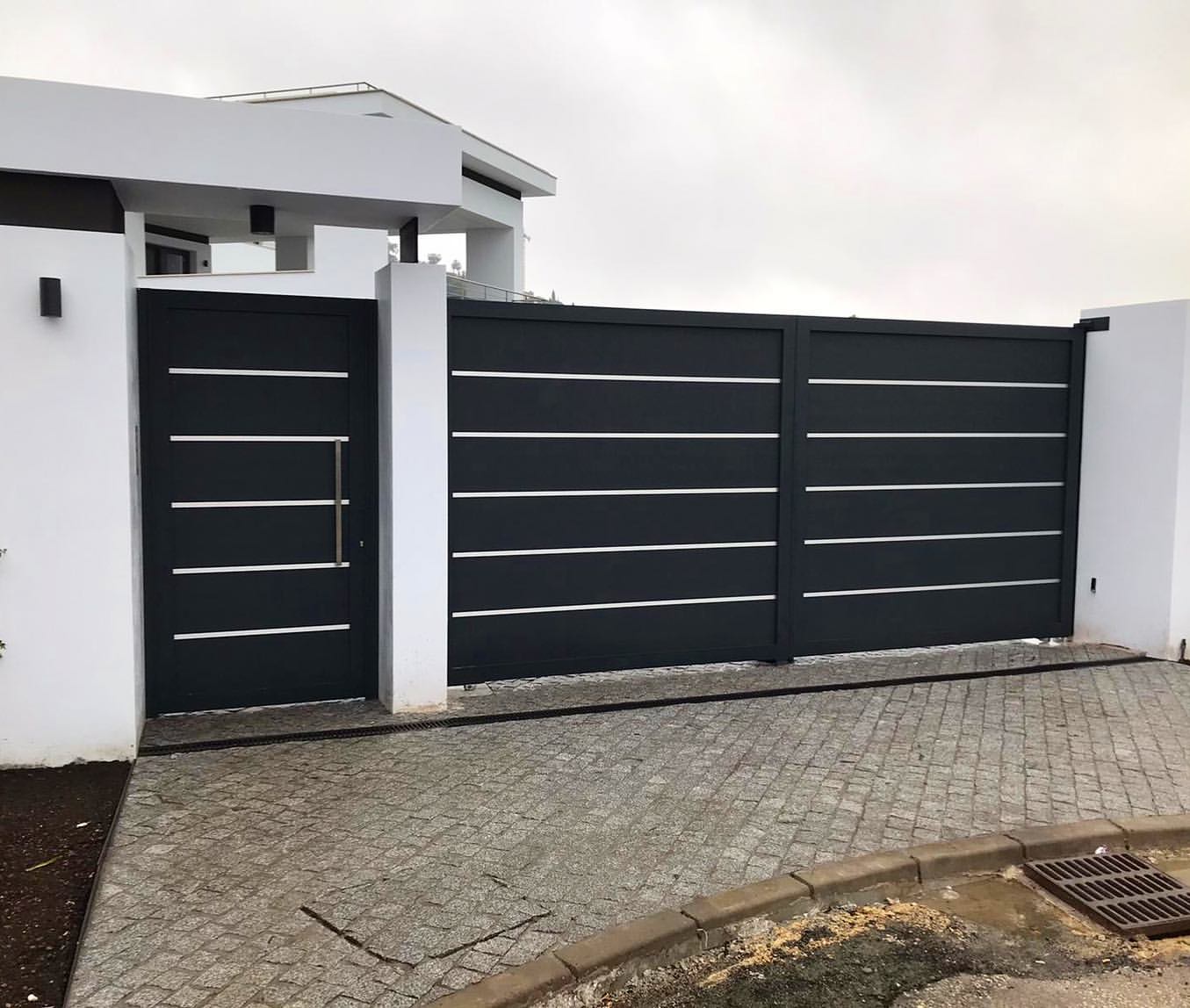
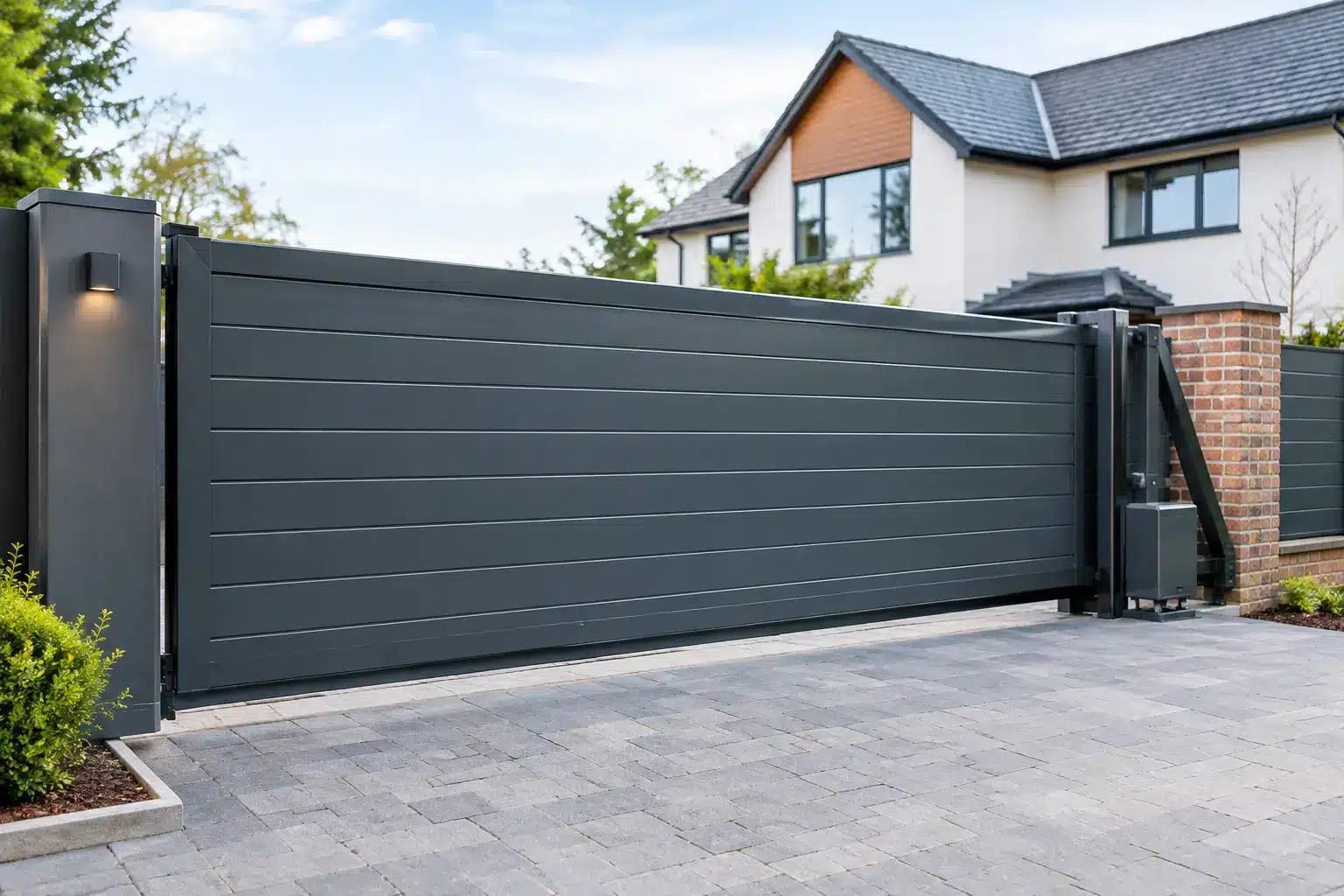
Solid-panel gates provide the greatest visual screening. They are particularly effective where the property sits close to a pavement or road, or where vehicles are parked directly behind the entrance. A fully enclosed aluminium design creates a confident architectural boundary and gives a clear sense of separation between public space and your home.

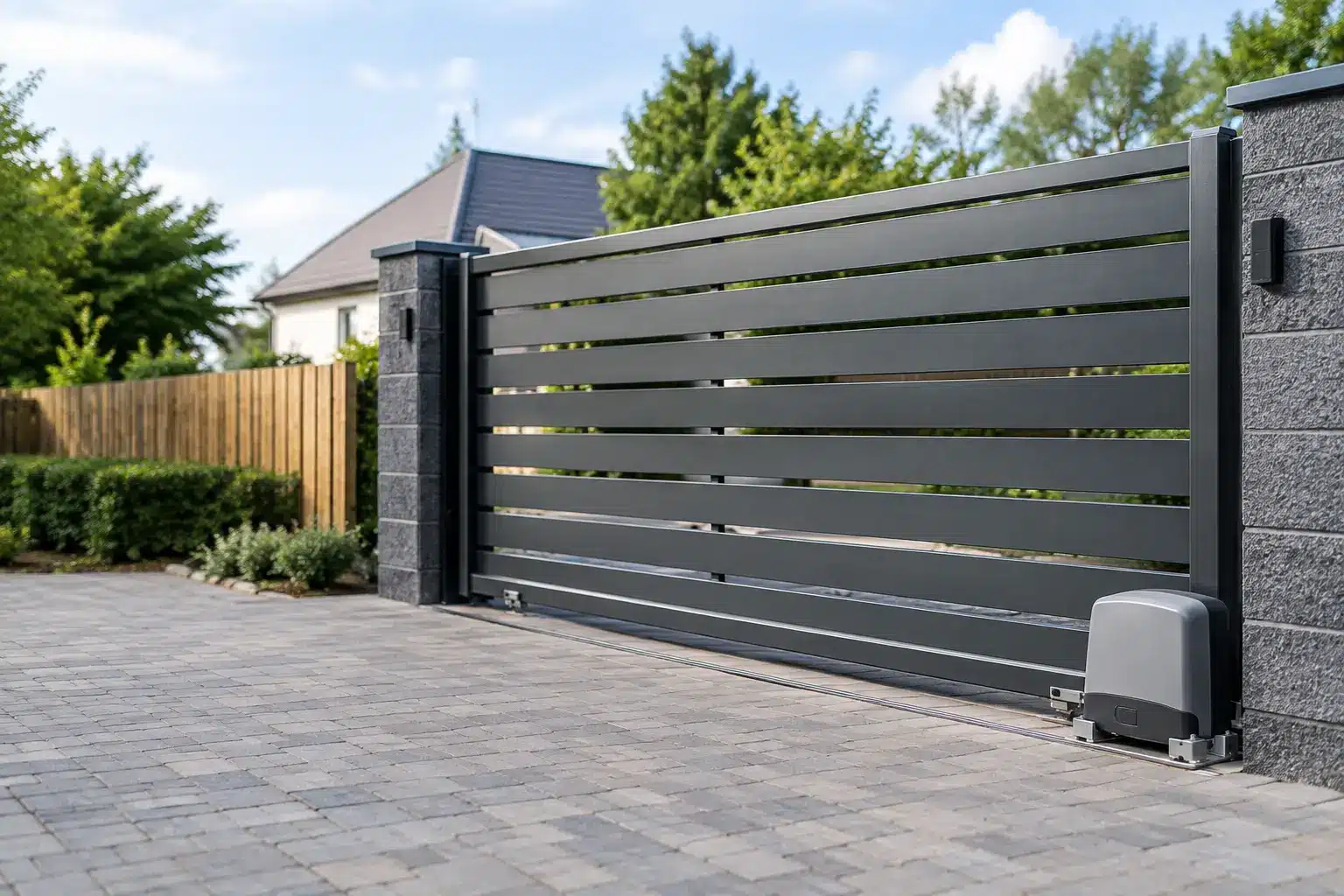
Slatted gates can also provide excellent privacy, provided the spacing and angle are specified carefully. Narrow gaps deliver a lighter, more textured appearance while obscuring clear views through the gate. This is often a good choice for properties that need screening without making the frontage feel overly enclosed. Wider gaps, by contrast, suit an open contemporary look but are less appropriate where privacy is the priority.

Gate height matters, but so does proportion. An oversized gate can dominate a modest frontage, while a low gate may leave vehicles and ground-floor windows visible. A bespoke design allows the height, panel arrangement and supporting fencing to work together as one considered boundary treatment.

Best entrance gates for privacy: choose the right format

The gate format should suit the way your driveway works, not just the style you prefer. Privacy, security and day-to-day convenience all improve when the opening method is properly matched to the site.

Solid swing gates

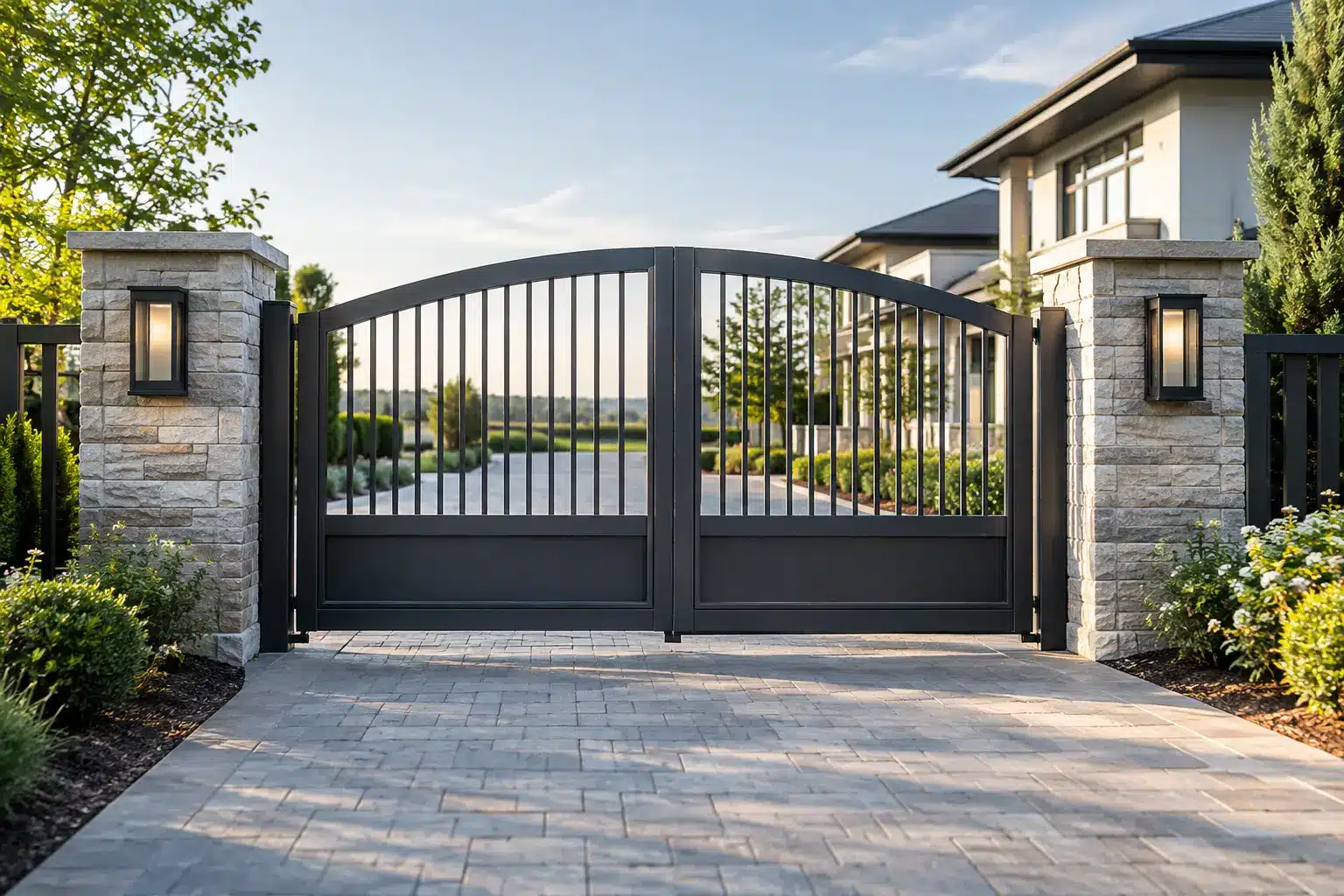
Double swing gates are a timeless choice for private driveways. They create a formal, balanced entrance and work especially well where there is enough clear space inside the property for the leaves to open. With solid aluminium panels, they offer maximum screening across the full width of the entrance.

Their main consideration is clearance. Gates should not swing out across a public pavement or road, and inward-opening leaves need room away from parked cars, planting and changes in ground level. For a well-proportioned residential entrance, this is often the most elegant privacy-led solution.

Sliding gates

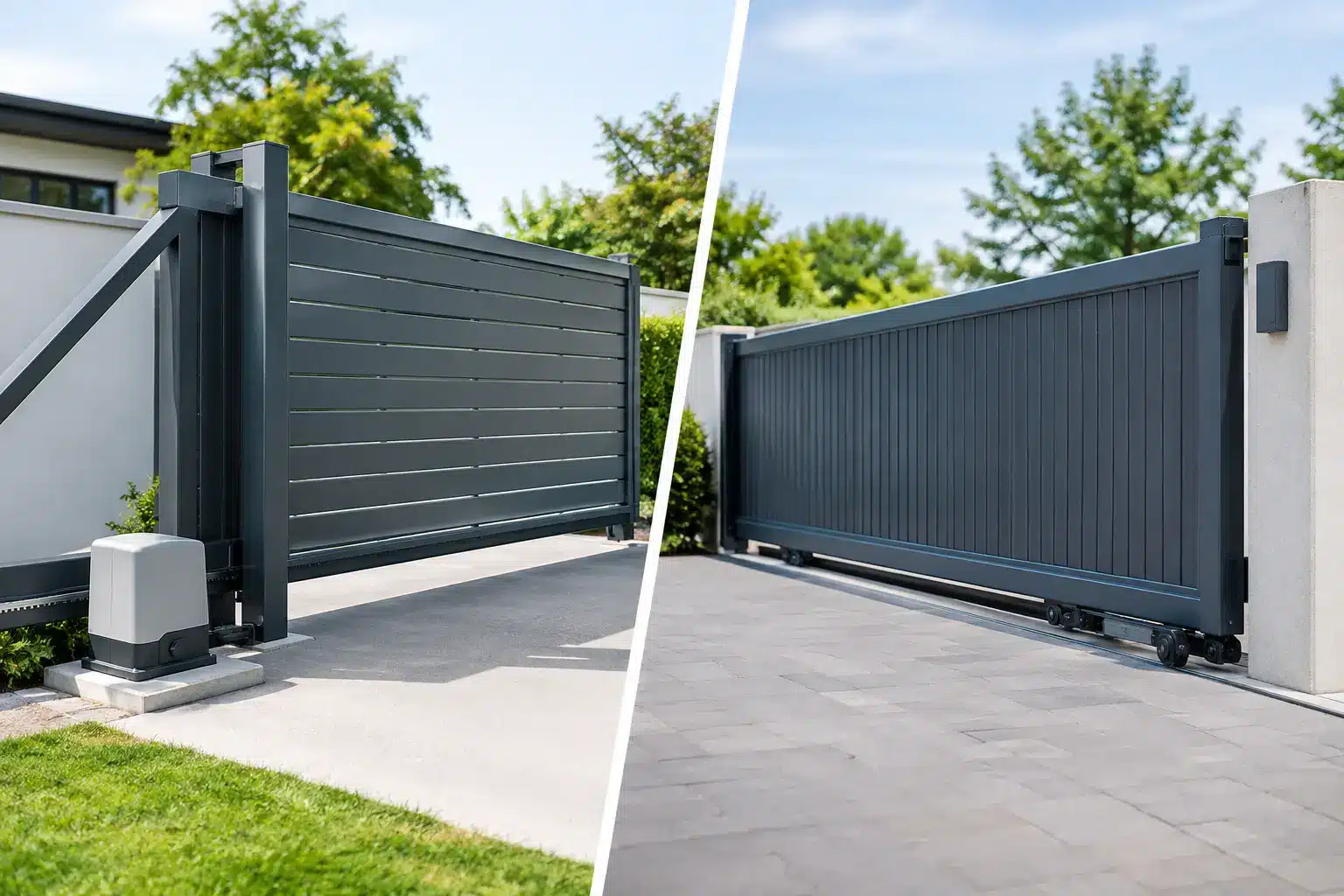
Sliding gates are ideal when the driveway is short, slopes towards the house or cannot accommodate swinging leaves. They travel horizontally along the boundary, leaving the driveway clear and providing a continuous privacy screen when closed. They are also highly suited to automation and controlled access.

A sliding system requires sufficient run-back space beside the opening for the gate to travel. Where that space is limited, telescopic sliding gates can be a practical alternative. Their overlapping sections reduce the required travel distance while retaining the clean, secure appearance of a full-width entrance gate.

Bi-folding and telescopic gates

For compact urban plots and challenging access points, bi-folding and telescopic designs can resolve space constraints that would rule out conventional swing gates. They open quickly and make efficient use of the available frontage. As with any privacy gate, the key is to specify a panel design that remains visually closed when shut, rather than treating the opening mechanism as the only decision.

Aluminium is the practical premium choice

Timber gates have warmth and character, but they demand attention. Britain’s wet winters, changing temperatures and strong sunlight can lead to movement, peeling finishes and a cycle of sanding, painting or staining. Steel can be strong, yet it needs appropriate protection against corrosion and can add considerable weight to an automated system.

Aluminium offers a compelling balance of strength, refined finish and low-maintenance ownership. It does not rust, remains stable in changing weather and can be powder coated in a wide range of colours and finishes. For privacy gates, this means large solid panels can retain their crisp lines and dependable operation year after year.

Construction quality remains crucial. A premium aluminium gate should be fully welded rather than assembled from visibly joined sections. Precision welding gives the frame greater integrity, supports a cleaner finish and helps the gate withstand frequent use. It is the difference between a gate that simply fills an opening and one designed to perform as a long-term part of the property.

Coordinate the gate with fencing and walls

A private entrance can be undermined by open fencing or low walls immediately beside it. For the strongest result, extend the same design language across adjacent fence panels, pedestrian gates and side returns. Matching aluminium fencing can continue the screening line while keeping the frontage cohesive rather than pieced together.

This is also where a design consultation adds real value. The gate should relate to the brickwork, render, window frames and landscaping, not compete with them. Anthracite grey remains a popular choice for contemporary homes, while black creates a sharper, more formal outline. Softer greys, textured finishes and bespoke colours can suit heritage-inspired or individually designed properties.

Consider how much of the boundary needs to be screened. Full-height solid panels may be right for a road-facing side return, while slatted fencing can soften the transition towards a garden or lower boundary wall. A considered mix can preserve privacy where it is needed most without making the whole site feel closed in.

Do not separate privacy from security and access

A closed-panel gate naturally improves privacy, but it should also make access more controlled. Automation allows you to operate the gate without leaving the car, which is particularly valuable in poor weather or on busy roads. It also avoids the temptation to leave a gate open for convenience.

An intercom system with video capability gives you a clear view of visitors before granting access. For homes with regular deliveries, tradespeople or guests, this turns the entrance from a simple barrier into a more intelligent point of control. Commercial sites may require additional features, such as keypad entry, fob access or integration with wider access systems.

Safety should be designed in from the outset. Automated gates need suitable safety devices, correctly specified motors and a layout that accounts for pedestrians, vehicles and pinch points. A premium system is not defined by automation alone. It is defined by reliable operation, safe installation requirements and a gate structure capable of supporting the system for years to come.

Check planning and practical constraints early

Before finalising a high privacy design, assess the position of the gate in relation to a public highway. In many cases, planning rules and permitted development considerations can affect the acceptable height of a gate next to a road. Listed properties, conservation areas and certain developments may have further restrictions.

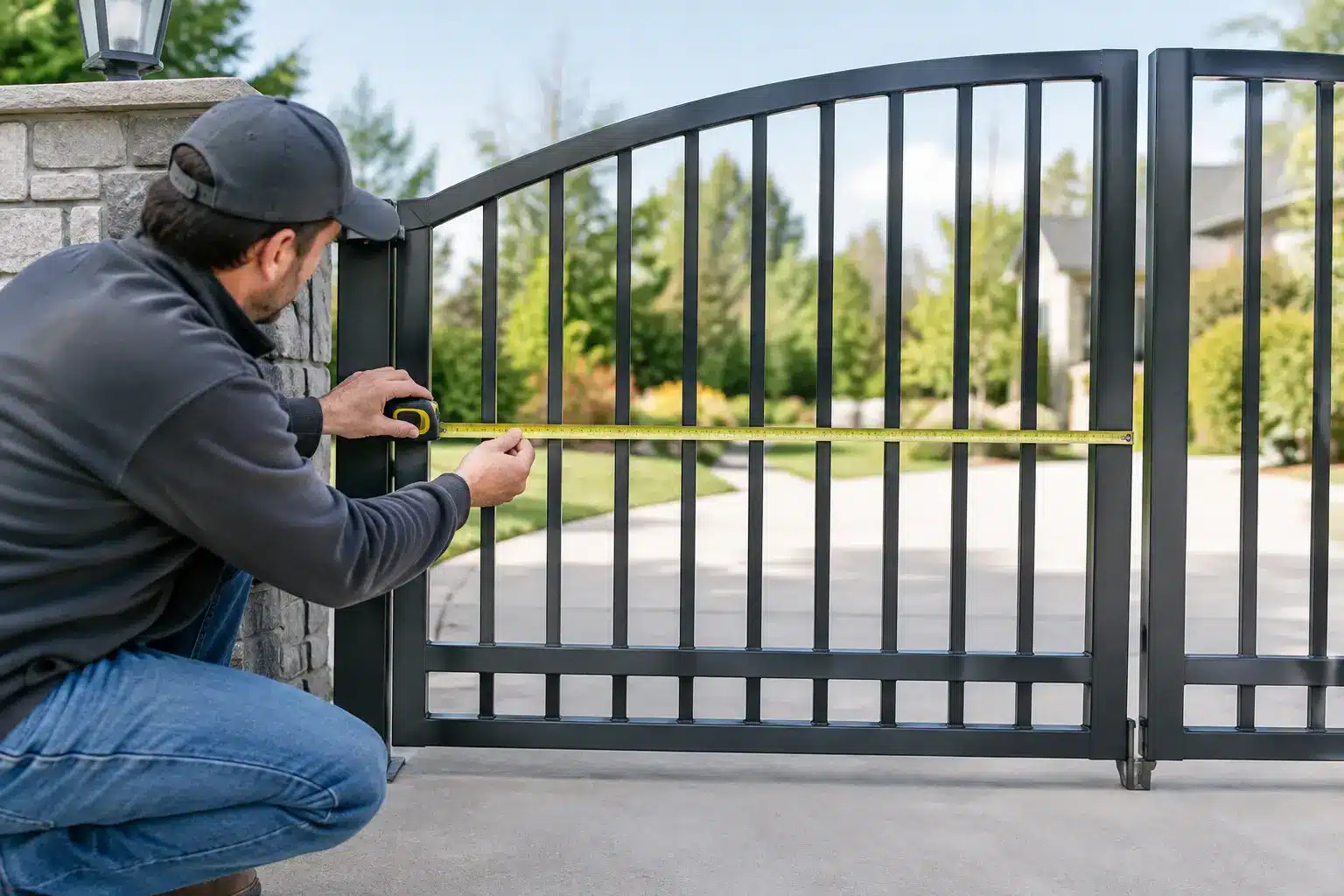
Ground levels, drainage, existing pillars and driveway gradients should also be assessed before manufacture. A gate that looks perfect in a drawing must still clear the surface, align with posts and operate correctly in all seasons. Made-to-measure fabrication gives far greater control over these details than adapting a standard-size product on site.

Alu-Gate approaches each entrance as a tailored system, helping property owners match gate style, opening method, finish and access control to the realities of their site. That level of specification is particularly valuable when privacy, security and appearance all need to work together.

Invest in the view you want to live with

The best private entrance does not need to feel defensive. It should feel calm, precise and purposeful from the street, while giving you the reassurance of a more secluded home behind it. Choose a design that suits the architecture, specify the screening level honestly and build the system around how you arrive, leave and welcome visitors. A well-made aluminium gate will then do its job quietly, every day, for years to come.

Can Aluminium Gates Be Automated for Your Drive?

Can Aluminium Gates Be Automated for Your Drive?

A driveway gate should not force you to stop in the rain, step into traffic or leave your vehicle to let visitors in. For homeowners and commercial sites alike, automated access brings a clear improvement in convenience and security. But can aluminium gates be automated? Absolutely – provided the gate, opening layout and automation equipment are specified as one considered system.

Aluminium is particularly well suited to electric operation. It is strong without carrying the excessive weight of many steel or timber alternatives, it does not swell or rot, and its low-maintenance finish helps keep the gate moving as intended over years of daily use. The right result is not simply a gate with a motor attached. It is a made-to-measure entrance designed for dependable movement, safe operation and a finish that complements the property.

Can aluminium gates be automated safely?

Yes. Both aluminium swing gates and sliding gates can be automated safely with correctly matched equipment and professional installation. The gate’s size, weight, construction, frequency of use and exposure to wind all influence the motor and safety specification.

A premium fully welded aluminium gate offers an excellent starting point. Its rigid frame helps maintain alignment, while aluminium’s lighter weight can reduce the load placed on hinges, tracks and motors. That does not mean every aluminium gate needs the same operator. A broad, solid-panel gate on an exposed rural driveway behaves very differently from an open-slatted pedestrian entrance in a sheltered town setting.

Safe automation also relies on more than the motor. A properly specified system includes controls that limit force, safety photocells that detect people or vehicles in the gate’s path, and a suitable method of releasing the gate manually if there is a power failure. The final installation should meet the relevant UK safety requirements for powered gates. This is why the design stage matters as much as the product choice.

Start with the way your entrance needs to work

The best automation system follows the site, rather than forcing a standard arrangement onto it. Before choosing a gate style, consider how vehicles approach, where they wait, how much space is available behind the gate and who will use it.

Automated swing gates

Swing gates create a traditional, imposing entrance and work well where there is clear space inside the property for the leaves to open. They can be configured as a single leaf or a pair, depending on the width of the opening and the desired appearance.

Underground motors are often chosen for a refined, uncluttered look because the mechanism is concealed below ground. Above-ground arm or ram motors can be a practical choice where access for servicing is preferred or where ground conditions make underground equipment less suitable.

The key consideration is clearance. A swing gate must never open into a public highway, pavement or shared access route. It also needs enough room to travel without meeting parked cars, slopes, planting or walls. On rising driveways, the gate geometry needs especially careful planning.

Automated sliding gates

A sliding gate is often the answer when inward swing space is limited. Instead of opening into the drive, the gate moves sideways along the boundary. This suits shorter or sloping driveways and can provide a strong, contemporary entrance statement.

There must be enough lateral run-back space for the gate when open. A tracked sliding gate requires a stable, level track across the opening, while a cantilever design runs above ground and can be useful where leaves, gravel, snow or uneven surfaces could obstruct a track. Cantilever systems generally require more return space, so they are not ideal for every plot.

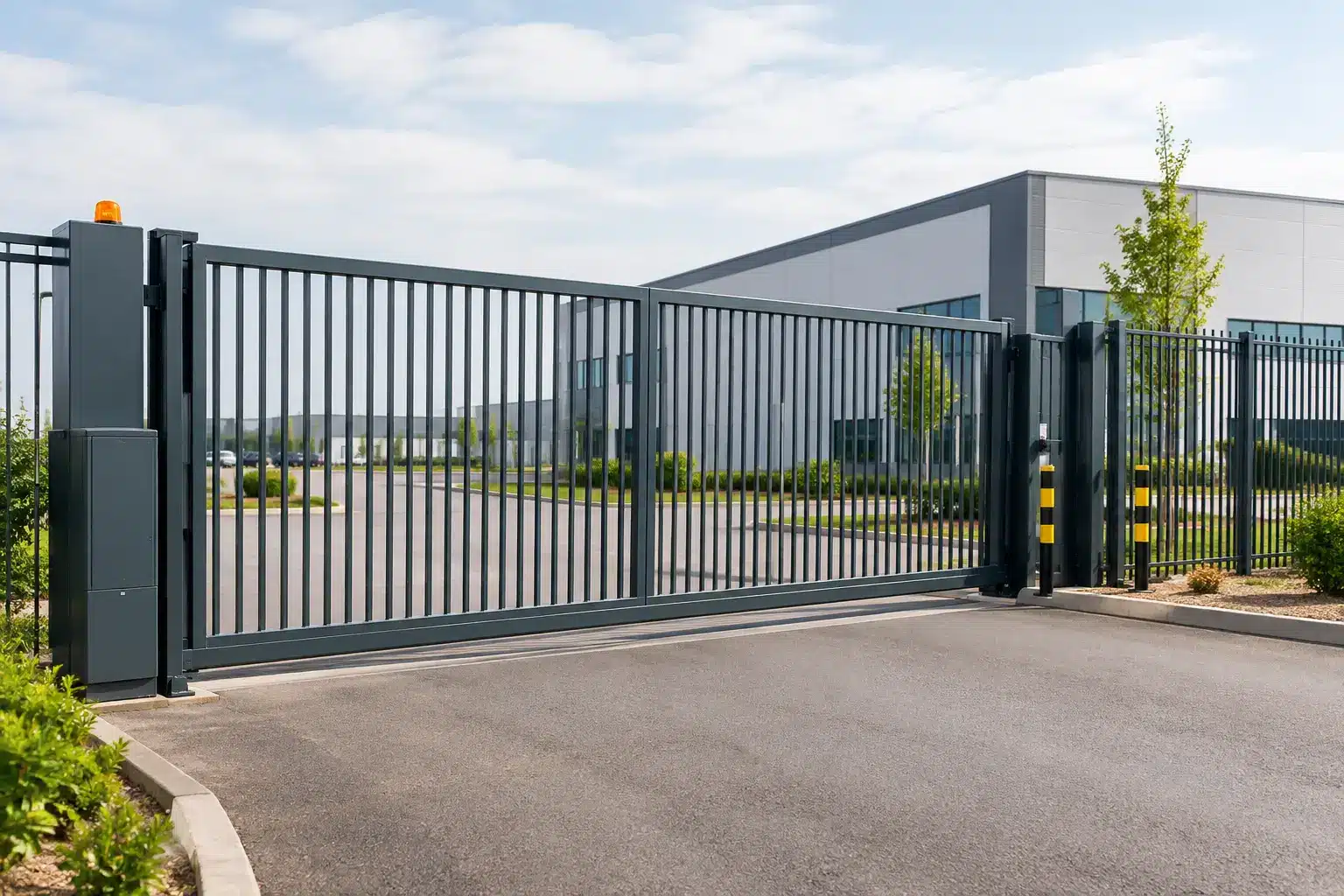
For commercial premises, sliding gates can be particularly effective at wider openings and higher usage levels. The correct operator should be selected for the gate’s duty cycle, not merely its weight. A gate used a few times each day has different demands from one serving a busy yard, office car park or managed development.

Bi-folding and telescopic options

Where space is extremely limited but fast opening is valuable, bi-folding or telescopic aluminium gates may be worth considering. These specialist formats reduce the space needed for a gate to open and can improve traffic flow. They demand precise fabrication and careful automation design, making bespoke manufacture especially valuable.

What makes an aluminium gate suitable for automation?

A motor can only perform as reliably as the gate it moves. The gate should be purpose-designed for automated use, with the right frame strength, hinge points, reinforcement and hardware. Retrofitting automation to an existing gate can be possible, but only after a thorough assessment of its condition and structure.

Weight is one of aluminium’s practical advantages. A well-engineered aluminium gate can be significantly easier to move than a comparable solid timber or steel gate, while retaining a substantial, premium feel. Lower weight can support smoother operation and reduce strain on components. Yet lightness alone is not the objective. The gate must be engineered to resist flexing, sagging and twisting, particularly across wide openings.

Wind loading is another essential factor. Closeboarded or solid aluminium panels offer privacy and a striking architectural finish, but they present a larger surface area to strong winds. In exposed locations, this can affect motor choice, post design and the gate’s operating limits. Open slatted designs allow more air to pass through, although the final decision should balance privacy, appearance and site conditions.

Posts and foundations deserve equal attention. Whether the gate is fixed to masonry piers or purpose-made aluminium posts, the supporting structure must carry the load without movement. For sliding gates, the base and track or cantilever foundation are central to long-term performance. A beautifully fabricated gate will not compensate for unstable groundwork.

Choosing access control that suits daily life

Automation is most useful when entry feels intuitive. A simple remote control may suit a private driveway, while a keypad, proximity reader or GSM system can offer more flexible access for family members, staff or regular visitors. Video intercoms, including Akuvox systems, allow you to see and speak to callers before granting access.

Think beyond arriving by car. A separate pedestrian gate is often a sensible addition, allowing people to enter without operating the main driveway gate. It can reduce unnecessary cycles, make deliveries easier and provide a coordinated entrance solution. Matching fencing and side panels can then carry the same design language around the boundary.

For commercial settings, access permissions and visitor management may be more important than visual convenience alone. A system can be configured around staff access, timed operation, delivery periods and emergency release requirements. The principle remains the same: select the controls around the people using the site, not simply the features available.

Power, maintenance and long-term reliability

Most automated gates use a mains electrical supply, planned discreetly from the outset. This allows dependable operation and supports accessories such as intercoms, lighting and safety devices. Where running a cable is difficult, solar-powered automation may be viable for certain gates and usage patterns, but it depends on available daylight, gate size and the expected number of cycles. It should be assessed honestly rather than treated as a universal substitute for mains power.

Aluminium gives owners a low-maintenance advantage. It will not need the routine staining, painting or rot repairs associated with timber, and a quality powder-coated finish is designed to retain its appearance with straightforward cleaning. However, low maintenance does not mean no maintenance.

Keep tracks and drainage areas clear, inspect hinges and fixings, and arrange periodic checks of the operator, safety devices and controls. A gate that begins to drag, make unusual noise or stop inconsistently should be inspected promptly. Small alignment issues are far simpler to resolve before they create wear in the motor or hardware.

A bespoke gate system delivers the better result

Automation is most successful when it is considered before fabrication begins. Gate dimensions can be tailored to the opening, reinforcement can be positioned where the operator requires it, and the design can account for the exact swing path or sliding run-back. That protects both the clean visual finish and the practical performance of the entrance.

At Alu-Gate, made-to-measure aluminium gates are designed around the property, the access requirements and the desired level of privacy. Fully welded construction, premium finishes and a 20-year guarantee provide the quality foundation an automated entrance deserves.

The most effective next step is a site-led conversation: measure the opening, understand the ground conditions and decide how the entrance needs to perform every day. From there, the right aluminium gate and automation system can be specified with confidence – designed to impress, and built to last.

Welded Gates vs Assembled Gates

Welded Gates vs Assembled Gates

A gate can look impressive on day one and still be the wrong choice five winters later. That is why the question of welded gates vs assembled gates matters far more than many buyers first realise. The construction method affects strength, appearance, maintenance, long-term reliability and, ultimately, whether your entrance feels like a lasting upgrade or a compromise.

If you are investing in a bespoke aluminium gate for a home or commercial property, this is not simply a technical detail. It is part of the gate’s core quality. Two gates may appear similar in a brochure, but how they are built will shape how they perform under regular use, wind loading, automation and the general wear that comes with a busy entrance.

Welded gates vs assembled gates – what is the difference?

A welded gate is fabricated by permanently joining the frame and key components through welding. This creates a single, integrated structure. In a well-made aluminium gate, the welds are finished carefully so the final product looks clean, precise and purpose-built rather than pieced together.

An assembled gate, by contrast, is typically made from separate sections that are mechanically fixed together using brackets, screws, bolts or knock-down joints. This can speed up production and simplify transport or installation, but it also means the gate relies on multiple fixing points rather than a fully fused frame.

That distinction has practical consequences. A welded frame behaves more like one solid unit. An assembled frame has more individual parts and more points where movement can develop over time.

Why construction matters more than many buyers expect

When customers compare styles, colours and infill options, the frame construction can easily be overlooked. Yet it is one of the biggest factors in how a gate ages. This is especially true for larger driveway gates, automated systems and exposed properties where strength and alignment are critical.

A gate is not static. It opens and closes repeatedly, carries its own weight through hinges or tracking systems, and must stay square as temperatures change and weather takes its toll. Any weakness in the build tends to show up gradually – slight movement at the joints, visible misalignment, rattling, sagging or a finish that no longer looks as crisp as it once did.

For a premium entrance, those issues are frustrating not just because they affect operation, but because they undermine the look and feel of the whole installation.

Strength and structural stability

This is where welded gates usually hold a clear advantage. Because the frame is permanently joined, the load is distributed through the structure more consistently. That gives the gate greater rigidity, which is particularly important on wider openings and heavier designs.

An assembled gate can still be serviceable, especially in lighter-duty applications, but it is more dependent on the quality of its fixings and the precision of the assembly. Over time, repeated use can place stress on those mechanical joints. If there is any tolerance in the connections, even a well-installed gate may develop movement that a welded frame is better placed to resist.

For residential driveways with regular daily use, or commercial entrances where reliability matters, rigidity is not a luxury. It is part of what keeps the gate operating cleanly and looking properly engineered.

Wind, automation and daily use

The larger the gate, the more important structural integrity becomes. Solid or semi-solid infill designs can catch wind, putting additional pressure on hinges, posts and the frame itself. Automation adds another layer, because motors work best when the gate remains correctly aligned and moves with predictable resistance.

A fully welded aluminium gate is generally better suited to these demands. It offers a more stable platform for long-term use, particularly where precision matters.

Appearance and finish quality

Premium buyers are not only comparing function. They are also looking at the visual standard of the finished product. A gate sits at the front of a property, often as a focal point. Every line, joint and detail is visible.

Welded gates tend to deliver a cleaner, more refined appearance because the construction is integrated rather than obviously sectional. When fabricated and finished properly, the result looks tailored and architecturally coherent. There is less sense of a product being assembled from standard components.

With assembled gates, visible joints and connection points can sometimes be more apparent. Not every buyer will object to that, and not every assembled gate is unattractive, but if the brief is a high-end entrance with a bespoke feel, welded construction usually supports that standard more convincingly.

This matters even more when you are matching gates with fencing, walling, railings or a wider exterior scheme. The cleaner the fabrication, the more polished the final result.

Maintenance and long-term ownership

One of aluminium’s biggest strengths is low maintenance. It does not rot like timber and will not suffer the same corrosion issues associated with untreated steel. However, low maintenance does not mean construction quality becomes irrelevant.

With assembled gates, multiple mechanical fixings can introduce more points that may need checking over time. Depending on the design, joints can loosen, components can shift slightly and small issues can become more noticeable as the gate ages.

A welded gate generally reduces that risk by removing many of those separate connection points from the equation. That does not eliminate the need for proper installation or occasional servicing, especially on automated systems, but it does support a more stable, lower-fuss ownership experience.

For buyers who want to install a gate once and enjoy it for years without ongoing irritation, that difference carries real value.

Cost versus value

Assembled gates are often chosen because they can be cheaper to manufacture. Lower production complexity and faster assembly can make them appealing at the budget end of the market. If the priority is simply to secure an opening at the lowest possible upfront cost, that route may seem attractive.

But premium gate buying is rarely about the cheapest invoice. It is about the quality of the finished entrance and what it delivers over time. A gate that costs less initially but develops movement, loses its visual sharpness or requires earlier replacement is not necessarily the better-value choice.

Welded gates usually command a higher price because they involve more skilled fabrication and a more substantial build process. In return, buyers are typically getting better structural performance, a cleaner finish and stronger long-term confidence. For many homeowners and commercial buyers, that is the more sensible investment.

Are assembled gates ever the right choice?

There are cases where an assembled gate can be suitable. Smaller pedestrian gates, lower-demand installations or projects with tight cost constraints may not require the same level of structural performance as a large automated driveway gate. In those settings, a well-made assembled gate may meet the brief.

The key point is to match the construction method to the demands of the project. Problems usually arise when buyers assume all gates are broadly the same, then discover too late that the build quality was not aligned with the application.

If the gate needs to deliver strong kerb appeal, withstand regular use, integrate with automation and hold its shape for the long term, a welded solution is often the more dependable answer.

What to ask before you buy

Rather than focusing only on style and price, ask how the gate is fabricated. Is the frame fully welded? Are the joints visible? How is the gate designed to cope with width, weight and wind exposure? What guarantee supports the product?

These are the questions that separate a genuine premium gate from a product that simply looks good in photographs. A confident manufacturer should be able to explain not just what the gate looks like, but why it is built the way it is.

For bespoke aluminium entrances, precision welding is often a sign that the gate has been designed as a long-term architectural feature, not a short-term fix.

Which option is better for a premium aluminium entrance?

For most design-conscious homeowners and commercial buyers, welded gates come out ahead. They offer the strength, finish quality and durability expected from a premium entrance system. They also align more naturally with made-to-measure design, where every element is produced to suit the property rather than adapted from standard parts.

That is why specialists such as Alu-Gate place such a strong emphasis on fully welded construction. It supports the kind of entrance buyers actually want – secure, refined, low maintenance and built to last.

A gate should do more than close an opening. It should add presence to the property, work reliably every day and still look right years from now. If you are weighing up welded gates vs assembled gates, the better question may be this: do you want a gate that is merely put together, or one that is properly built?

Aluminium or Steel Gates: Which to Choose?

Aluminium or Steel Gates: Which to Choose?

Choosing between aluminium or steel gates usually comes down to one simple question: do you want a gate that looks impressive on day one, or one that still performs beautifully years later with far less upkeep? For most UK property owners, the right answer is not just about appearance or headline strength. It is about how the gate will live with the property, the climate, the level of use and the finish you expect to maintain.

A front entrance is one of the few exterior features that needs to do several jobs at once. It has to secure the boundary, complement the architecture, withstand weather and repeated use, and continue to look right in a setting that may have cost a great deal to create. That is why the aluminium versus steel decision deserves more than a quick price comparison.

Aluminium or steel gates – what is the real difference?

At a glance, aluminium and steel can appear similar. Both can be fabricated into contemporary or traditional gate designs, both can be automated, and both can create a strong physical presence at the entrance to a home or commercial site. The differences become clearer when you look at weight, corrosion resistance, maintenance demands and the way each material performs over time.

Steel has long been associated with strength. It is dense, solid and often chosen where buyers want a traditional wrought-iron look or a visibly heavy-duty structure. That reputation is earned, but weight is not always an advantage. Heavier gates place greater demand on posts, hinges, motors and supporting hardware. Over time, that can mean more wear and more adjustment, particularly on larger driveway openings.

Aluminium offers a different kind of strength – strength with efficiency. A well-engineered, fully welded aluminium gate can deliver excellent rigidity and security while remaining far lighter than steel. That lower weight matters in daily use. It supports smoother operation, reduces strain on automation systems and makes it easier to achieve larger bespoke gate formats without introducing unnecessary load.

Why aluminium suits modern UK properties

The British climate is not gentle on external metalwork. Rain, frost, airborne pollutants and coastal exposure all play their part. This is where aluminium stands apart.

Unlike steel, aluminium does not rust. That single fact changes the ownership experience significantly. With steel gates, even when they are galvanised and powder coated, any damage to the protective finish can create a route for corrosion to begin. Once rust takes hold, maintenance becomes a cycle of treatment, repainting and repair.

Aluminium removes much of that concern. It is naturally corrosion resistant, which makes it especially well suited to exposed driveways, busy entrances and properties where owners want a premium finish without committing to regular refurbishment. For clients investing in a smart exterior upgrade, low maintenance is not a minor benefit. It is a key part of long-term value.

There is also a design advantage. Aluminium fabrication supports clean lines, sharp detailing and high-end powder-coated finishes that work particularly well on contemporary homes, renovated period properties and commercial premises where presentation matters. The result is a gate that feels tailored and architectural rather than simply functional.

Where steel gates still make sense

Steel remains a valid choice in some situations. If the brief calls for ornate detailing, heritage styling or a particularly traditional visual language, steel can be attractive. Certain commercial or industrial settings may also favour steel where a visibly heavier material aligns with the surrounding architecture or security specification.

That said, steel is often selected because of perception rather than full-life performance. Buyers hear that steel is stronger and assume it is therefore the superior option. In practice, the best material depends on how the gate is designed, fabricated and installed. A poorly made steel gate will not outperform a precision-made aluminium one simply because it is heavier.

There is also the issue of ownership cost. Steel may appear competitive at the point of purchase, but if the gate requires more maintenance, coating repairs or hardware attention over the years, the long-term picture can look very different.

Aluminium or steel gates for security

Security matters, but it should be assessed properly. Material is only one part of the equation. Gate height, infill design, locking method, hinge quality, posts, automation and access control all influence how secure the entrance really is.

Steel is undeniably strong, but aluminium should not be mistaken for lightweight in the negative sense. Premium-grade aluminium gates, especially when fully welded and made to measure, can deliver excellent security performance for residential and many commercial applications. Their lighter operating weight can also be a practical advantage when paired with motors, intercoms and controlled access systems.

If your priority is a secure entrance that also feels refined, the specification matters more than the stereotype. A bespoke aluminium gate system with quality fabrication and integrated access control can provide a highly effective barrier while maintaining a cleaner, more premium look.

Maintenance and ownership over time

This is often the deciding factor once buyers move beyond first impressions. Steel requires more attention. Even high-quality coated steel can chip, scratch or wear, and every damaged point in the finish is a potential maintenance issue. In a damp environment, that becomes hard to ignore.

Aluminium is far easier to live with. Routine cleaning is generally enough to keep it looking its best, and there is no ongoing battle with rust. For busy homeowners, developers and facilities managers, that reduction in maintenance is not just convenient. It protects the appearance of the entrance and helps preserve the original investment.

This is particularly relevant for larger gates, automated systems and coordinated boundary projects where repainting or reactive repairs become more disruptive and more expensive. When the gate is part of a wider design scheme, consistency of finish matters. Aluminium helps maintain that standard.

Style, finish and kerb appeal

Premium gates are not only security products. They are part of the architecture of the property. The right design should frame the entrance, elevate the exterior and feel proportionate to the building behind it.

Aluminium is exceptionally strong in this area. It lends itself to sleek horizontal lines, solid privacy panels, contemporary slatted designs and coordinated fencing systems that create a unified look across the frontage. Powder-coated finishes offer a refined appearance with excellent durability, and the visual quality tends to remain stable with less intervention.

Steel can achieve impact too, particularly in classic styles, but it often suits a narrower design brief. For many modern UK homes and upgraded driveways, aluminium offers greater flexibility without compromising presence. It gives buyers the opportunity to choose a gate that feels bespoke and design-led rather than inherited from standard catalogue styling.

Cost versus value

The cheapest gate is rarely the best-value gate. A premium entrance should be judged over years, not weeks.

Steel can sometimes look attractive on upfront price, depending on the design and finish. But that comparison can be misleading if it excludes future maintenance, repainting, hardware strain or shorter aesthetic lifespan. The total cost of ownership matters.

Aluminium often delivers stronger long-term value because it reduces ongoing maintenance, supports durable finishes and performs efficiently in everyday use. When paired with made-to-measure fabrication, it also avoids the compromises that come with off-the-shelf sizing. That means a better fit, better appearance and better performance from the start.

For high-end residential projects and quality-focused commercial properties, value is rarely about buying the least expensive option. It is about choosing the system that will continue to justify its place at the entrance year after year.

Which material is right for your property?

The answer depends on what you are trying to achieve. If you want a heritage aesthetic and are comfortable with a more hands-on maintenance schedule, steel may still suit the brief. If you want a gate that combines strength, low maintenance, modern styling and long-term reliability, aluminium is usually the stronger choice.

That is especially true for bespoke driveway gates, sliding gates, swing gates, pedestrian access gates and coordinated fencing schemes where finish quality and ease of ownership matter as much as security. In these settings, aluminium offers a balance that is hard to ignore – lighter operation, corrosion resistance, design flexibility and a premium appearance that lasts.

At Alu-Gate, that is why the focus stays firmly on made-to-measure aluminium systems built with precision, fully welded construction and long-term durability in mind. For buyers who want an entrance solution that feels considered rather than compromised, material choice is not a small technical detail. It sets the standard for everything that follows.

If you are weighing up aluminium or steel gates, think beyond the brochure claims. Consider the finish in five winters’ time, the way the gate will operate every day, and whether the entrance you choose will still reflect the quality of the property behind it. The right gate should not just close an opening. It should complete the space.

Aluminium Sliding Gate Review for UK Buyers

Aluminium Sliding Gate Review for UK Buyers

A sliding gate can solve a problem that a swing gate simply cannot. If your driveway rises sharply, space is tight, or you want a cleaner, more architectural entrance, this aluminium sliding gate review will give you a clear view of where the format excels, where it needs careful planning, and whether it is the right long-term investment for your property.

For many UK buyers, the first attraction is obvious. Aluminium sliding gates look sharp, feel modern and avoid the clearance issues of gates that open inwards or outwards. Yet the better question is not whether they look good. It is whether they will perform well, hold their finish, support reliable automation and still feel like a smart purchase years down the line.

Aluminium sliding gate review: what stands out

The strongest argument for aluminium is that it delivers a premium appearance without the ownership demands that often come with timber or the weight penalty associated with steel. A well-made aluminium sliding gate offers a clean, precise look, strong corrosion resistance and lower routine maintenance, which is a significant advantage in the British climate.

That said, not all aluminium gates are equal. A proper review has to separate premium, made-to-measure systems from lightweight, generic products. The quality of the frame design, the welding, the track or cantilever specification, the finish and the installation details all affect how the gate will feel in daily use.

When aluminium sliding gates are done properly, they tend to score highly in five areas: appearance, durability, low maintenance, automation compatibility and design flexibility. For homeowners investing in kerb appeal and security at the same time, that combination is difficult to ignore.

Design and kerb appeal

This is where aluminium often outperforms expectations. Sliding gates naturally create a more contemporary frontage because the movement is controlled and discreet, and the gate itself can be designed with strong horizontal lines, privacy infills or more open styles depending on the property.

For modern homes, aluminium complements glazing, rendered walls, brickwork and dark-framed windows especially well. On period or mixed-style properties, the result depends more on the design brief. A bespoke aluminium gate can still work beautifully, but the profile choice, spacing and finish need to be considered carefully so the entrance feels intentional rather than too stark.

Powder-coated finishes are another major strength. Buyers are no longer limited to a basic industrial look. Premium finishes offer a refined surface and a broad choice of colours, making it easier to match fencing, pedestrian gates and other exterior elements across the site.

The trade-off is simple. If you choose a standardised design to save money, aluminium can look flat or generic. If you choose a made-to-measure, fully welded system, it can look genuinely high-end.

Security and day-to-day performance

A gate is not just a design feature. It needs to control access, withstand regular use and feel dependable every time it opens. On that front, aluminium sliding gates perform well, especially when paired with quality automation and access control.

Sliding gates are inherently practical where security matters because they open in a fixed path. There is no broad swing arc to account for, and the closed position can feel solid and deliberate. For residential driveways, that can create a strong sense of privacy and control. For commercial settings, it supports more predictable entry management.

The key point is structural quality. Aluminium itself is strong, but the gate must be engineered correctly. A poorly fabricated gate may flex, rattle or lose alignment over time. A properly built gate with precision welding and the right section sizes feels stable, secure and premium.

Automation is often where buyers notice the difference between average and excellent specification. A gate can only be as reliable as the system around it. Motor choice, safety edges, photocells, intercom integration and control setup all matter. The best sliding gates are designed from the outset to work as a complete entrance solution rather than as a standalone leaf with automation added as an afterthought.

Durability in UK conditions

British weather is not kind to exterior joinery or metalwork. Rain, frost, road grime and coastal air can all shorten the life of the wrong material. This is one of the clearest areas where aluminium earns its reputation.

Unlike timber, aluminium will not rot, warp or require repeated painting to remain presentable. Unlike untreated or poorly finished steel, it is not prone to the same corrosion concerns. That does not mean it is indestructible, but it does mean ownership tends to be far simpler over the long term.

A good finish is essential. Marine-grade or high-spec powder coating is worth attention, particularly in exposed or coastal locations. Buyers should also ask how the gate is fabricated. Fully welded construction generally offers a more rigid, refined result than mechanically assembled alternatives, and it supports long-term durability in a way many cheaper systems do not.

In practical terms, aluminium suits buyers who want a premium entrance without signing up to constant upkeep. That low-maintenance advantage is not marketing fluff. It is one of the material’s most persuasive benefits.

Aluminium sliding gate review on maintenance and ownership

Most buyers are not looking for a hobby. They want a gate that works, looks right and does not start demanding time and money after the first few winters. Aluminium scores well here.

Routine care is typically limited to cleaning the surface, checking moving parts and servicing automation components at sensible intervals. There is no cycle of sanding, staining or repainting that often comes with timber gates. For larger entrances or commercial sites, that reduction in maintenance can make a real difference to lifetime cost.

Still, low maintenance does not mean no maintenance. Tracks need to stay clear. Automation needs proper servicing. Safety systems should be checked. A sliding gate is a mechanical entrance system, not a decorative panel. Buyers who understand that from the start tend to be happier with the result.

Where sliding gates are not the perfect answer

A balanced review should be clear about this: sliding gates are not right for every site.

They need lateral run-back space, so the gate has somewhere to travel when open. If your boundary layout does not allow that, a swing or bi-folding option may be more practical. Ground conditions also matter. Traditional tracked systems need accurate groundwork and drainage planning. Cantilever systems avoid a ground track across the opening, which is useful in some settings, but they require their own structural allowances.

Cost can also be higher than buyers first expect. A quality aluminium sliding gate is not simply a panel on wheels. It is part of a wider engineered system that may include fabrication, posts, supports, automation, controls and safety measures. If you compare it with a basic manual swing gate, the price gap can look significant.

But that comparison is not always fair. Buyers are usually comparing different levels of convenience, security, finish and lifespan. In many premium residential and commercial projects, the better comparison is not cheapest gate versus most expensive gate. It is short-term saving versus long-term value.

What to look for before you buy

The difference between a gate that impresses for years and one that disappoints often comes down to specification. Ask how the gate is made, not just what it looks like. Material grade, frame depth, welding quality, finish standard and automation integration all deserve attention.

It is also worth asking whether the system is genuinely bespoke. Made-to-measure gates usually sit better within the opening, look more considered and perform more consistently because the design responds to the exact site conditions. That is especially important on sloping driveways, wide openings or properties where the entrance needs to coordinate with fencing and pedestrian access.

Guarantees matter too, but only if they are backed by real manufacturing standards. A long guarantee is a strong signal when it is supported by quality materials, fabrication and finish. Specialist suppliers tend to offer more confidence here than general resellers.

For buyers who want a premium result, this is where consultation-led design becomes valuable. A good supplier should challenge assumptions, explain the trade-offs and recommend the gate format that actually suits the property.

Final verdict

So, how does an aluminium sliding gate score overall? Very well, provided the product is specified properly and matched to the site. It is an excellent choice for buyers who want modern styling, strong security, low maintenance and a tailored entrance that feels every bit as good as it looks.

It is less suitable where budget is the only driver or where the site cannot accommodate the gate’s travel requirements. But for design-conscious homeowners and commercial buyers who value durability, precision and long-term ownership, aluminium sliding gates are one of the strongest options on the market.

If your entrance needs to work hard and look exceptional while doing it, it is worth taking the time to get the specification right. The right gate does more than close an opening. It changes how the whole property is seen.

Best Gates for Narrow Driveways

Best Gates for Narrow Driveways

A narrow driveway exposes every design mistake. Leave too little clearance and the gate becomes awkward to use. Choose the wrong opening style and you lose valuable parking space, clip a car wing mirror, or create a daily frustration every time you arrive home. That is why selecting the best gates for narrow driveways is less about trends and more about getting the geometry, access and build quality exactly right.

For many UK properties, especially period homes, town plots and urban new builds, driveway width is fixed. You cannot move a boundary wall or widen a brick pier without major cost. The gate, then, has to work harder. It must provide security, look proportionate, open cleanly and make the entrance feel considered rather than compromised.

What makes a gate work on a narrow driveway?

A narrow driveway does not always mean a tiny opening. More often, it means limited manoeuvring space, reduced depth behind the gate, awkward boundary lines, or pillars and walls that leave very little tolerance for error. The best result comes from measuring the full approach, not just the gap between posts.

A gate that suits a narrow opening usually needs to do three things well. First, it must preserve usable space, whether that means reducing swing arc or stacking neatly out of the way. Second, it must be made precisely enough to avoid clearance issues. Third, it needs to feel visually balanced. A gate that is technically functional but looks heavy or cramped can diminish the whole frontage.

This is where made-to-measure aluminium has a clear advantage. It allows for exact sizing, fully welded strength and slim, refined profiles that do not overwhelm a smaller entrance. It also gives long-term durability without the maintenance burden of timber or the weight of steel.

The best gates for narrow driveways by opening type

There is no single right answer for every property. The best gates for narrow driveways depend on how much room you have in front, behind and to the side of the opening, as well as whether you plan to automate the system.

Sliding gates

If the site allows lateral run-back, a sliding gate is often the strongest option for a narrow driveway. Instead of swinging inwards or outwards, the gate moves across the entrance and stacks to one side. That means you keep your driveway depth clear, which is especially useful when parking space is tight or the car sits close to the boundary.

Sliding gates also suit properties on slopes, where swing gates may struggle with rising ground. From a security perspective, they are strong, stable and well suited to automation. The trade-off is space to the side. You need sufficient room for the gate to travel, and the supporting structure must be specified properly.

For homeowners and commercial buyers who want a premium, space-efficient entrance, a bespoke aluminium sliding gate can offer the cleanest solution.

Bi-folding gates

Where side run-back is limited, bi-folding gates are often one of the smartest answers. These gates fold back on themselves as they open, reducing the swing arc and opening faster than many traditional systems. On a tight driveway, that speed and efficiency can make everyday access noticeably easier.

Bi-fold gates are particularly effective where cars need to pull up close to the entrance before opening. They also work well in modern settings, where a crisp architectural look matters. The key is build quality. Folding systems rely on accurate fabrication and dependable hardware, so a poorly made gate will quickly show its weaknesses.

Swing gates

Traditional swing gates can still be the right choice on a narrow driveway, but only when the site has enough internal depth and the opening arc has been thought through carefully. Split-leaf designs are usually more practical than a single large leaf because each panel requires less clearance.

For some homes, especially those with a straight, level approach and room behind the gate, swing gates remain a classic and elegant option. They can look more residential and softer in appearance than sliding systems. The limitation is simple: if space is already tight, the swing arc may become an obstacle rather than a feature.

Telescopic sliding gates

A telescopic gate is a strong alternative when you want the benefits of a sliding gate but do not have full run-back to one side. Instead of one long gate leaf, the sections slide and stack together. This reduces the side space required and can solve layout problems that would otherwise rule out a sliding system.

This type of gate tends to suit more complex or constrained sites, including commercial entrances and high-spec residential projects. It is not always the first option people consider, but on the right property it can be the most efficient answer.

Material matters as much as the opening style

On a narrow driveway, extra weight is rarely your friend. Heavier gates place more strain on hinges, motors and track systems, and they can feel cumbersome in everyday use. That is one reason aluminium stands out.

Premium aluminium gates combine strength with lower weight, which is especially valuable for automated systems and space-conscious openings. They resist rust, require very little maintenance and hold their finish well in the British climate. Just as importantly, they can be fabricated with sleek proportions that suit narrower entrances.

Timber can look attractive, but it brings ongoing maintenance and can move over time. Steel is undeniably strong, yet often heavier and less forgiving where precision and ease of operation matter. For clients investing in a long-term entrance solution, aluminium usually offers the best balance of performance, appearance and ownership value.

Design details that make a narrow entrance look better

A narrow driveway can still make a strong visual statement. In fact, the more compact the entrance, the more important the detailing becomes.

Vertical infills often help a narrow gate feel taller and more elegant, while horizontal lines can work beautifully on contemporary homes if the proportions are handled carefully. Privacy levels matter too. Fully solid designs increase screening and security, but in a smaller opening they can feel visually heavier. Semi-solid or slatted designs often create a lighter, more refined look without sacrificing presence.

Colour and finish also play a role. Dark tones can look striking and architectural, but the best choice depends on the surrounding brick, render, fencing and front elevation. A coordinated approach across the gate, fencing and pedestrian access creates a cleaner overall result.

Practical questions to answer before you choose

Before specifying a gate for a narrow driveway, it helps to think beyond width alone. Consider how you actually use the entrance day to day. Do you reverse in or drive straight out? Does a second car need to pass through quickly? Is the driveway sloped? Will the gate be automated from the start?

You should also consider whether a pedestrian gate is needed separately, rather than forcing regular foot traffic through the main driveway gate. On tighter frontages, separating vehicle and pedestrian access can improve convenience and reduce wear on the main system.

Automation deserves special attention. On narrow driveways, automated opening can remove much of the inconvenience of a constrained entrance, but only if the gate type is suitable and the installation is properly planned. Intercoms, keypads and controlled access can all be integrated into a bespoke system, making the entrance more secure and more convenient at the same time.

When bespoke is the better investment

Narrow driveways rarely reward off-the-shelf thinking. Standard gate sizes and generic hardware often lead to compromises in clearance, appearance or operation. A bespoke gate is not simply about getting a custom width. It is about designing the right system for the property.

That includes the gate format, frame construction, infill style, automation allowances and the relationship with surrounding walls, fencing and access points. Precision matters more on a restricted site because there is less room to hide a mistake.

For that reason, consultation-led design is often the difference between a gate that just about fits and one that improves the entrance altogether. A specialist manufacturer can assess the site constraints, explain the trade-offs clearly and recommend the most effective solution based on how the property is used.

At Alu-Gate, that approach is central to the process. A gate is not treated as a generic product, but as a made-to-measure entrance solution designed to suit the exact access requirements of the site.

Which option is usually best?

If there is enough side space, a sliding gate is often the best all-round choice for a narrow driveway because it preserves depth, works well with automation and delivers strong security. If side space is limited, a bi-folding gate is often the next best option, particularly for homeowners who need a fast-opening, space-saving system. Swing gates can still work beautifully, but only where the driveway layout gives them the room they need.

The right answer depends on the property. That is the part worth getting right. A narrow driveway should never force you into a second-rate entrance. With accurate design, premium materials and the correct opening system, even a compact access point can feel secure, elegant and built for daily use.

If your driveway is short on space, the best gate is the one designed around the reality of your entrance, not the one that happens to come in the nearest standard size.