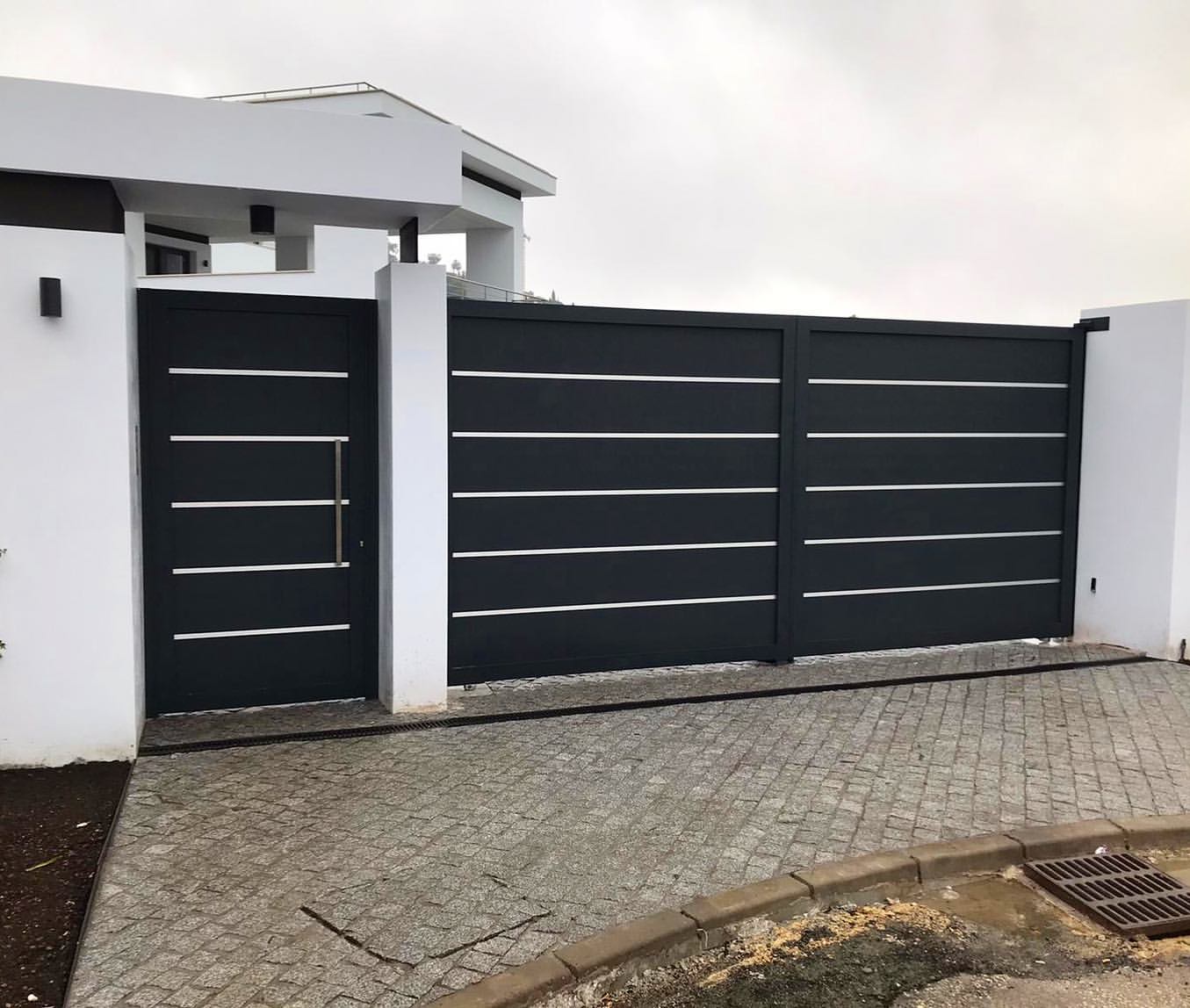
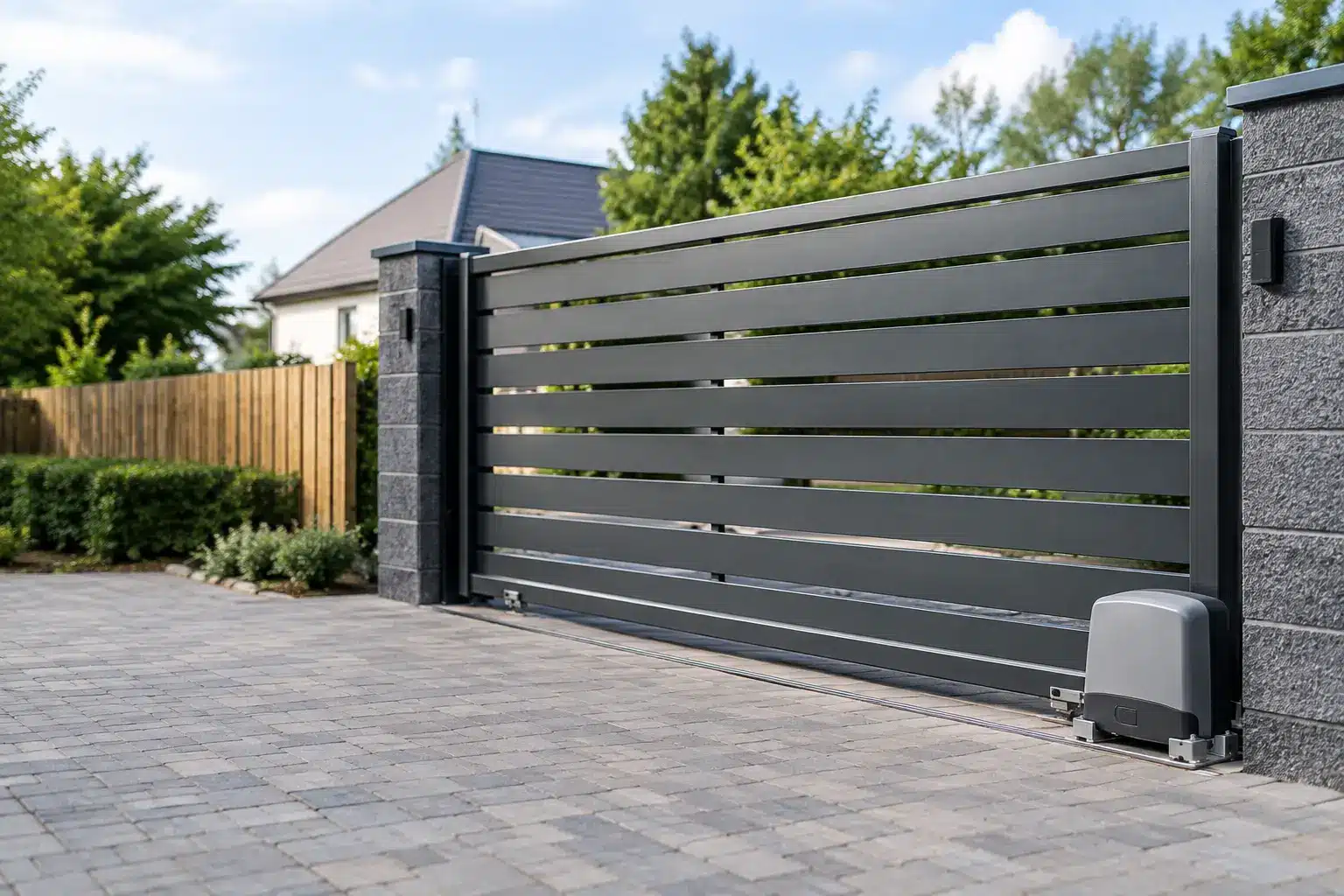
Electric Sliding Gate Review for UK Properties
A driveway gate should not become the least reliable part of your arrival home. Yet many electric sliding gate review searches begin after a timber gate has warped, a motor has struggled in winter, or an off-the-shelf system has failed to suit the width, slope or character of a property. The right sliding gate is a long-term entrance solution, not simply a moving barrier.
For UK homes and commercial sites, an electric sliding gate can deliver exceptional security, privacy and kerb appeal. Its value, however, depends on the quality of the gate structure, the accuracy of the survey and the automation specified for the job. A handsome gate with an underpowered operator is a compromise. So is a powerful motor attached to a poorly constructed frame.
Electric Sliding Gate Review: What Makes a System Worth Buying?
A premium electric sliding gate should feel composed in daily use. It should open at a measured pace, close accurately, respond reliably to controls and remain visually straight and stable through changing weather. Those outcomes are determined well before installation, beginning with the gate design and its supporting groundworks.
Aluminium is particularly well suited to this application. Unlike timber, it will not absorb moisture, swell or require routine painting. Unlike untreated steel, it will not develop surface rust. A properly fabricated aluminium gate provides a strong yet comparatively lightweight leaf, reducing strain on the automation while allowing for clean, substantial designs.
Construction matters as much as the material itself. Fully welded frames offer greater long-term rigidity than gates assembled from multiple mechanical joints. This is especially relevant on wide driveway openings, where movement, vibration and wind loading can expose weaknesses over time. Precision welding creates a cleaner, more durable structure and helps the gate retain its alignment.
Finish quality also deserves close attention. A premium powder-coated finish gives aluminium its refined appearance and creates a protective outer layer suited to British weather. The colour, texture and infill style should be selected as part of the wider exterior scheme, whether that means contemporary horizontal slats, solid privacy panels, decorative detailing or coordinated fencing.
Sliding Gates Solve Problems Swing Gates Cannot
The best gate format depends on the site. A sliding gate is often the stronger choice where a drive rises behind the entrance, where vehicles need to stop close to the gate, or where inward-opening leaves would consume valuable parking space. It is also an effective solution for broad entrances that would make a pair of swing gates excessively heavy.
Because the gate travels sideways, the available run-back space is critical. A single sliding leaf needs sufficient clear room along the fence line or boundary to park when open. If that space is limited, a telescopic sliding design may be more appropriate. It uses multiple leaves that overlap as they open, making it possible to secure a wide opening within a shorter return area.
There are two principal operating arrangements. A tracked gate runs on wheels over a ground track, providing a straightforward and dependable solution when the driveway surface is suitable. It does require the track to be kept clear of leaves, gravel, ice and accumulated debris.
A cantilever sliding gate travels above ground, supported by a counterbalanced section and specialist hardware. This avoids a track across the driveway and can be advantageous on uneven surfaces or entrances exposed to debris. It typically needs more space to one side and a carefully engineered support structure. Neither option is universally better. The correct choice follows the site survey, intended usage and finish level expected.
Automation Is Only as Good as Its Specification
Electric operation brings genuine convenience, particularly in poor weather and on busy roads. A remote control, keypad, intercom or smartphone-enabled access system allows drivers and visitors to enter without unnecessary delay. For a home, that means a calmer arrival. For a commercial site, it can support better control of staff, deliveries and authorised visitors.
The operator must be matched to the gate’s true weight, length, frequency of use and exposure. It should have sufficient capacity in reserve rather than being selected at the edge of its capability. A domestic gate used a handful of times each day has different demands from a shared development, warehouse entrance or office premises with regular vehicle movements.
Ask how the system will perform during a power cut. A manual release mechanism should allow authorised access when electricity is unavailable. Battery backup can be worthwhile where continuity is important, while a professionally planned electrical supply protects against avoidable faults and unsightly retrofitted cabling.
Access control should be specified around the way the property is used. Simple remote fobs may be ideal for a private drive. A video intercom can add reassurance where homeowners want to verify visitors before granting access. For larger sites, keypad entry, proximity credentials and timed controls can make access more manageable without compromising the entrance’s appearance.
Safety Cannot Be Treated as an Add-On
An automated gate is machinery, and it must be designed to protect people, vehicles and pets. Safety begins with identifying potential trapping, crushing and shearing points around the moving gate, posts, track and surrounding boundary.
Photocells are commonly used to detect an obstruction in the gate’s path and prevent closure. Sensitive safety edges can provide further protection on leading edges or areas where a person could become trapped. The gate’s force settings, stopping behaviour and clearance around fixed structures all need professional attention. A safe system is not merely one with sensors fitted. It is one whose gate, controls and safety devices work together as intended.
This is also why a low-cost online gate package can become expensive once the missing elements are added. The advertised price may not account for foundations, posts, ground track, electrical works, control equipment, safety devices, installation or commissioning. Comparing complete specifications is far more useful than comparing a headline figure.
The Details That Separate a Premium Gate From a Basic One
A bespoke gate should fit the property rather than force the property to fit a standard size. Accurate measurements account for the opening, levels, side room, existing walls, vehicle approach and any gradients that influence the design. The result is a gate with correct proportions and a more convincing relationship to the building and boundary.
Privacy is another design decision rather than an afterthought. Closely spaced slats or solid aluminium infills can shield a driveway from view, while more open designs maintain sight lines and create a lighter visual effect. Taller gates may improve privacy and deterrence, but their wind loading, planning considerations and structural support require careful assessment.
Hardware is equally important. Quality rollers, guide assemblies, rack systems and stoppers do quiet, repetitive work that owners rarely notice until something fails. Selecting durable components and allowing for adjustment helps preserve reliable movement over years of use.
At Alu-Gate, made-to-measure aluminium sliding gates are designed around these practical requirements as well as the desired appearance. Fully welded construction, premium finishes and a 20-year guarantee reflect the standard expected of an entrance intended to serve a property for the long term.
What Maintenance Should You Expect?
Aluminium reduces the maintenance burden considerably, but low maintenance does not mean no maintenance. Wash the gate periodically with clean water and a mild, non-abrasive cleaner to remove road film, salt deposits and general dirt. Avoid aggressive chemicals or abrasive pads that can mark the finish.
For tracked systems, keep the running track clear and check that leaves, stones and compacted debris are not affecting travel. Inspect visible fixings, rollers and safety devices periodically, particularly after severe weather. Automation should be serviced in line with the manufacturer’s recommendations, with any faults addressed promptly rather than ignored.
A gate that begins to move noisily, stops intermittently or closes unevenly is asking for attention. Early adjustment is normally simpler and less costly than allowing a small alignment issue to place strain on the operator and mechanical components.
The Verdict: Choose the System, Not Just the Gate
An electric sliding gate is a strong investment when space, security and daily convenience point towards a sideways-opening design. The most successful installations pair a well-engineered aluminium gate with correctly rated automation, considered safety measures and a layout designed for the particular site.
Before choosing a style, arrange a detailed discussion around how the entrance is used, where the gate can travel and what must happen when power is unavailable. A gate designed to impress should also be built to perform quietly, safely and reliably every day it is asked to open.
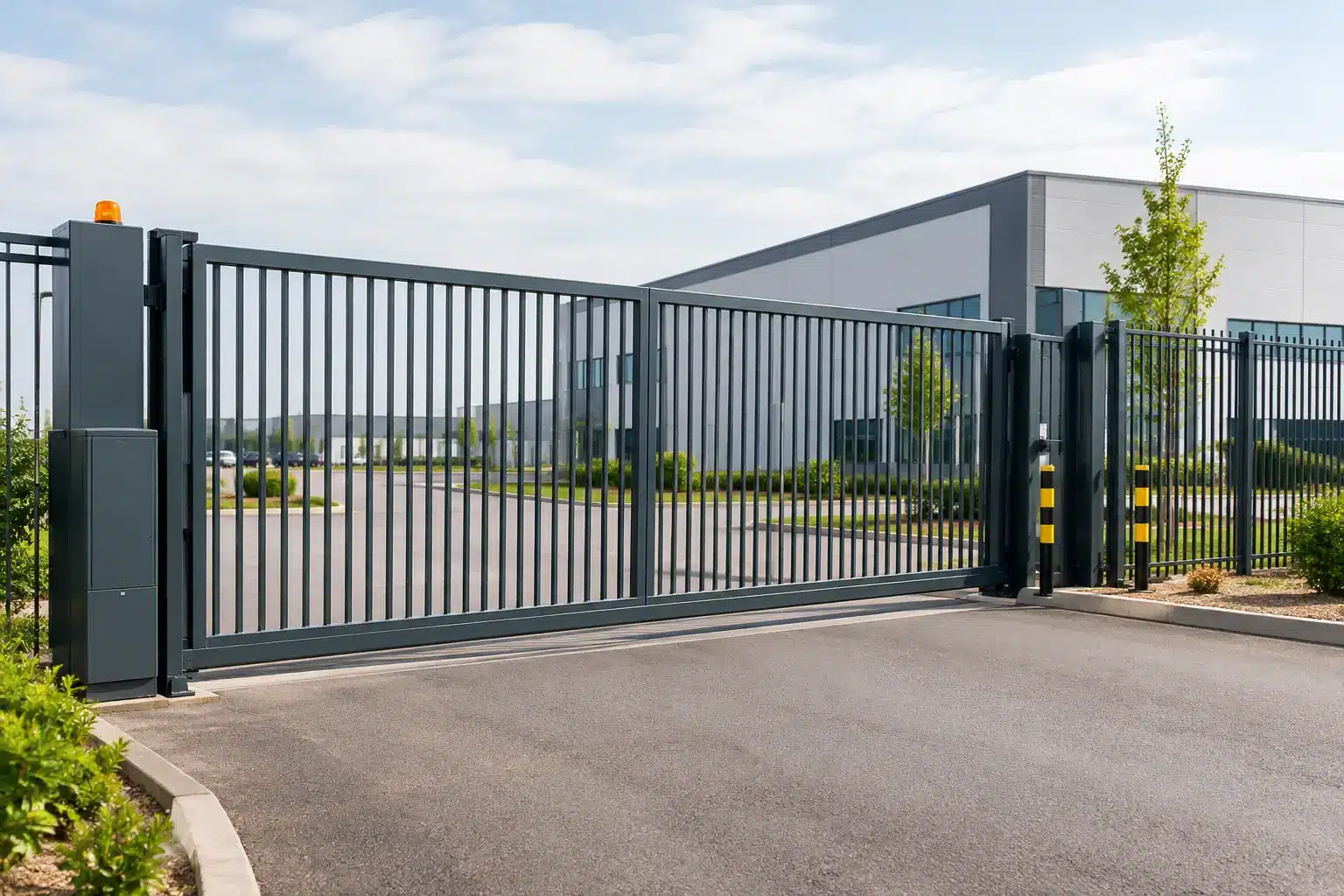
Commercial Gate Specification Guide for UK Sites
A commercial gate is rarely just a boundary feature. It controls who enters, how vehicles move, how secure staff and assets feel, and what visitors see before they reach the building. This commercial gate specification guide sets out the decisions that matter before a gate is designed, priced or manufactured.
For commercial premises, the right answer is not simply the strongest or largest gate available. It is a made-to-measure system that suits the site layout, traffic pattern, security risk and architectural finish, while remaining dependable through daily use.
Start with the site, not the gate style
The best specification begins with a clear picture of how the entrance works on an ordinary busy day. Consider the width of the opening, the road position, gradients, available run-back space and where vehicles can wait without obstructing public highways or internal routes.
A gate that looks impressive on a plan can be impractical if a delivery vehicle cannot clear the entrance before the gate closes, or if a swing leaf opens into a sloping drive. Measure the clear opening rather than relying on the distance between existing posts. Also allow for hinges, guide posts, safety clearances and any future changes to surfacing.
Traffic type matters as much as volume. A small office car park with predictable employee access has different requirements from a depot receiving frequent lorries, a school entrance at peak times or a private development with visitors and contractors arriving throughout the day. Establish the largest vehicle, busiest access period and expected daily cycle count early. These details influence the gate format, automation equipment and supporting structure.
Choose a gate format that works with the layout
Sliding gates for constrained or high-use entrances
Sliding gates are often the strongest choice where frequent vehicle movements, wide openings or limited space behind the entrance make swing gates unsuitable. A tracked sliding gate can be a practical option on level, well-prepared ground. A cantilever sliding gate avoids a ground track, which can be beneficial where debris, uneven surfaces or regular vehicle use would make track maintenance less convenient.
The trade-off is run-back space. A sliding gate needs sufficient clear area alongside the opening for the leaf to travel when open. On a restricted site, a telescopic sliding design can reduce the required run-back length by using overlapping leaves. This is particularly valuable where the entrance is wide but the available side space is limited.
Swing gates for a more formal entrance
Swing gates give commercial entrances a strong, architectural presence and can suit lower-traffic premises with adequate internal space. They work especially well for offices, flat developments, showrooms and gated business parks where design is central to the arrival experience.
Their suitability depends on the ground levels and leaf size. Large leaves create considerable loading at hinges and posts, particularly in exposed locations. Inward opening is normally preferred so gates do not encroach on a pavement or carriageway, but it must be checked against the fall of the driveway and vehicle manoeuvring area.
Bi-folding gates for speed and limited space
Bi-folding gates are designed for sites where opening speed is a priority and a conventional sliding gate cannot run back far enough. They fold as they open, reducing the space required and helping to keep traffic moving at busy access points.
They involve more moving components than a single-leaf sliding gate, so quality fabrication, precise installation and an appropriate maintenance plan are essential. For a high-security or high-cycle site, specification should focus on the complete engineered system rather than the gate leaf alone.
Specify the structure before the finish
A commercial gate must carry its own weight, resist wind loading and tolerate repeated movement without losing alignment. The framework, welding, posts, hinges, rollers and foundations all need to be considered as one system.
Fully welded aluminium construction offers a clean, premium appearance with lasting strength and none of the rot, splitting or routine repainting associated with timber. Aluminium is also naturally corrosion resistant, making it well suited to UK weather and locations exposed to moisture. The exact section sizes and reinforcement required will depend on leaf dimensions, infill design, automation and local exposure.
Open slatted designs allow wind to pass through more readily, which can reduce loading in exposed areas. Solid or closely boarded designs deliver greater privacy and a more imposing perimeter, but they present a larger surface to the wind. There is no universal right choice. A coastal or open-site installation may need a different structural approach from a sheltered urban courtyard.
Posts and foundations deserve equal attention. Even a beautifully fabricated gate will not perform as intended if its supports are undersized or set into inadequate groundworks. Where existing brick piers are being retained, their condition, dimensions and capacity should be assessed before committing to a heavy automated gate.
Build security into the complete entrance system
The gate leaf is one layer of security, not the entire solution. A well-specified entrance controls access, discourages opportunistic intrusion and avoids creating weak points at the sides, beneath the gate or through poorly considered release arrangements.
Start by defining the security objective. Is the aim to mark a boundary, prevent unauthorised vehicle access, restrict pedestrian entry, protect valuable stock or manage access to a residential development? The higher the risk, the more closely the gate, fencing, pedestrian access and control equipment should be coordinated.
Height, infill spacing and the relationship between the gate and surrounding fencing all affect performance. A gap beside the gate or a lower adjacent panel can undermine an otherwise secure frontage. Matching aluminium fencing and purpose-designed pedestrian gates create a continuous perimeter that looks considered rather than pieced together.
Access control should be chosen around the people who use the site. Keypads may suit staff and regular contractors; fobs provide simple controlled access; video intercoms give reception teams or residents visual verification before releasing a visitor. Akuvox intercoms can form part of a refined access strategy where video calling, remote management and a premium entrance experience are required.
Make automation safe, reliable and maintainable
Automated gates should be specified for the duty they will perform, rather than fitted with a domestic operator simply because the gate is small. The motor, controls and safety equipment must match the gate weight, leaf configuration, expected use and site conditions.
Safety is fundamental. Risk assessment should account for trapping, crushing, shearing, impact and entanglement hazards around the gate’s full travel path. Appropriate safety devices may include photocells, safety edges, force limitation and emergency release arrangements. The exact combination depends on the gate design and how pedestrians and vehicles use the entrance.
Plan for failure as carefully as normal operation. Consider how authorised users will enter during a power cut, what happens if a vehicle stops in the opening and who is responsible for isolating or releasing the system. For critical premises, backup power, monitored access control or alternative entry procedures may be justified.
Commercial gate automation also needs sensible servicing. High-use sites benefit from scheduled inspections that check alignment, fixings, safety devices, moving parts and control equipment before minor wear becomes disruptive downtime.
Specify appearance as part of the investment
A commercial entrance should reinforce the quality of the business or development behind it. Aluminium gives designers freedom to create horizontal slats, vertical lines, solid privacy panels, perforated patterns or coordinated fencing in proportions that suit the architecture.
Powder-coated finishes provide long-lasting colour and a refined surface with low maintenance requirements. Dark contemporary tones remain popular, but the right colour should complement the building materials, signage, boundary treatment and surrounding streetscape. A bespoke gate can be practical without looking purely industrial.
At Alu-Gate, each made-to-measure design is considered around the opening, access requirements and desired visual impact, with fully welded construction and a 20-year guarantee supporting long-term ownership confidence.
Questions to resolve before approving a specification
Before fabrication begins, make sure the proposal answers the practical questions that can otherwise become costly late changes. Confirm the clear opening and available space, the gate travel direction, finished ground levels, largest vehicle dimensions, pedestrian routes, access control method and power supply location.
You should also establish responsibility for civils, drainage, electrical works and ongoing servicing. If the entrance connects directly to a public road, check that the gate position and operation do not force vehicles to wait in an unsafe location. Planning requirements, lease conditions and any site-specific security policies should be reviewed before work is commissioned.
A premium commercial gate should feel effortless for the people using it, but that result comes from careful decisions behind the scenes. Specify around the real demands of the site, invest in properly engineered construction and choose a design that gives the entrance the authority it deserves.
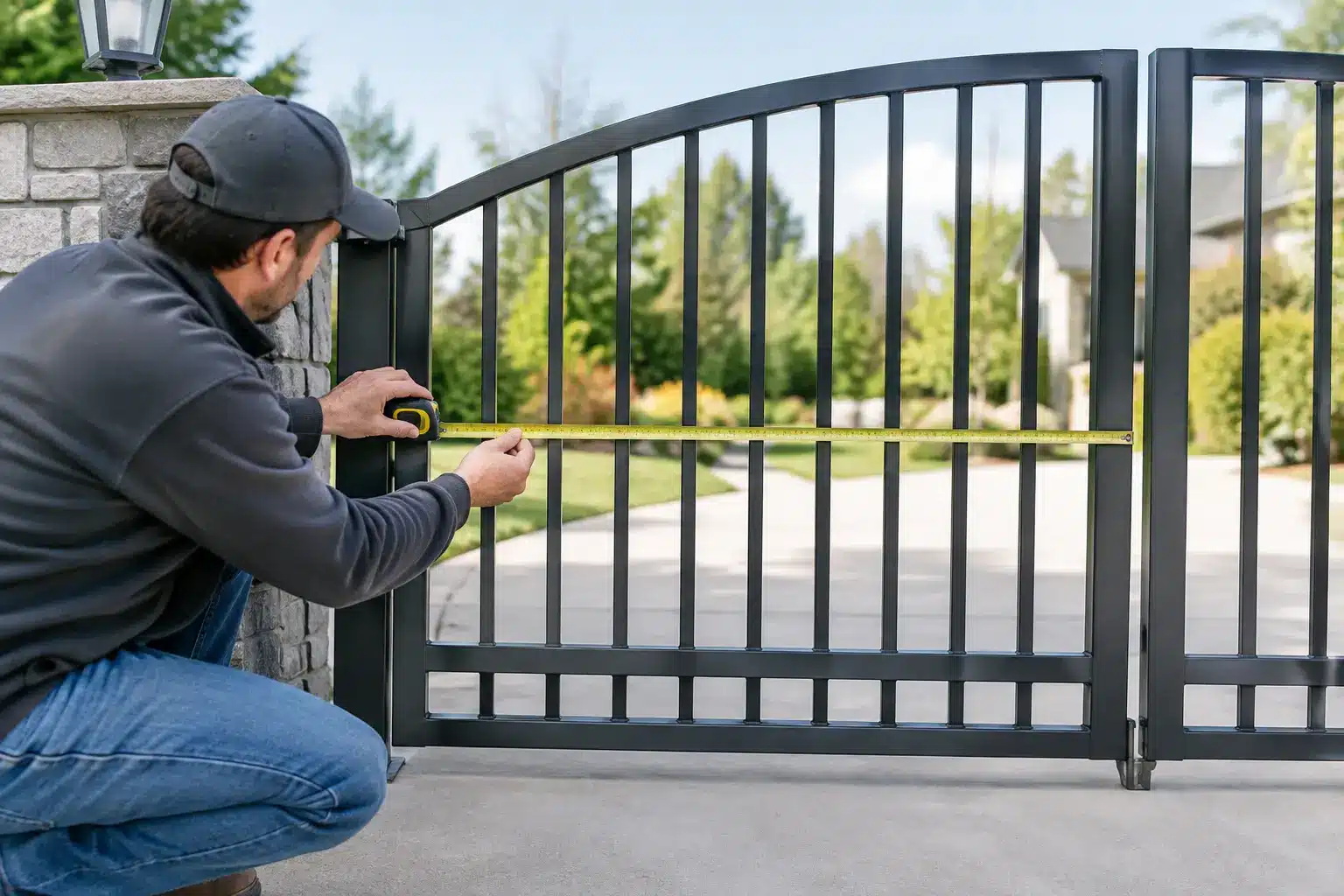
How to Measure Driveway Gates for a Perfect Fit
A driveway gate that is even slightly wrong in size can look out of place, catch on a slope, restrict vehicle access or leave an avoidable security gap. To measure driveway gates accurately, you need more than one width measurement. The opening, posts, ground conditions, hinge positions and intended gate style must all work together.
For a premium made-to-measure aluminium gate, careful measuring is the starting point for a result that feels considered from every angle. It allows the finished entrance to sit squarely, operate reliably and enhance the character of the property.
Start with the clear opening width
The clear opening is the usable distance between the two fixed points that will support or contain the gates. In most cases, this is the inside face of one gatepost to the inside face of the other. It is not the distance between the outside edges of the posts, nor the width of an existing gate leaf.
Take this measurement at three points: near ground level, midway up the opening and close to the top. Older brick piers and timber posts are not always perfectly parallel. If the measurements differ, the narrowest point is usually the figure that governs the design, but the variation itself also matters. It may call for adjustment to the posts, specific fitting allowances or a gate arrangement designed around the existing structure.
Record the width in millimetres. This avoids the uncertainty that can creep in when measurements are converted from metres and centimetres. A steel tape measure is preferable to a flexible fabric tape, and it is worth checking every key dimension twice.
Allow for hinges, gaps and latches
The gate width is not normally identical to the clear opening width. Gates require working clearances so they can open freely without binding against posts or each other. Hinges also take up space, while the centre meeting gap and latch arrangement need to be considered for double gates.
The exact allowance depends on the hinge system, gate configuration and whether the structure is level and true. This is why a bespoke gate should be specified as a complete system, not simply ordered to match an opening measurement. A gate that fills every millimetre of an opening may look precise on paper, but it will not function correctly in practice.
Measure driveway gates with the finished ground in mind
Ground level is one of the most common reasons otherwise attractive gates fail to operate as expected. Measure from the ground to the underside of the proposed gate at both hinge points, at the centre of the opening and along the swing path. Note any changes in height, drainage channels, kerbs, paving joints or raised thresholds.
A driveway that slopes upwards into the property can prevent standard swing gates from opening inwards. A slope falling towards the road may create a different clearance issue. Neither situation rules out a premium entrance, but it does influence the right solution. Depending on the site, outward opening gates, sliding gates, bi-folding gates or carefully engineered rising hinges may be more suitable.
Do not measure only from the highest point of the driveway. What matters is the full travel of each gate leaf. For example, a gate may clear the ground when closed but catch halfway through its swing if the driveway rises across the opening arc.
Establish the height and the visual line
Measure the proposed gate height from the finished driveway level, not from an unfinished surface that may later receive paving, tarmac or gravel. If landscaping or resurfacing is planned, provide the anticipated final level rather than relying on what is there today.
Consider what the top of the gates should align with. It may be the top of brick piers, an adjoining fence, a wall coping or a change in level across the frontage. A level gate top often creates a crisp, architectural appearance, while a raked or stepped design may be better suited to sloping ground or varied boundary levels.
Height is also a balance between privacy, security and proportion. Taller gates can offer greater enclosure, but should still complement the scale of the property and the surrounding boundary. Planning restrictions may apply, particularly for gates facing a highway or in conservation areas. Checking this before finalising the design avoids costly revisions later.
Check the posts and supporting structure
The strongest gate is only as reliable as the structure supporting it. Measure the width, depth and height of existing posts or brick piers, then assess their condition honestly. Look for movement, cracking, loose brickwork, leaning posts or poorly finished foundations.
Heavy, fully welded aluminium gates are built for long-term performance, so the posts must be capable of carrying the load and managing the leverage created when gates are open. A narrow or damaged pier may not be suitable for hinge fixings without reinforcement. Steel, aluminium or substantial timber posts may be required where no suitable masonry structure exists.
For sliding gates, the survey extends beyond the entrance itself. Measure the available run-back space beside the opening, including any changes in level, walls, planting beds, services and obstructions. A sliding gate needs sufficient space to travel fully clear of the access route. Telescopic designs can reduce the run-back requirement, while bi-folding gates are often useful where opening speed and limited space are priorities.
Measure the approach, not just the entrance
A gate can be correctly sized and still be inconvenient if the driveway approach has not been considered. Measure the distance from the gate line to the nearest public road, pavement, garage or turning area. This helps establish whether vehicles can wait safely while the gates open and whether a visitor can enter without obstructing traffic.
Think about the vehicles that use the entrance now and those likely to use it in future. A family car, delivery van, refuse lorry access and occasional tradesperson may all have different clearance needs. Wide openings are useful, but excessive width can change the proportions of swing gates and increase the demands on posts and automation. The best size is the one that delivers practical access without compromising the design or structure.
If the gates will be automated, allow space for motors, underground equipment where specified, safety devices and cable routes. Intercoms, keypads and access control should be positioned where drivers and pedestrians can reach them comfortably before passing through the entrance. Planning these details early produces a cleaner, more integrated result.
Choose the gate format before final dimensions
Your measurements should inform the gate type, not force a design that does not suit the site. Swing gates are a classic choice for many driveways and can make a strong statement, particularly between substantial brick piers. They need clear swing space and suitable ground levels.
Sliding gates are often the answer where driveways slope or space behind the gate is restricted. They offer excellent security and a clean contemporary appearance, but require adequate side room. Bi-folding gates reduce the depth needed for opening, making them a practical choice for shorter driveways. Telescopic gates can provide wide access where a conventional sliding gate would not have enough run-back.
There is no single best format. The right choice depends on available space, desired opening speed, architecture, access requirements and the level of privacy required. A detailed site survey turns these variables into a specification that works.
Create a simple measurement record
Photographs are as valuable as dimensions. Take clear images looking directly at the opening, from inside and outside the property, along each side return and across the driveway surface. Include close-ups of existing posts, hinges, utility boxes, drains and any feature likely to affect installation.
Alongside the photographs, record the clear width at three heights, opening height, post dimensions, driveway levels, available run-back space and the distance to the road or turning point. Mark the direction you expect the gate to open and identify any nearby obstructions, such as walls, parked vehicles, mature planting or lamp posts.
This information gives a gate specialist a strong starting point. A professional survey remains the safest route before fabrication, especially for automated, sliding or unusually wide installations. It confirms the structural and operational details that a preliminary measurement cannot always reveal.
Precision at the survey stage protects the finished result
Made-to-measure gates are an investment in security, kerb appeal and daily convenience. The quality of aluminium, welding and finish matters, but so does the accuracy of the opening they are designed to serve. At Alu-Gate, each bespoke specification is considered around the property rather than adapted from a standard size.
Measure carefully, share the full picture of the site and be open about future paving, access needs and automation plans. The result is not simply a gate that fits the gap, but an entrance designed to impress and built to perform for decades.
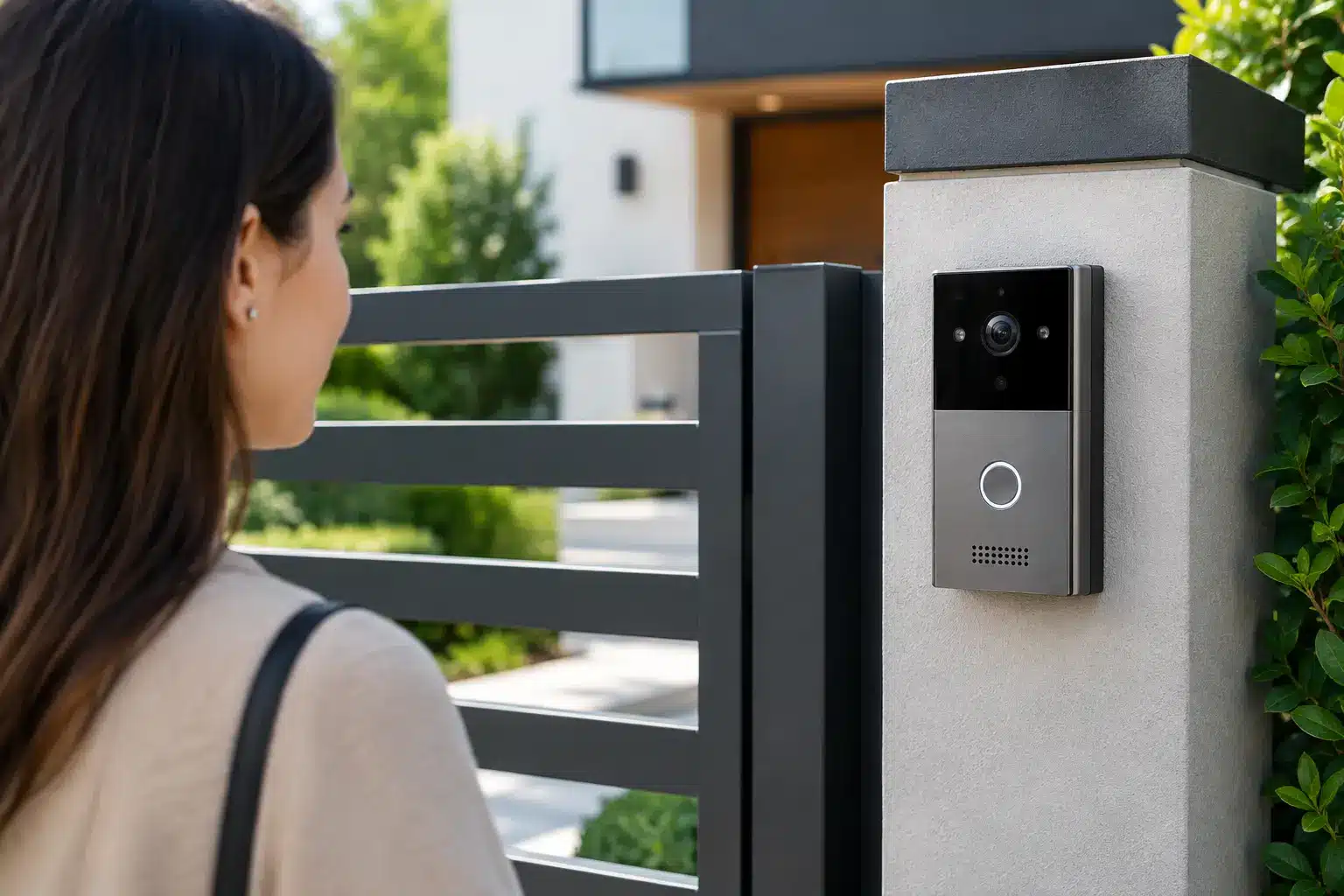
Akuvox Intercom Review: Right for Your Gate?
A premium gate should do more than mark a boundary. It should give you clear control over who enters, whether you are at home, in the office or away for the weekend. This Akuvox intercom review considers what the system brings to a residential or commercial entrance, where it performs particularly well, and the specification details that make the difference between a polished installation and a frustrating one.
For homeowners investing in made-to-measure aluminium gates, Akuvox is often an attractive choice because it combines contemporary video entry with practical gate-release control. It suits properties where security, kerb appeal and everyday convenience need to work together rather than compete.
What Is an Akuvox Intercom?
Akuvox produces IP-based door entry and access-control equipment. In simple terms, the outdoor unit at your gate lets a visitor call through to an internal monitor, a mobile app or both. You can see and speak to the caller, then release the pedestrian gate, driveway gate or another connected access point where the system has been correctly specified.
The range includes compact video door stations for private homes, units with keypads or card readers, and more capable systems for flats, offices and managed sites. That breadth is useful, but it also means there is no single “best” Akuvox setup. The right model depends on the entrance layout, how many users require access, the distance to the property and whether an automated gate is already in place.
For a high-end aluminium gate installation, the visual finish matters as much as the technology. A well-positioned intercom can be integrated into a dedicated post, wall or coordinated entrance panel so it feels like part of the overall design, not an afterthought fixed beside it.
Akuvox Intercom Review: The Main Strengths
Video access that feels genuinely useful
The strongest reason to choose a video intercom is not novelty. It is certainty. A clear live view lets you identify a courier, contractor or unexpected visitor before releasing the gate. For properties set back from the road, this avoids unnecessary trips to the entrance and gives occupants more confidence when responding to callers.
Akuvox systems can provide two-way audio and video through an indoor screen, compatible mobile device or a combination of both. For many homes, mobile calling is especially valuable. You can answer a delivery while upstairs, working in the garden or away from the property, then decide whether to grant access.
Performance will depend on broadband, local network design and mobile signal. Remote video calling is only as dependable as the connection supporting it, so a serious installation should assess connectivity at the gate rather than assume the house Wi-Fi will reach it.
Flexible access beyond the front door key
Many Akuvox units can support several ways to gain entry, including a call button, PIN code, RFID credential, mobile access or a physical exit control. This is a major benefit for busy households and commercial sites where different users need different levels of access.
A family may want a code for regular visitors, a fob for the gardener and app access for the owners. A business may prefer credentials that can be issued or removed without collecting keys. The exact options depend on the selected device and the wider access-control configuration, but the principle is sound: access can be managed more deliberately than with a conventional key alone.
This flexibility is particularly well suited to automated driveway gates. Rather than carrying separate remotes for every user, the intercom can become part of a broader, more orderly entrance system.
A modern appearance for contemporary entrances
Akuvox equipment generally has a clean, architectural appearance that works well with modern aluminium gates, fencing and rendered or brick entrance walls. It is available in a choice of formats, from discreet single-button stations to units with screens, keypads and reader technology.
That said, the unit itself is only one part of the visual result. The position, mounting height, cable routing and surrounding materials matter just as much. A premium gate deserves a purpose-designed location for the intercom, with no exposed conduit, awkward fixings or compromised sightlines.
Scalable enough for larger projects
Akuvox is not limited to a single-household use case. Its IP approach can be advantageous for larger homes with multiple internal screens, guest accommodation, workshops or separate access points. It can also suit commercial premises that need visitor calling alongside controlled staff entry.
For more complex sites, the value lies in planning rather than simply adding features. An access-control system should make the site easier to manage. If too many credentials, devices and release points are introduced without a clear user plan, it can become needlessly complicated.
Points to Consider Before You Specify One
Installation quality is critical
An intercom may appear straightforward, but gate installations involve several connected elements: power, data, network equipment, gate automation, safety devices and the physical mounting arrangement. These need to be considered as one system.
IP-based equipment is often powered using Power over Ethernet, which can reduce the need for separate power cabling at the entrance. However, cable runs, network switches and weather protection still need careful planning. If the gate is a considerable distance from the house, the route and specification of the cable become especially important.
The intercom should also be configured with the gate operator by a suitably competent installer. A release command must work predictably and should never bypass the safety systems required for an automated gate. This is not an area for improvised wiring.
App convenience comes with network dependence
Answering gate calls on a phone is one of Akuvox’s most appealing features, but it introduces a practical trade-off. A weak home network, unreliable internet connection or poor mobile coverage can affect the experience. Indoor monitors provide useful reassurance where the property has inconsistent mobile reception or where occupants prefer a dedicated, always-available point of contact.
It is worth discussing how calls should be handled if the internet drops out. Do you still need local communication from the gate to the house? Should selected users have a physical credential as a fallback? Thinking through these ordinary scenarios produces a more dependable setup.
Not every property needs every feature
A keypad, reader, camera, indoor monitor and app access can all be useful. They are not automatically necessary. For a private pedestrian gate with one or two users, a simple video call station and internal screen may be the most elegant answer. For a shared driveway, a keypad or managed credential system may offer far greater value.
Feature-led purchasing can inflate the budget without improving daily use. The best specification starts with how people actually arrive, leave and receive visitors at the property.
Choosing the Right Setup for Your Gate
Start with the gate type. A pedestrian entrance normally benefits from an intercom positioned at a natural calling height beside the latch or within a dedicated gate post. A driveway gate requires the caller to be safely clear of the opening area, with the unit visible from a vehicle where appropriate. Sliding, swing and bi-folding gates each place different demands on the layout around the entrance.
Next, consider who needs access. A private home may need a limited group of family members, whereas a commercial property may have staff, tenants, visitors and delivery drivers. The more varied the user groups, the more valuable managed PINs, fobs or cards become.
Finally, decide where calls should be received. A single internal monitor is reassuring for households that want a permanent screen. Mobile access is ideal for flexibility. In many premium installations, both are worthwhile: the screen provides a reliable in-property control point, while the app gives owners freedom when they are elsewhere.
At Alu-Gate, an intercom is best considered early in the gate design process, alongside the gate style, automation and entrance posts. This allows the system to be integrated cleanly into a made-to-measure aluminium entrance rather than retrofitted around finished work.
Is Akuvox a Good Choice for UK Properties?
For the right project, yes. Akuvox offers a capable and design-conscious route to video entry, remote visitor communication and controlled gate release. It is particularly appealing for homeowners replacing an outdated entrance with a modern automated aluminium gate, and for commercial buyers who need a more controlled approach to visitor access.
Its limitations are not flaws so much as reminders that access control must be properly designed. The technology needs a dependable network, correct integration with gate automation and a clear plan for the people using it. A modest system that is carefully specified will serve a property better than an advanced one installed without thought.
The most successful entrance schemes feel effortless because the choices were made before fabrication, cabling and installation began. Choose the access method around your routine, position the intercom around the visitor journey, and let the finished gate deliver the secure, composed first impression your property deserves.
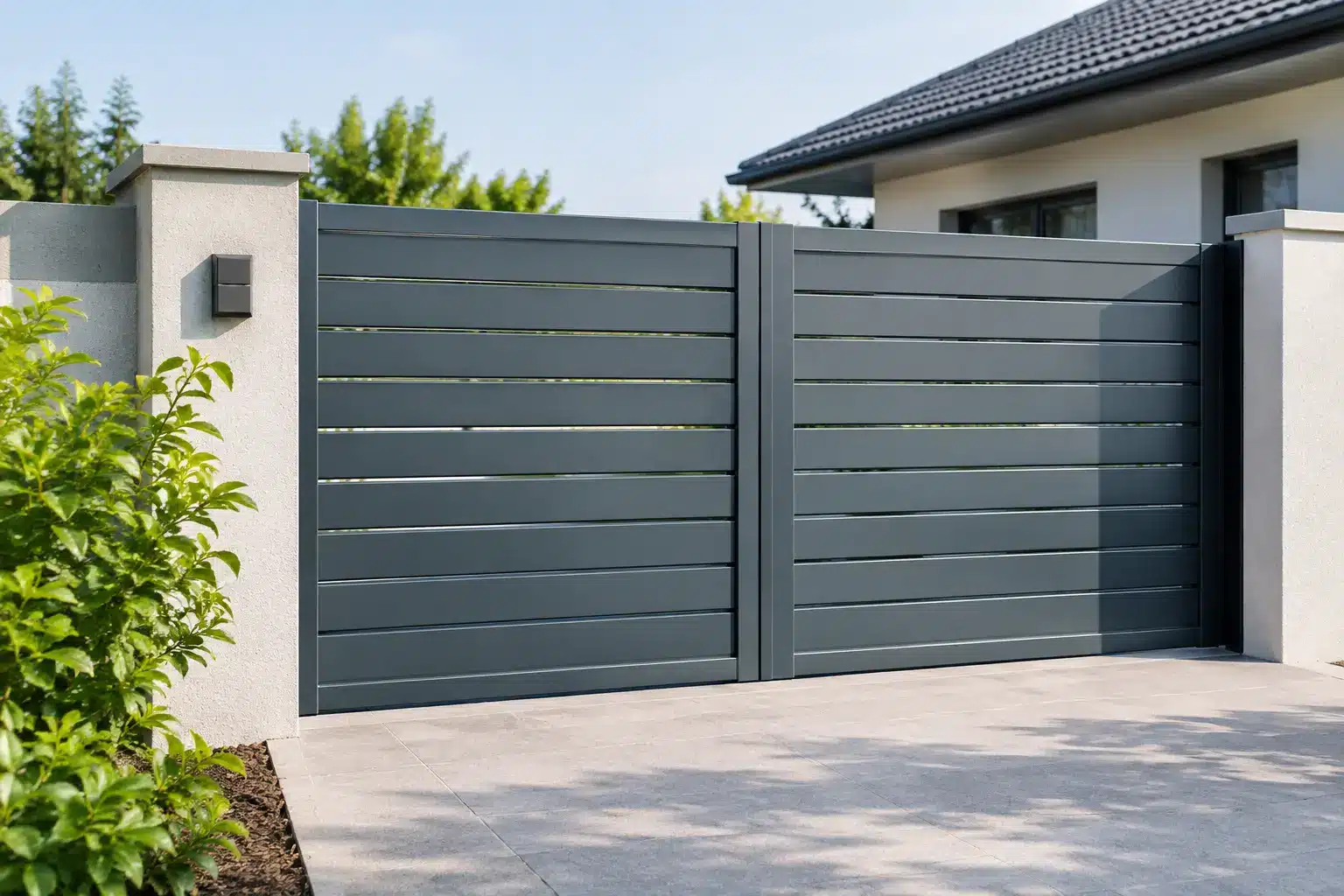
RAL Colour Gate Finishes for Lasting Style
A gate is often the first architectural detail people notice from the road. The right RAL colour gate finishes can make an entrance feel quietly refined, sharply contemporary or perfectly connected to the rest of the property. The wrong choice can make a well-designed gate look separate from the home it is meant to enhance.
For made-to-measure aluminium gates, colour is not an afterthought. It is part of the design specification, alongside gate layout, infill style, automation and access control. A considered finish brings the whole scheme together while helping your gate retain its appearance with minimal upkeep for years to come.
Why RAL colour matters for aluminium gates
RAL is a widely recognised colour-matching system used across architecture, construction and metalwork. Selecting a RAL reference gives homeowners, designers and installers a clear point of reference when coordinating gates with window frames, front doors, garage doors, fencing, brickwork and exterior joinery.
That consistency is particularly valuable on a bespoke project. A driveway gate may sit beside aluminium fencing, masonry piers and a composite or timber-clad façade. Choosing a specific RAL shade allows those elements to feel intentional rather than simply assembled.
A RAL number alone, however, does not tell the whole story. The same nominal shade can look different depending on the coating texture, gloss level, surrounding materials and changing natural light. Anthracite grey can appear almost black in shadow but softer and more blue-grey on a bright morning. This is why viewing a physical colour sample against the property is a far better decision-making process than relying on a screen.
RAL colour gate finishes: choosing the right direction
The most successful gate colour responds to the character of the building and the practical demands of its setting. There is no single premium colour. A bold, dark finish may suit a contemporary rendered home, while a softer neutral can bring balance to a traditional stone property or a rural boundary.
Dark greys and black for a contemporary entrance
RAL 7016 Anthracite Grey remains a popular choice for aluminium gates in the UK. It works naturally with modern glazing, grey roof tiles and contemporary front doors, giving a property definition without the starkness of pure black. It is particularly effective on slatted gates, where shadow lines add further depth.
RAL 9005 Jet Black creates a more dramatic result. On a simple, fully welded aluminium frame, black looks crisp, confident and architectural. It can also sit well alongside black-framed windows and steel-style doors. The trade-off is that very dark colours show dust, pollen and water spotting more readily than mid-tone finishes, especially on large flat panels. Aluminium remains low maintenance, but a periodic wash will keep the finish looking its best.
Mid-tone greys for a quieter, flexible finish
Mid and lighter greys are often the right answer where a gate should complement the property without becoming its strongest visual feature. Shades such as RAL 7030 Stone Grey or RAL 7040 Window Grey can feel elegant beside pale render, natural stone and lighter brickwork.
These colours are also practical. They tend to be more forgiving of everyday dust than black and can reduce the visual scale of a tall driveway gate. For commercial premises, a neutral grey may offer a professional appearance that works with changing signage, landscaping or building upgrades.
White, cream and light neutrals for traditional properties
A pale gate can look exceptional when it is properly specified. RAL 9016 Traffic White offers a clean, fresh finish for coastal-style homes, period renovations and properties with white-painted joinery. Cream and off-white tones can provide a gentler alternative where the house has traditional features or warm stonework.
Light finishes need careful consideration on exposed driveways or near busy roads, as surface dirt is naturally more visible. They are best chosen by owners who value the brighter aesthetic and are happy to include a simple clean in their routine exterior maintenance.
Earthy tones and statement colours
Greens, browns and muted bronze-inspired shades can give a boundary a more natural relationship with planting, timber cladding and countryside surroundings. Deep green is especially effective where a gate should sit comfortably within mature landscaping rather than contrast with it.
A statement colour can be equally successful when it has a clear connection to the property. A rich blue pedestrian gate, for example, may echo a front door or heritage detail. The principle is restraint: use a distinctive colour where it supports the architecture, not simply because it stands out on a sample chart.
Finish texture and sheen change the final result
Colour and finish should be specified together. Powder coating is commonly available in different surface effects, and each changes the way the gate reads at close range and from the street.
A smooth matt or satin finish delivers a clean, contemporary appearance. It suits minimalist aluminium driveway gates and properties with sharp-lined detailing. Fine-textured finishes have a subtly tactile surface that can soften reflections and disguise minor everyday marks more effectively. They are a strong choice for busy family homes, commercial entrances and exposed locations.
Glossier finishes can bring a more formal look, but they also reflect light and highlight surface marks more readily. For many modern aluminium gate designs, matt and fine-textured coatings provide the most balanced combination of premium appearance and easy ownership.
The coating must also be applied to a properly prepared aluminium structure. Precision fabrication and fully welded construction create the sound basis for a finish that looks consistent across the frame, posts and infill. A premium coating cannot compensate for poor underlying workmanship.
Coordinate the gate with the wider property
A bespoke gate should belong to the whole entrance scheme. Start by identifying the fixed elements that will remain for the longest time: window frames, roof colour, brick or stone, garage door and boundary walls. These usually provide a more reliable guide than removable items such as planters or outdoor furniture.
Matching gate and window-frame colours exactly can create a sharp, cohesive look. Choosing a related tone can be just as effective, particularly if an exact match would make the frontage feel too dark. For example, anthracite gates may sit comfortably with black doors or darker grey fencing, provided the undertones do not clash.
If you are including coordinated fencing, pedestrian gates or side panels, specifying one finish across the system creates a stronger result than treating each item separately. It also gives the property a more complete, purpose-designed appearance from every angle.
Consider sunlight, location and use before committing
A colour sample should be assessed outdoors at different times of day. North-facing entrances, tree cover and deep porches can make colours appear much darker than expected. South-facing driveways may intensify warm undertones and show glare on smoother, darker finishes.
Location also affects the practical choice. Properties near the coast, main roads or agricultural land can experience more airborne salt, grime or dust. Aluminium is valued for its resistance to corrosion and low-maintenance nature, but regular cleaning remains good practice. Use mild soapy water and a soft cloth or sponge, then rinse clean. Avoid abrasive pads and harsh solvents that could damage the coating.
For automated gates, do not let colour selection overshadow operational design. Sliding, swing, bi-folding and telescopic systems each have different space requirements, opening speeds and site considerations. The best entrance solution combines a finish you are proud to see every day with a gate format that works reliably for the way you arrive, leave and secure the property.
Use samples to make a confident final choice
Before finalising your specification, compare physical samples beside the gate location, your exterior walls and any adjacent metalwork. Look at them in direct sun, overcast weather and evening light. If several elements are being colour-matched, confirm whether they use the same coating type and sheen as well as the same RAL reference.
At Alu-Gate, this level of detail is part of a consultation-led approach to bespoke aluminium entrances. Colour, layout and function should be resolved together, so the final gate delivers the security, kerb appeal and long-term value expected of a premium installation.
Choose a colour that respects the building, works with its surroundings and still feels right when fashions move on. A well-specified aluminium gate should not just make a strong first impression – it should continue to do so with very little demanded in return.
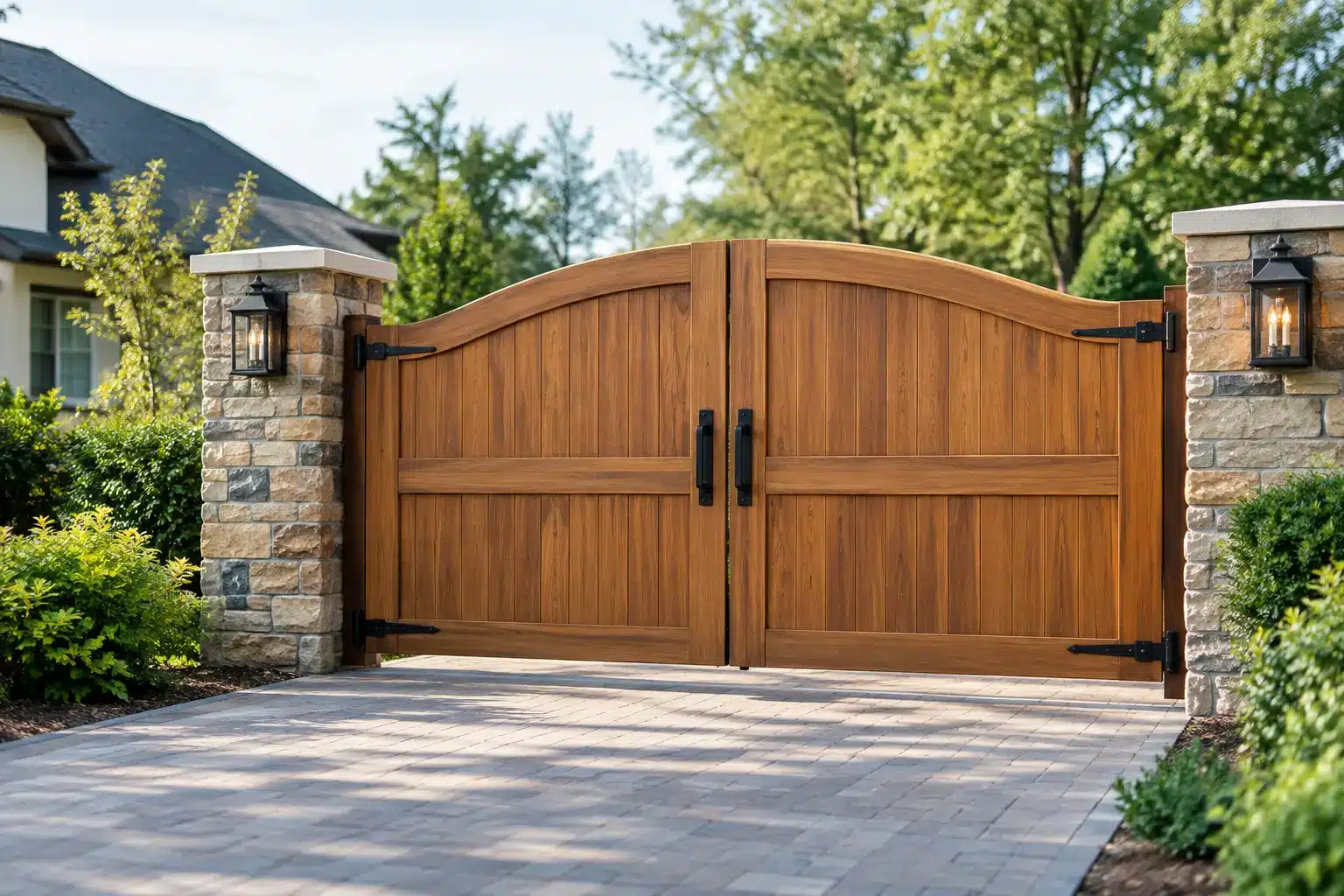
Timber Gate Replacement Ideas for Better Entrances
A timber gate rarely fails all at once. It starts with a sticking latch after rain, a bottom rail softening near the ground, or a finish that needs repainting far sooner than expected. The best timber gate replacement ideas address more than the appearance of an ageing gate: they improve daily access, strengthen security and give the whole frontage a more considered finish.
For many UK properties, aluminium is the natural next step. It can recreate the warmth, privacy and proportions of a timber design while removing the regular cycle of sanding, staining and repairing. More importantly, a made-to-measure replacement can be designed around the way the entrance actually works.
Start with the reason for replacing the timber gate
A replacement should solve the problem that prompted it. If the existing gate is warped, split or rotten, durability may be the priority. If it looks dated against a renovated home, the focus may be architectural style. For a driveway opening onto a busy road, security, visibility and automated operation may matter most.
This is why replacing timber with a like-for-like gate is not always the strongest option. The opening may be wide enough for a pair of swing gates, but unsuitable for their arc of travel. A sliding gate may save usable driveway space. A pedestrian gate may need a new locking arrangement or intercom rather than simply a new leaf and hinges.
Before choosing a design, consider the width and height of the opening, the available space behind or within the driveway, ground levels, existing pillars and how frequently the gate will be used. Commercial sites should also account for vehicle movements, access permissions and the need for reliable operation throughout the working day.
Aluminium timber gate replacement ideas that last
Aluminium offers a crisp, premium alternative to timber without forcing every property towards a starkly modern look. The right profile, spacing and colour can make it feel traditional, contemporary or deliberately understated.
Wood-effect aluminium for familiar warmth
For homeowners who like the character of timber, wood-effect aluminium is a compelling option. It gives the visual texture of wood grain while avoiding the vulnerabilities of natural boards. There is no timber to absorb moisture, swell through winter or become a target for rot at the post and rail joints.
This approach works particularly well for period properties, rural homes and gardens where a plain grey gate would feel out of place. A vertical-board arrangement creates a clean, tailored interpretation of a traditional timber gate, while horizontal boards can make a frontage feel wider and more contemporary.
The trade-off is that a realistic wood-effect finish is a design choice rather than an attempt to disguise the material completely. For some schemes, a confident solid colour provides a sharper match to window frames, doors or metal fencing.
Slatted gates for privacy with lighter visual weight
Slatted aluminium gates are among the most versatile replacements for heavy timber panels. Narrow horizontal or vertical slats can provide strong privacy, but their shadow lines introduce detail and prevent a large gate from looking flat.
The spacing is crucial. Closed or closely spaced slats suit a property where screening is the main requirement. Small gaps allow light and airflow while retaining a sense of enclosure. Wider gaps create a more open, architectural look, although they are less suitable where privacy or containment is essential.
A slatted design can be continued into side panels and fencing to turn a tired boundary into one cohesive entrance scheme. This is often more effective than installing an impressive new driveway gate beside mismatched, weathered timber fencing.
Solid infill gates for stronger screening
Where a property fronts a road or overlooks a public footpath, solid aluminium infill offers a clean solution. It creates a confident boundary, limits views into the driveway and provides a substantial visual barrier without the bulk or maintenance burden of a traditional close-boarded timber gate.
Solid gates are well suited to modern homes, commercial premises and side entrances where privacy is non-negotiable. They can be softened with a warm finish, framed detailing or a contrasting border. Consider wind exposure, however. A fully closed gate catches more wind than an open slatted design, so the posts, hinges and foundations must be specified accordingly.
Framed designs that respect a traditional home
Not every timber gate needs to be replaced with an ultra-modern statement. A fully welded aluminium gate can be designed with framed sections, rails and balanced proportions that echo the form of a classic five-bar or boarded timber gate.
This is an especially strong choice for homes with brick piers, heritage detailing or established landscaping. The benefit is not merely visual. Precision-welded construction removes the loose mechanical joints that can develop movement over time, producing a gate that retains its alignment and presence.
Choose the right operation for the entrance
The format of the gate has as much influence on convenience as the finish. Timber replacements are an opportunity to correct an awkward layout rather than repeat it.
Swing gates for classic driveways
Swing gates remain a popular choice where there is clear space inside the property for the leaves to open. They suit symmetrical entrances, pillar-mounted installations and homes that want a formal arrival. Single-leaf versions can work well for narrower driveways, while double-leaf gates reduce the sweep required from each side.
For automation, swing gates need adequate clearance, sound foundations and careful positioning. They should never open across a public pavement or carriageway. On sloping driveways, the direction of the fall must also be assessed early, as it can affect whether the leaves can open safely.
Sliding gates for space-conscious layouts
A sliding aluminium gate is often the better answer where a driveway rises immediately behind the entrance, vehicles park close to the gate or there is limited room for swinging leaves. It travels parallel to the boundary, keeping the drive clear and creating a controlled, high-security entry point.
Sliding systems require sufficient run-back space alongside the opening. Where that is unavailable, telescopic or bi-folding options can provide a faster, more compact solution. These formats are particularly useful for commercial sites and urban homes where every metre matters.
Pedestrian gates that complete the boundary
A side or garden gate should not be an afterthought. Replacing a timber pedestrian gate with a coordinated aluminium design can improve security at a vulnerable access point and create consistency across the whole property.
Specify a quality lock, secure hinges and a latch arrangement that suits daily use. For shared or controlled access, an intercom system can allow visitors and deliveries to be managed without compromising the appearance of the entrance.
Make security part of the design
A gate is only as effective as its construction, fixings and access strategy. Decorative detailing has value, but a premium replacement should begin with strength. Look for fully welded aluminium construction, substantial posts or appropriate pillar fixings, dependable locking and hardware designed for the gate’s size and weight.
Height and visibility need balancing. A tall, closed gate increases privacy, yet a more open upper section may preserve sightlines when leaving the driveway. This depends on the location, the road layout and the level of security required. In some cases, integrated access control, lighting and matching fencing will deliver more practical benefit than simply making the gate taller.
Automation also changes how an entrance is used. Remote operation offers comfort in poor weather, while keypad, intercom or app-enabled access can make a property easier to manage for family members, staff and regular visitors. It should be specified as part of the system from the outset, not treated as an add-on after the gate has been made.
Select colour and finish with the whole property in mind
Anthracite grey and black remain popular because they complement contemporary brick, render, aluminium windows and composite doors. They are not the only premium choices. Deep green can sit beautifully within mature planting, while a wood-effect finish brings warmth to stone, brick and rural settings.
The strongest results come from considering the gate alongside fencing, railings, garage doors, window frames and front-door hardware. A coordinated palette makes an entrance feel designed rather than assembled over time. Powder-coated aluminium finishes also offer a durable, low-maintenance surface that can remain smart with straightforward cleaning rather than frequent redecorating.
At Alu-Gate, bespoke fabrication allows the proportions, infill, colour and operating format to be shaped around the property rather than selected from a limited off-the-shelf range. That detail matters when replacing a gate at the front of a valuable home or business.
Budget for the complete replacement, not just the gate leaf
The cost of a timber gate replacement can vary substantially because the visible gate is only part of the installation. Posts, foundations, ground preparation, automation, safety equipment, access control and removal of the old gate all influence the final specification.
It can be tempting to reuse existing timber posts or worn masonry fixings, but this is often a false economy. A premium aluminium gate deserves support that is correctly engineered for its dimensions and operation. If the entrance is being upgraded, it is also worth resolving drainage, uneven levels and tired boundary panels at the same time.
A 20-year guarantee can provide useful confidence, but only when the overall system has been designed and installed with comparable care. Ask how the gate is constructed, what finish is applied, how movement is managed and which elements are covered. Clear answers are a sign of a supplier that understands long-term performance.
The right replacement does more than remove the maintenance frustrations of timber. It gives every arrival a stronger sense of security, quality and intent – designed to impress, and built to last.
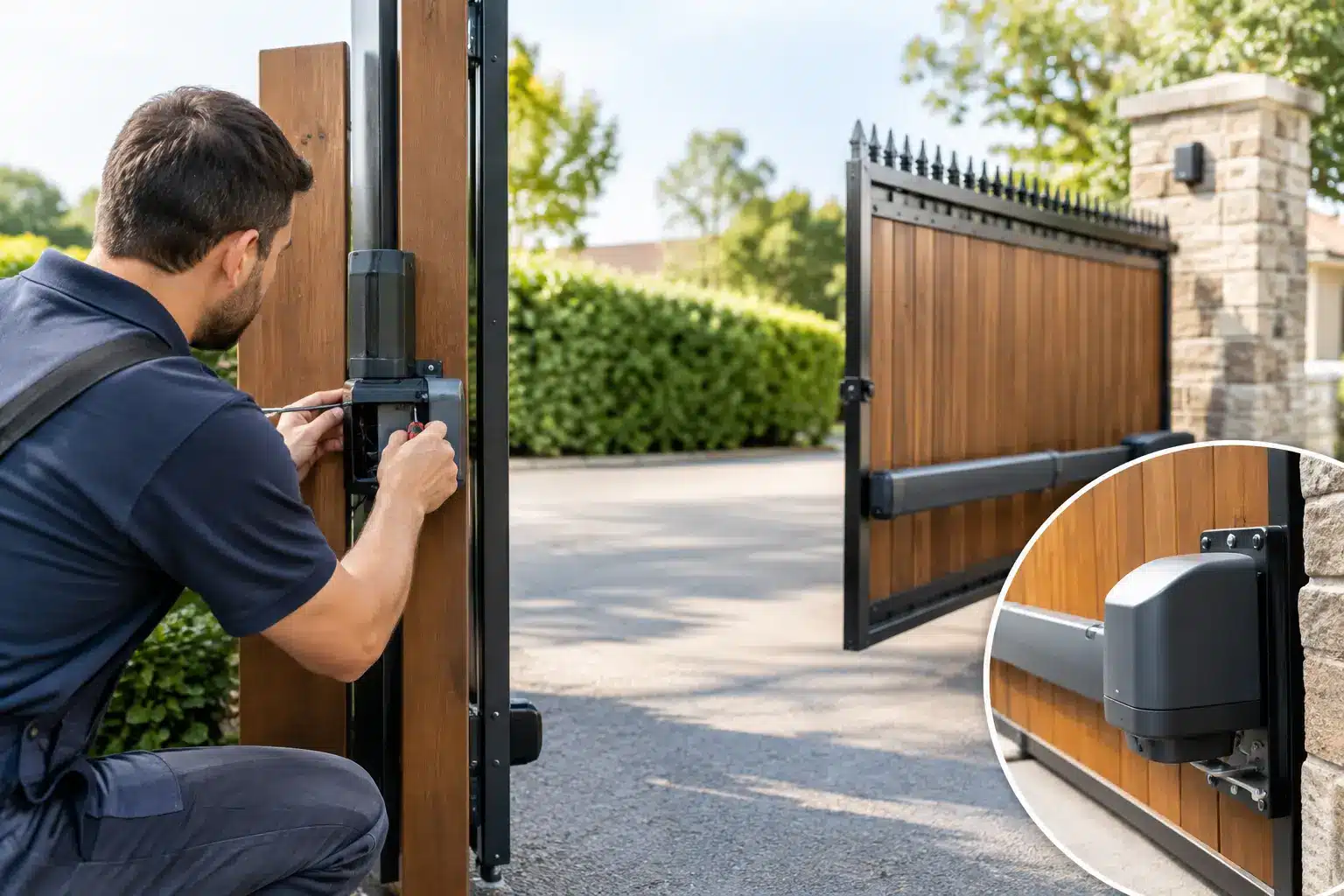
Can Electric Gates Be Retrofitted to Existing Gates?
A solid pair of manual driveway gates can look the part, but getting out of the car in rain, darkness or heavy traffic soon loses its appeal. So, can electric gates be retrofitted? In many cases, yes. The deciding factor is not simply whether an operator can be fitted. It is whether the existing gates, supporting structure and access layout can provide the strength, movement and safety needed for dependable automation.
Retrofitting can be an excellent way to improve security, convenience and kerb appeal without replacing every part of an entrance. However, it should be assessed as a complete system. A high-quality motor cannot compensate for weak timber, poorly aligned hinges or unstable gate posts.
Can electric gates be retrofitted safely?
Existing swing gates and sliding gates can often be automated successfully where they are structurally sound and correctly installed. This includes gates made from aluminium, steel and, in some circumstances, well-maintained hardwood. The gates must be suitably sized and weighted for the proposed automation equipment, and they must move freely by hand before any motor is considered.
For a swing gate, each leaf should open and close smoothly without dragging, dropping or binding. There should be no excessive play in the hinges, and the posts or pillars must remain stable under load. For a sliding gate, the track, rollers, guide posts and cantilever components need the same careful scrutiny. A gate that already struggles to travel freely will place unnecessary strain on its motor, shortening the system’s working life.
The best retrofit projects begin with an on-site assessment. This establishes whether the gate is a suitable candidate, what equipment is required and whether replacing the gates would deliver better long-term value.
The condition of the gate comes first
Automation adds controlled force to a moving gate. That makes the quality of its construction critical. Lightweight decorative gates, ageing timber leaves or gates assembled with bolted joints may not withstand the repeated loading that powered operation creates.
Fully welded aluminium gates are particularly well suited to automated operation. They offer an excellent balance of strength and manageable weight, do not rot or rust, and retain their shape with minimal maintenance. For larger openings, this lower weight can reduce demand on motors, hinges and foundations while still achieving a substantial, premium appearance.
Existing metal gates may also be suitable, but corrosion must be addressed honestly. Surface rust, cracked welds and distorted frames are warning signs. A repair may be viable, but there comes a point where fitting automation to a gate nearing the end of its serviceable life is false economy.
Weight is not the only consideration. Gate design affects how wind passes through it. A tall, solid-panel gate can behave like a sail in exposed locations, placing considerable pressure on hinges, posts and motors. Perforated panels, carefully spaced slats or an alternative gate configuration can be a more practical choice where wind exposure is high.
Posts, pillars and foundations must carry the load
The gate itself is only one part of the installation. Posts and pillars take the forces created every time the gate starts, stops and rests in an open position. Masonry pillars may look substantial but can still be unsuitable if they lack proper foundations, have movement cracks or were not designed to carry a heavy gate leaf.
Timber posts can be adequate for lighter gates if they are sound, correctly sized and securely founded. Yet they may not be the best long-term partner for a premium automated entrance. Steel or aluminium posts fixed into properly designed concrete foundations often offer greater stability and a cleaner, more durable finish.
During a retrofit survey, an installer should check gate alignment, hinge fixings, ground levels and the condition of the supporting structure. This is particularly relevant on sloping driveways. Swing gates need enough clearance to open without catching the surface, while sliding gates need sufficient level run-back space beside the opening.
Choosing the right type of automation
The operator must suit the gate format, dimensions, weight and site layout. There is no single motor that is right for every entrance.
For swing gates, underground motors are often chosen where a discreet, high-end finish is the priority. They are largely concealed below ground and preserve the clean lines of the gate. They do, however, require appropriate drainage and civil works. Above-ground ram or articulated-arm operators can be more straightforward to service and may be the better choice where pillars, hinge positions or ground conditions limit underground installation.
Sliding gates usually use a track-mounted or cantilever arrangement with a rack-and-pinion motor. They are well suited to driveways where there is limited space for gate leaves to swing inward. A sliding system needs adequate room alongside the entrance for the gate to park when open. If that space is restricted, telescopic or bi-folding gate designs may offer a more compact solution.
A careful specification also considers duty cycle. A private home with a few movements each day has different demands from a commercial site with regular vehicle access. Selecting equipment with suitable capacity protects reliability and avoids a system that feels underpowered from day one.
Power, controls and everyday access
Most retrofitted electric gates require a dedicated mains electrical supply. The cable route should be planned early, particularly where it must cross a driveway, pass through landscaping or connect to a property some distance from the entrance. Electrical work must be completed by a competent professional and designed for external use.
Solar-powered automation can be a practical option where running a mains supply would be disruptive or costly. Its suitability depends on gate use, local shading, panel position and the available daylight throughout the year. For a heavily used entrance or a shaded rural setting, mains power is usually the more dependable choice.
The retrofit is also an opportunity to improve how the entrance is used. Remote controls provide straightforward vehicle access, while keypads, fobs, GSM calling systems and video intercoms can give residents and visitors controlled entry. A professionally specified intercom allows you to see and speak with callers before granting access, adding a valuable layer of security without compromising the appearance of the entrance.
Do not overlook pedestrian access. A separate pedestrian gate is often the safest and most convenient way for people to enter, rather than opening the main driveway gates for every delivery, visitor or school run.
Safety is a design requirement, not an optional extra
An automated gate is a powered machine, and it must be designed and installed with appropriate safety measures. This is especially important where children, visitors, delivery drivers or members of the public may come into contact with the entrance.
A compliant system will normally include safety devices such as photocells to detect an obstruction in the gate’s path, force limitation, emergency release arrangements and risk protection at potential trapping points. The exact measures depend on the style and movement of the gate, the surrounding fencing, the hinge arrangement and how the entrance is used.
For example, a swing gate can create crushing or shearing zones near its hinges and closing edge. A sliding gate introduces different risks around its leading edge, rollers and run-back area. The gate, automation and surrounding structure must work together to prevent access to hazardous gaps and moving parts.
Safety should never be treated as an add-on to reduce costs later. A properly planned installation is safer, more reliable and easier to maintain. It also gives property owners greater confidence that their entrance is suitable for daily use.
When replacement is the better investment
Retrofitting is not always the right answer. If existing gates are warped, corroded, too heavy, poorly proportioned or unsupported by stable posts, replacement can be the more sensible route. It avoids spending on motors and controls only to encounter structural problems further down the line.
A made-to-measure aluminium gate system can be designed specifically for automation from the outset. The gate weight, frame strength, infill style, hinge positions, posts and ground clearances can all be coordinated before fabrication. The result is an entrance that looks intentional rather than adapted, with the performance to match its appearance.
For homeowners replacing tired timber or steel gates, this can also be the moment to create a unified frontage with matching pedestrian gates, fencing and access control. Premium powder-coated aluminium offers lasting colour, precision-welded strength and low-maintenance ownership, making it a compelling long-term alternative to repeated repairs and repainting.
A retrofit should be assessed as a complete entrance system
The right question is not just whether a motor can be attached to existing gates. It is whether the entire entrance can operate safely, smoothly and reliably for years to come. Gate condition, structural support, available space, power provision, wind exposure, control requirements and safety all deserve equal attention.
A professional consultation brings those considerations together before work begins. Whether your current gates are ready for automation or your driveway would benefit from a bespoke replacement, the strongest result is one designed to impress and built to last.
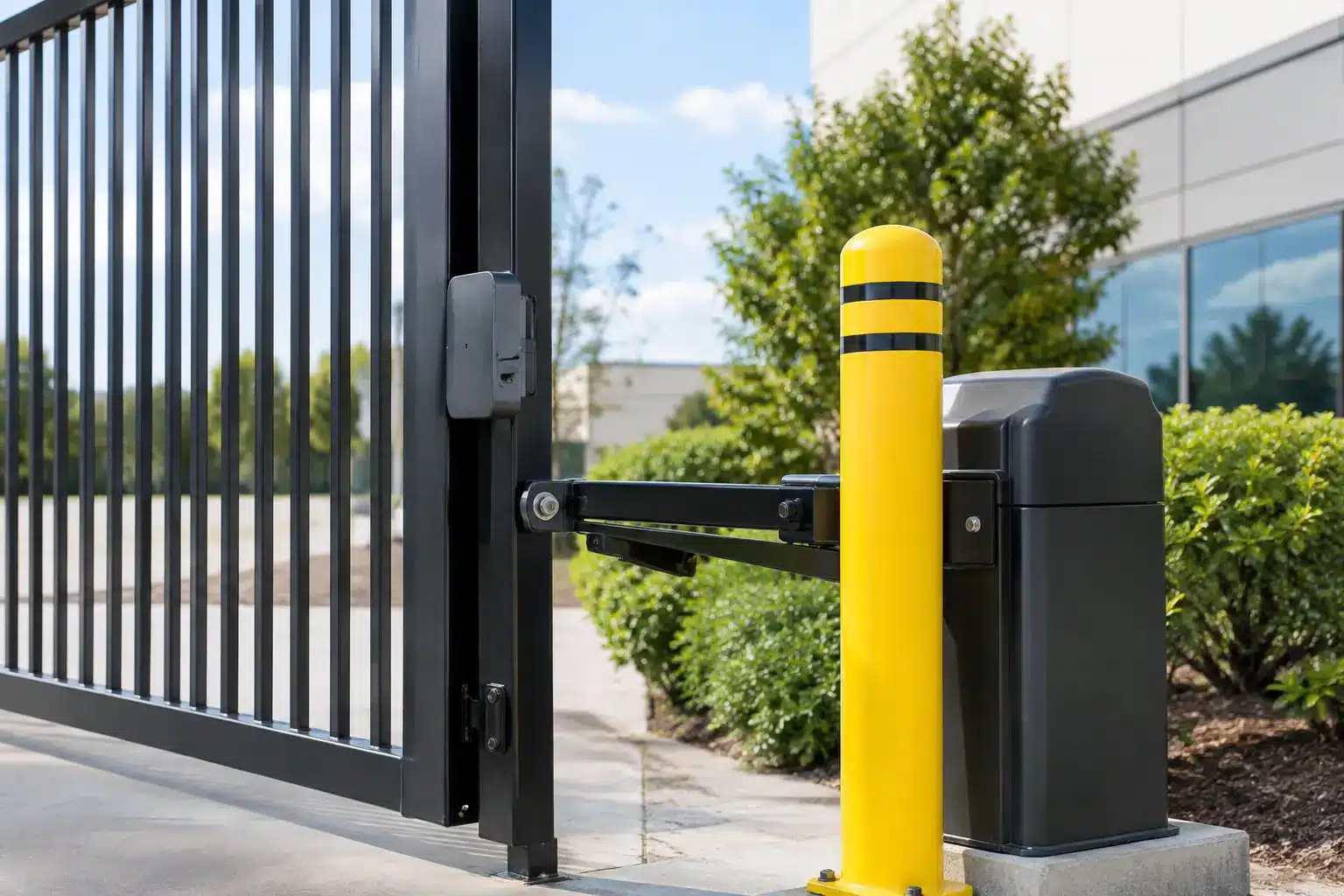
Best Commercial Gate Safety Features to Specify
A commercial gate has to do more than control access. At a busy depot, office development, school, flat scheme or private estate, it must protect pedestrians, vehicles and visitors every time it moves. The best commercial gate safety features are therefore not optional extras chosen at the end of a project. They should shape the gate design, automation and access-control specification from the outset.
A premium entrance should feel effortless to use, but its safety strategy needs to be carefully engineered. The right combination depends on who uses the site, how traffic approaches, whether pedestrians share the entrance and the gate format itself. A sliding gate faces different risks to a pair of automated swing gates. There is no credible one-size-fits-all specification.
Start with the movement and the people around it
Every automated gate creates potential trapping, crushing, shearing and impact points as it opens and closes. The first question is not which safety device to buy. It is where people, cars, delivery vehicles and cyclists can realistically be while the gate is moving.
A commercial entrance may be used by trained staff during working hours, then by visitors, contractors and couriers with no familiarity with the layout. A gate positioned near a public footpath or communal access route demands particular care. Equally, a busy entrance with limited visibility may need more detection coverage than a quiet, controlled site.
A proper site assessment should consider the opening route, adjacent fencing, gradients, pinch points, visibility, queueing space and the way users enter on foot. It should also identify what happens when a vehicle stops halfway through the entrance or a pedestrian follows a car towards the gate. Safety works best when it is designed into the full entrance arrangement, rather than added to an unsuitable gate later.
Best commercial gate safety features for active protection
Active safety devices detect an obstruction or person and either prevent movement, stop the gate or reverse it. They are central to a professionally specified automated system, particularly where a gate operates without a person standing beside it.
Photocells and monitored detection beams
Photocells create an invisible beam across an access route. If the beam is interrupted while the gate is closing, the control system can stop or reverse the gate before contact occurs. They are particularly effective for protecting the clear opening between gate posts and for detecting vehicles that have not fully passed through.
For commercial use, placement matters as much as the device itself. A single low beam may not detect every hazard. Additional beams at suitable heights can provide better coverage for cars, pedestrians and smaller obstructions. They must also be positioned to avoid false triggers caused by normal site activity, while remaining accessible for cleaning and testing.
Pressure-sensitive safety edges
Safety edges are fitted to leading or closing edges where there is a foreseeable contact risk. When compressed, they send a signal to stop or reverse the gate. On a sliding gate, this may include the leading edge and areas where the gate passes close to a post, wall or fixed panel. On swing gates, edges can protect closing gaps at the meeting point, hinge-side areas and other trapping zones identified by the assessment.
A safety edge is not an excuse for poor geometry. It is a final layer of protection where a residual risk remains. Premium fabrication helps here: accurately aligned gate leaves, stable frames and properly designed clearances allow protective devices to perform as intended over the long term.
Safety scanners and light curtains
Where people regularly pass close to a gate, monitored laser scanners or light curtains can create a wider, more intelligent detection zone than standard photocells. These systems can detect presence within a defined area and prevent the gate moving into that space.
They are especially valuable at high-traffic commercial sites, entrances with unusual layouts or locations where pedestrians may approach from the side. They require careful commissioning, however. A poorly configured scanner can create nuisance stoppages, while inadequate coverage leaves risks unresolved. The goal is dependable protection without frustrating legitimate access.
Force limitation and obstacle recognition
Modern gate operators can monitor resistance as they move. If the gate meets an obstruction, the operator can stop or reverse. This provides useful secondary protection, but force limitation should never be relied upon as the sole safeguard at a commercial entrance.
The operating force must be correctly set for the size, weight and movement of the gate. A made-to-measure aluminium gate offers a practical advantage here. Aluminium combines strength with relatively low weight, helping to create a responsive automated system without compromising the substantial, premium appearance expected at a commercial property.
Controls that prevent unsafe operation
The safest gate is one that only moves when its surroundings are appropriately protected. Access controls and operating logic play a major role in achieving this.
A well-specified system may use keypad entry, key fobs, proximity credentials, vehicle detection or an intercom to manage access. Video intercoms allow staff or residents to identify visitors before granting entry, which can reduce unnecessary gate cycles and improve control at the boundary. For commercial sites, timed permissions and restricted user access may also be appropriate.
Control positions deserve the same attention as the gate itself. A pedestrian should not be able to operate a gate from a place where they cannot see its path of travel. Where a hold-to-run control is suitable, it should be positioned to give the operator a full view of the danger area. In other settings, guarded automatic operation with suitable detection is the more practical choice.
Emergency stop controls, where appropriate, should be visible, accessible to authorised users and clearly understood by those responsible for the site. A manual release is also essential for controlled access during power failure or maintenance. It should be secure from misuse, yet available to trained personnel when needed.
Gate design still matters to safety
Safety equipment cannot compensate for an entrance that has been poorly planned. The best result brings gate design, fencing, posts, automation and pedestrian access together as one system.
Separate pedestrian access is often a sensible decision. Asking people to walk through the same opening used by delivery vehicles and cars increases interaction with a moving gate. A coordinated pedestrian gate, with appropriate access control, can make daily use safer and more convenient while preserving a consistent architectural finish.
Sliding gates are often well suited to commercial entrances because they do not sweep into a roadway or vehicle waiting area. They do, however, need sufficient run-back space and careful protection along the travel line. Swing gates can be an excellent choice where space allows, but their opening arcs must remain clear of vehicles, pedestrians, slopes and public highways.
The construction quality of the gate also affects safe operation. Fully welded aluminium frames resist movement and distortion, helping the gate remain correctly aligned with its safety devices. Premium powder-coated finishes reduce the maintenance burden, while correctly specified hinges, track systems, rollers and guides support predictable movement. A gate that drags, drops or becomes misaligned is not simply inconvenient. It can compromise the performance of the entire safety system.
Commissioning, documentation and maintenance
Commercial gate safety is not completed on installation day. The system should be professionally commissioned, tested and handed over with clear information on operation, emergency procedures and maintenance requirements. The responsible person for the premises should understand how to isolate the system, use the manual release and report faults.
The legal and technical obligations will vary by site and application, so the automated gate should be assessed and supplied in line with relevant UK legislation and applicable safety standards. This is one reason a consultation-led specification is so valuable. It allows the gate, safety devices and operational controls to be chosen for the real conditions on site, not an assumed layout.
Regular planned maintenance is equally essential. Photocells can become dirty or misaligned. Safety edges can suffer damage. Tracks collect debris, and moving components require inspection and adjustment. A visual check by site staff is useful, but it does not replace scheduled professional servicing and recorded safety testing.
If a gate behaves unpredictably, reverses without reason, fails to stop correctly or shows visible damage, it should not be treated as a minor inconvenience. Restrict use and arrange inspection before normal operation resumes. Reliable access begins with a system that is maintained as carefully as it was designed.
For a commercial entrance that looks as considered as it performs, specify safety at the same time as the gate style, finish and access method. The result is a tailored aluminium entrance built to make a strong first impression, while giving every user the confidence to pass through it safely.
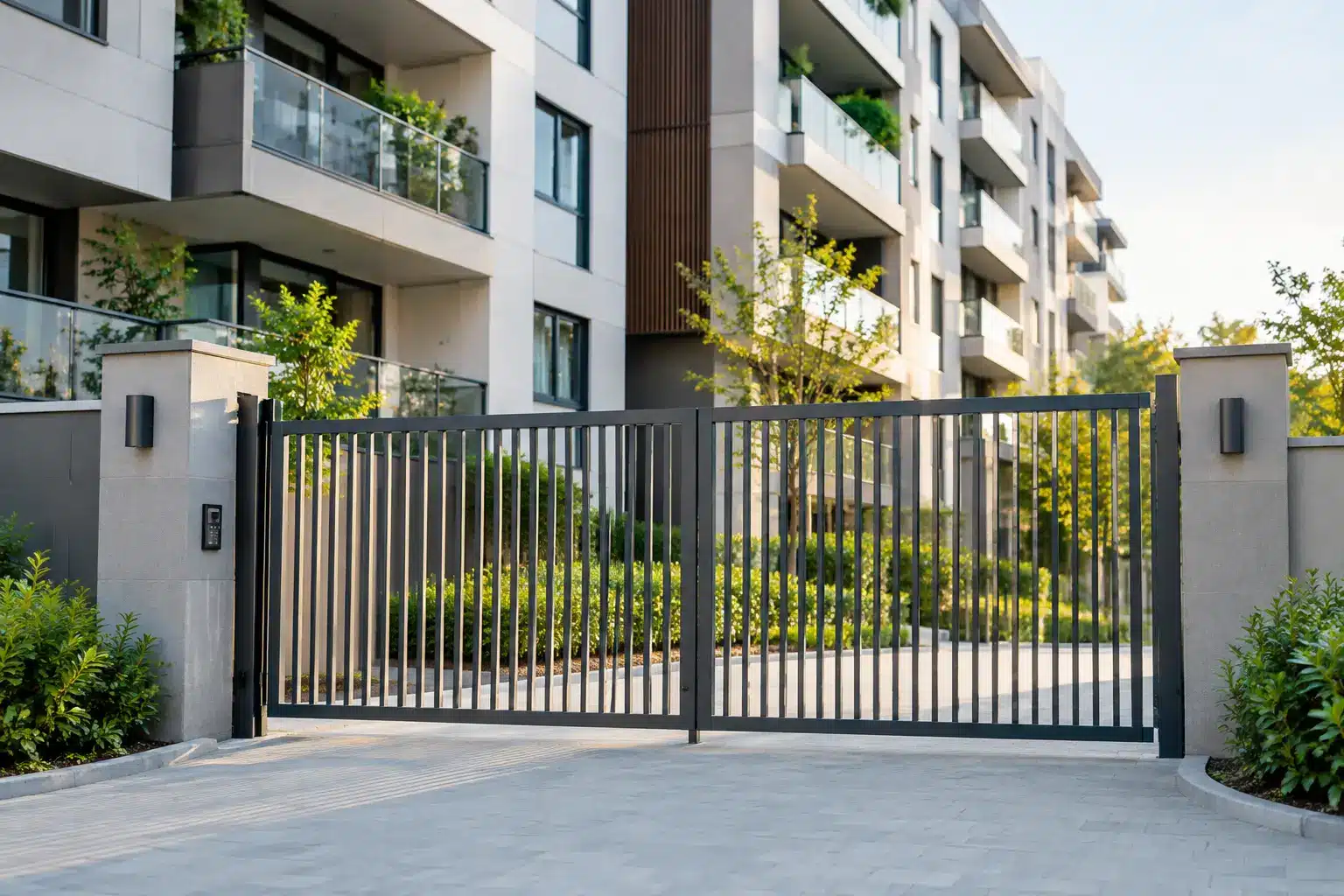
Choosing Best Gates for Apartment Blocks
A communal entrance has to work harder than a private driveway gate. It may open hundreds of times each day, accommodate residents, visitors, deliveries and refuse collections, and still present a smart, secure face to the street. The best gates for flat blocks are therefore not simply the strongest or most attractive option. They are the gates designed around the building’s traffic, footprint, access arrangements and long-term management needs.
For freeholders, developers and managing agents, getting this specification right avoids a familiar problem: a gate that looks impressive on handover but quickly becomes inconvenient, damaged or costly to maintain. A made-to-measure aluminium system offers a more considered route, combining clean architectural lines with dependable daily performance.
Start with how the entrance is actually used
Before choosing a gate style, map the movements through the site. A block with underground parking has different demands from a converted house with six allocated spaces. A development where delivery drivers regularly need entry requires a different access strategy from a quiet residents-only courtyard.
Consider how many vehicles use the entrance at peak times, whether pedestrians have a separate route, and what needs access beyond residents’ cars. Emergency services, cleaning contractors, landscaping teams, bin lorries and moving vans all influence the clear opening required. Where a gate is too narrow or slow, drivers queue on the road, residents become frustrated and the installation is more likely to suffer accidental impact.
Pedestrian access should never be an afterthought. A dedicated pedestrian gate reduces unnecessary vehicle-gate cycles, gives residents a convenient route on foot and helps keep vulnerable users away from moving vehicles. It can also be coordinated with the main entrance for a unified finish across the frontage.
The best gates for flat blocks by layout
There is no single format that suits every residential development. The available space, gradient, traffic flow and desired appearance should shape the decision.
Sliding gates for busy or restricted entrances
Sliding gates are often the strongest choice for flat blocks with frequent vehicle movements or limited space behind the entrance. Because the gate travels sideways rather than swinging into the driveway, it keeps the approach clear and works particularly well where cars need to wait close to the boundary.
A cantilever sliding gate can be especially effective for high-use locations. It operates without a track across the driveway, avoiding the debris build-up and winter maintenance associated with ground tracks. This makes it a practical option for sites exposed to leaves, gravel and standing water. The trade-off is that a sliding gate needs adequate run-back space along the fence line, usually greater than the width of the opening itself.
Swing gates for generous, lower-traffic forecourts
Double swing gates create a formal, substantial entrance and suit blocks with sufficient level space inside the boundary. They can provide a wide clear opening and are an excellent design choice where the gate is part of a carefully considered façade.
Their limitation is the sweep area. The leaves must not open across a public pavement or road, and they need room to move without conflicting with parked vehicles. On a sloping driveway, the direction of travel and ground clearance need careful assessment. For a smaller scheme with modest vehicle traffic, however, automated swing gates can be both elegant and highly effective.
Bi-folding and telescopic gates where speed matters
Where the entrance is tight but traffic flow is high, bi-folding or telescopic gates deserve consideration. Bi-folding gates fold back in sections, while telescopic gates use overlapping leaves to reduce the space needed at the side of the opening. Both can offer faster operation than a conventional single-leaf sliding gate.
These systems are more complex than standard swing gates, so engineering quality and accurate installation are essential. They are best specified where the operational benefit is clear, such as a constrained urban entrance with regular resident access.
Choose a material that supports long-term management
Communal gates are a long-term asset, not a short-term cosmetic upgrade. Timber can look attractive but requires regular treatment and can move, split or fade under British weather conditions. Steel is strong but needs reliable corrosion protection and ongoing inspection, particularly at welds and exposed edges.
Premium aluminium is well suited to flat developments because it is lightweight, corrosion-resistant and low maintenance. It does not rot, and a quality powder-coated finish retains its appearance without the repeated painting associated with many traditional materials. Lower weight can also reduce strain on hinges, motors and supporting structures, which matters when the gate is operating throughout the day.
Construction matters as much as the material. Fully welded aluminium frames deliver a solid, cleanly finished structure, avoiding the looseness and water traps that can develop in poorly assembled systems. For a managed building, this is not just a finish detail. It supports reliability, reduces future intervention and protects the appearance of a shared investment.
Balance security with visibility and kerb appeal
Flat gate design has to deter unauthorised entry without making residents feel shut in. Solid infill panels give high privacy and a bold contemporary look, but they can restrict sightlines when vehicles leave the site. Horizontal slats, perforated panels or carefully spaced vertical sections can maintain a secure boundary while allowing light and visibility through.
The right level of openness depends on the setting. A street-facing block near busy footfall may benefit from greater privacy, while a development at a blind junction may require improved visibility for drivers. Gate height, gaps between rails and landscaping should be considered together rather than in isolation.
A coordinated aluminium gate and fencing scheme creates a stronger result than mixing unrelated boundary products. Matching colours, lines and proportions gives the development a considered finish, whether the aim is understated anthracite grey, a warmer wood-effect look or a bespoke colour selected to complement the building. Designed to impress, the entrance should also make ownership and access feel clear.
Access control is part of the gate system
A high-quality gate is only as effective as the way people gain entry. Residents need convenient, dependable access, while visitors need a clear means of contacting the right flat. For many flat blocks, video intercoms offer the best balance of security and usability, allowing residents to verify callers before releasing the gate.
An Akuvox intercom can be integrated into a tailored entrance arrangement, alongside key fobs, keypad access, remote controls or app-based entry where appropriate. The best combination depends on the number of residents and the management approach. A small block may favour a straightforward panel and fobs, whereas a larger development may need named directories, timed access permissions and audit-friendly controls.
Avoid relying on one method alone. A sensible specification includes secure resident access, a visitor call point and an agreed override procedure for authorised contractors and emergencies. It should also account for power failure and manual release, with these arrangements understood by the managing agent rather than left undocumented after installation.
Do not treat safety as an add-on
Automated gates at shared residential sites must be designed with safety at the centre of the brief. Risk points include the closing edge, hinge areas, gaps around the structure and the path of moving leaves. Appropriate safety devices may include photocells, safety edges, force limitation and warning signage, selected according to the gate format and site conditions.
The approach zone also matters. Drivers need enough room to stop safely before the gate, without obstructing the highway. Sightlines must remain clear, and the controls should be positioned so users are not tempted to reach from an unsafe location. A professional survey identifies these practical details before fabrication begins, when they are simpler and more economical to resolve.
Specify for maintenance, not just installation day
Low maintenance does not mean no maintenance. A communal gate should have a planned inspection routine covering automation, safety devices, fixings, hinges, tracks where fitted and access-control equipment. The frequency should reflect usage, exposure and the complexity of the system.
A durable aluminium gate reduces the cosmetic workload, but motors and moving parts still benefit from regular servicing. Ask early who will hold remote controls, manage resident credentials, report faults and authorise repairs. Clear responsibility protects the investment and prevents a minor issue becoming a prolonged access problem.
At Alu-Gate, a consultation-led approach makes it possible to align gate format, fully welded fabrication, finish and access requirements before production begins. For flat developments, that level of planning is what turns an attractive boundary feature into a dependable entrance system, backed by a 20-year guarantee.
The strongest choice is the one that feels effortless to residents and difficult for unauthorised visitors: a gate proportioned for the site, engineered for daily use and finished to enhance the building for years to come.
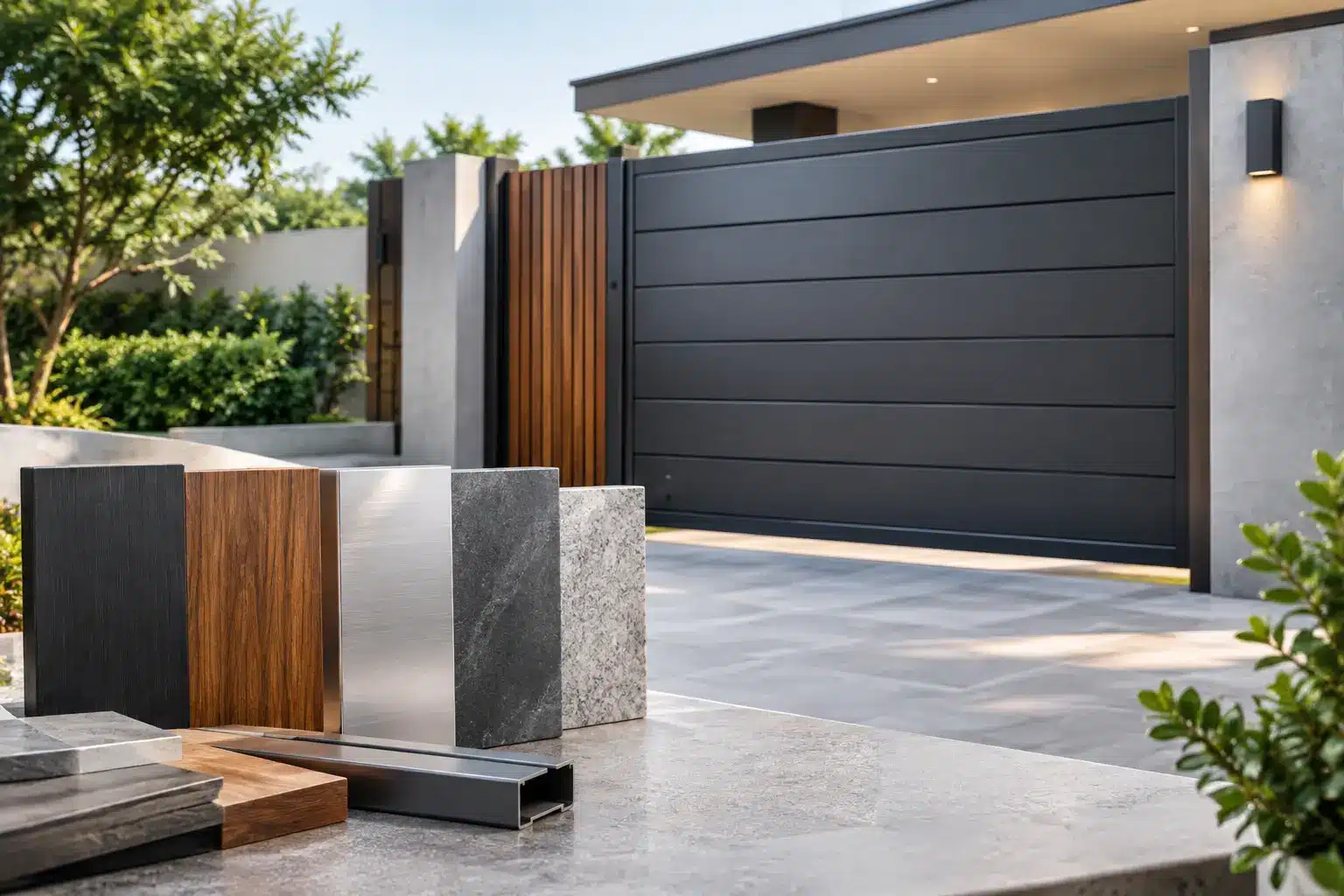
Gate Materials: What Suits a Premium Entrance?
A driveway gate is exposed to the conditions that test a property most: driving rain, frost, road grime, strong winds and daily use. Choosing between gate materials is therefore about far more than appearance. The right choice determines how your entrance performs, how much maintenance it needs and whether it continues to complement the property years from now.
For a premium residential or commercial entrance, the material should support the whole specification: the gate’s size, opening method, privacy level, automation, security requirements and finish. A handsome gate that warps, corrodes or demands constant repainting soon becomes a costly compromise.
Why gate materials deserve careful consideration
Every material brings a different balance of strength, weight, maintenance and design flexibility. Timber has natural character, for example, while steel can create a traditional statement. Yet both need considered protection and ongoing care in the British climate. Aluminium offers a different proposition: a lighter metal with excellent resistance to corrosion, broad design potential and minimal routine maintenance.
This matters particularly for wide driveway gates and automated systems. Weight affects the load on posts, hinges, tracks and motors. A gate that is unnecessarily heavy can require more substantial supporting structures and may place greater demands on its operating hardware. Conversely, a material that is too light for its design or poorly constructed can feel insubstantial and may not give the long-term rigidity a premium entrance requires.
The best decision is rarely made from a sample alone. It comes from assessing the material alongside the design, fabrication standard and intended use of the gate.
Comparing the main gate materials
Aluminium: refined, durable and low maintenance
Aluminium is increasingly the preferred choice for contemporary gates, fencing and coordinated entrance systems. It does not rust, making it particularly well suited to wet weather, coastal exposure and locations where regular upkeep is not practical. A quality powder-coated finish adds a durable protective layer and provides a wide choice of colours, from understated anthracite shades to bespoke tones that work with window frames, cladding or brickwork.
Its lower weight is a practical advantage, not a shortcut. Properly designed, fully welded aluminium gates can offer impressive strength while remaining easier to operate manually or through automation. This is valuable for sliding, bi-folding and telescopic configurations, where controlled movement and dependable operation are essential.
Aluminium also gives designers freedom. Clean horizontal slats, vertical rails, solid privacy panels, decorative cut-outs and mixed styles can all be made to measure. For homeowners seeking a sharp architectural finish without the recurring burden of timber treatment or metal repainting, it is often the strongest all-round option.
Timber: warm character with a maintenance commitment
Timber gates have enduring appeal, especially beside period homes, rural properties and traditional garden settings. The grain, texture and warmth of natural wood can make an entrance feel established from the first day. However, timber moves as moisture levels change. Without regular sealing, staining or painting, it can fade, split, twist or swell.
This does not make timber the wrong choice. It can be excellent where authentic natural character is the principal design priority and the owner is prepared to maintain it. The important point is to budget for that commitment from the outset. Larger timber gates can also be heavy, which should be considered carefully if the gate will be automated.
Steel: strong and versatile, but reliant on protection
Steel remains a capable choice for ornate, traditional and high-security gate designs. It can be shaped into detailed scrollwork, railings and formal entrance features that suit heritage architecture. Its inherent strength can be useful for demanding commercial applications too.
The trade-off is corrosion protection. Galvanising and high-quality coating systems are essential, particularly around welds, fixings and any point where the finish may be chipped. If moisture reaches unprotected steel, rust can develop and spread beneath the coating. Steel gates can deliver decades of service, but their finish needs inspection and timely repair.
Wrought iron: classic presence, specialist upkeep
The term wrought iron is often used to describe decorative metal gates with an ornamental, traditional appearance. Genuine wrought ironwork brings real craftsmanship and visual weight, making it a natural fit for listed-style homes, formal estates and statement entrances.
As with steel, the priority is protection from corrosion. Detailed designs contain more joints, corners and surfaces where water can sit, so maintenance is rarely optional. Choose this material for its heritage style and artisan detail, rather than expecting the low-maintenance ownership offered by aluminium.
Composite: convenient, but not always fully bespoke
Composite boards are sometimes used within metal gate frames to recreate the look of timber with less maintenance. They can offer useful privacy and a consistent finish, and may be suitable for certain fencing and side-gate applications.
Their limitations depend on the product and construction method. Some options have a more uniform appearance than real timber or premium aluminium, while expansion in changing temperatures must be accommodated correctly. A composite infill can work well, but buyers should look beyond the boards and assess the frame, connections and long-term stability of the complete gate.
Choosing gate materials for your property
Start with the demands of the opening. A narrow pedestrian entrance has different priorities from a six-metre driveway or a commercial access point used throughout the day. Gate width, ground levels, available run-back space and the need for automation will influence which materials and gate formats are sensible.
Then consider the level of privacy required. Open rail designs create visibility and a welcoming frontage, while closely spaced slats or solid panels can screen a driveway or garden. Aluminium is especially adaptable here because it can be fabricated into privacy-led or open designs without losing its crisp, cohesive finish.
Architecture should guide the visual direction, but it should not be the only factor. A period property may suit a heritage-inspired aluminium design as well as traditional metalwork. A modern home may benefit from horizontal aluminium slats, yet a vertical pattern can make a lower frontage appear taller. Made-to-measure fabrication allows the proportions to be tailored to the building instead of forcing the building to accept an off-the-shelf gate.
For commercial sites, security and frequency of use usually lead the specification. The gate material must work with access control, safety features and the chosen opening system. A well-designed aluminium system can provide an authoritative perimeter while avoiding the excessive operating weight associated with some steel alternatives.
Construction matters as much as material
Two gates made from the same material can perform very differently. The quality of fabrication, welding, reinforcement, hinges, posts and finishing process is what turns a good material into a reliable entrance solution.
For aluminium gates, fully welded construction is particularly important. It creates a more rigid, integrated structure than a gate assembled mainly with mechanical joints. This supports clean lines, helps maintain alignment and gives the finished product a substantial feel. It is also worth checking how the gate will be supported, especially on wide openings or sloping driveways, where correct post specification and hinge placement are vital.
The finish should be viewed as part of the protection system, not merely a colour choice. A premium powder-coated surface enhances the design while helping the gate withstand weathering. Coordinating the gate with fencing, panels and access control creates a considered frontage rather than a collection of separate additions.
Factor in maintenance before you buy
Low maintenance does not mean no care at all. Any gate benefits from occasional cleaning, checking moving parts and ensuring tracks or drainage areas remain clear. Automated gates should also be serviced in line with their system requirements.
The difference lies in the scale of ownership. Timber may require regular treatment. Steel and decorative ironwork may need attention to chips and early signs of corrosion. Powder-coated aluminium generally needs only a wash with mild soapy water to remove surface dirt, helping it retain its appearance without sanding, staining or repainting.
That reduced upkeep has a real value. It protects the appearance of the entrance, limits disruption and makes aluminium a compelling choice for busy households, rental properties and commercial premises where maintenance time is better spent elsewhere.
Specify for the life of the gate
A gate is not a short-term decorative purchase. It is a working part of the property boundary, used in all seasons and seen every day. The right specification should account for how the entrance will be used now, as well as changes that may come later, such as automation, new fencing or upgraded access control.
At Alu-Gate, each system is designed around the individual opening, property style and practical requirement, with precision-welded aluminium construction and a 20-year guarantee. The result is an entrance designed to impress, built to last and made for the way the property is actually used.
Choose a gate material that earns its place over time. When strength, finish and fabrication are specified together, the entrance becomes a lasting statement of security, style and considered investment.